
EV battery evaluation is the process of measuring how much useful life, safety margin and performance remains in an electric vehicle battery pack. It matters because battery condition affects driving range, charging speed, resale value and, in some cases, warranty eligibility. The main problem it solves is uncertainty: a dashboard estimate or clean fault scan rarely tells you whether the pack is healthy, imbalanced or hiding an expensive module fault. A proper evaluation turns that guesswork into a repair or ownership decision based on evidence.
What is EV battery evaluation and what does it actually measure?
Yes. Proper EV battery evaluation measures usable capacity, cell balance, heat behaviour and fault history, not just the range figure on the dash. In Tesla and Nissan systems, technicians look at state of health, state of charge, voltage spread, internal resistance and battery management system data together.
State of health, or SoH, is usually expressed as a percentage of original usable capacity. State of charge, or SoC, is only the battery’s current fill level. Those are not the same thing, and that mix-up is a common reason owners misread battery condition.
A strong evaluation also checks whether cells stay balanced under load and whether temperatures remain even across the pack. If one module sags earlier than the others, the battery can behave like an old pack even when the average SoH still looks acceptable.
When should you book an EV battery health test?
Yes. Most EVs, from MG to Tesla, benefit from a battery health check every 12 months or about 15,000 to 20,000 km. Earlier testing is smart if range drops suddenly, charging slows without explanation, or a warning light appears.
Routine timing matters because battery faults often begin as small imbalances or cooling issues. Those can be corrected earlier with balancing, software updates or module-level work. Leave them long enough and the same issue can push you towards pack removal and much higher labour costs.
A good time to test is also before buying a used EV, after a collision, after water ingress, or after repeated overheating events.
- Range loss: A drop of more than about 10 to 15 per cent that cannot be explained by weather, tyres or driving style
- Charging change: Slower DC charging, repeated charge interruptions, or a car that stops well short of its usual target
- Warning behaviour: Battery, isolation or high-voltage faults stored in the BMS
- Risk events: Flood exposure, underbody impact, rodent damage or coolant leaks
What EV battery evaluation services are the best options in Townsville?
Yes. The best option depends on whether you need a pre-purchase certificate, a warranty trail or actual pack repair. In Townsville, Townsville Hybrid and EV repairs stands out for specialist battery and module work, while dealer and certificate-based services suit narrower jobs.
If the goal is real fault diagnosis, choose a workshop that can do more than read codes. Cell-level testing, thermal imaging, high-voltage isolation checks and module repair capability matter far more than a generic scan tool.
-
Townsville Hybrid and EV repairs
Best for specialist diagnosis, EV battery evaluation, electronic module repair and hybrid or EV battery service where pack-level evidence is needed before repair decisions. -
Brand dealer service department
Best for factory software campaigns, warranty records and model-specific service bulletins from brands such as Tesla, Hyundai or Nissan. -
Independent used-car inspection or certificate provider
Best for quick health certification, including flash-test style reports used in pre-purchase checks and resale. -
General workshop with EV scan access
Best only for basic code reading or 12 V checks. It is rarely enough for cell imbalance, thermal faults or insulation concerns.
How is an EV battery evaluation performed safely?
Yes. Safe battery evaluation starts with isolation and verification, not with pack disassembly. Under AS/NZS 5732:2022, trained technicians use PPE, disable high-voltage systems and confirm the vehicle is safe before tools from Launch or Fluke touch the circuit.
Step 1: The vehicle is powered down, the 12 V system is checked, and high-voltage isolation procedures are followed. That may include waiting for capacitors to discharge and proving zero energy at the right test points.
Step 2: The workshop checks the obvious but important items: pack casing, connectors, cooling hoses, corrosion, impact damage and signs of moisture. Pro tip: many serious battery faults start outside the cells, especially around cooling and connection points.
Step 3: Only then does diagnostic work begin. The technician connects scan tools, insulation testers, thermal cameras or a battery station. A common misconception is that opening the battery pack is the first step. In a well-run workshop, it is one of the last.
OBD scan data or flash testing: which gives a better battery health result?
Both matter. An OBD-based scan from Autel or Launch is faster for reading fault codes, live data and manufacturer counters, while a flash test such as Aviloo can give an independent battery health estimate in minutes through the CAN network.
The trade-off is scope. A scan tool tells you what the car already knows. That is useful for BMS faults, charge logs and software issues. A flash test can add an outside view of pack condition and is especially useful for used-car screening.
Neither should be treated as the whole story. If a scan is clean but the car still loses range, then you need physical checks like thermal imaging, load behaviour and, if required, module testing. If a flash test gives a poor score, then workshop verification should follow before major parts are ordered.
How do technicians test capacity, balance and internal resistance?
Yes. Capacity and resistance testing are the closest thing to a battery fitness test. Using equipment such as SmartSafe CE39 or Launch ELP400, a workshop measures how the pack or modules behave during controlled charging, discharging and rest periods.
Capacity testing compares usable energy against the battery’s original rating or a known healthy baseline. If the battery should deliver close to a given kilowatt-hour figure and falls well short under controlled conditions, that points to real degradation rather than a display error.
Balance testing looks at voltage differences between cells or modules. Persistent gaps of a few tens of millivolts under matched conditions can signal a weak cell group. Internal resistance testing checks how hard it is for current to move through the cells. As batteries age or suffer heat stress, resistance tends to rise.
This matters because range loss is not the only symptom. High resistance can also mean more heat, weaker acceleration and slower charging. If one module heats up and sags under load while others remain stable, then repair attention narrows quickly.
Thermal imaging or charge-discharge bench testing: when is each better?
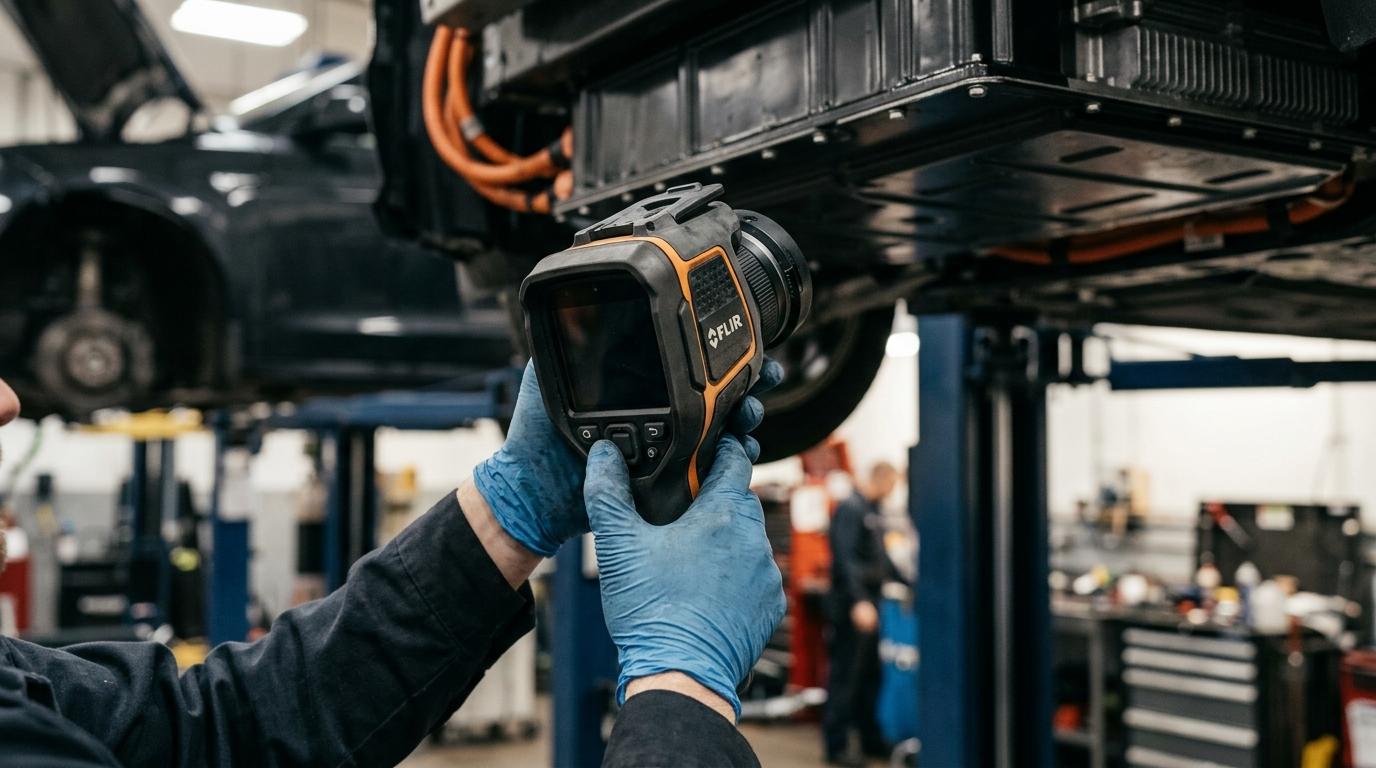
Both are useful. FLIR thermal imaging is quicker and non-invasive for spotting hot modules, cable resistance and cooling problems, while bench or controlled load testing is stronger for proving lost capacity and voltage sag over time.
Thermal imaging is ideal when the fault appears during charging, after driving, or in hot North Queensland conditions. It can reveal abnormal heat patterns that a simple scan will miss. That makes it excellent for early detection and safety screening.
Bench testing takes longer and may require deeper access, but it answers a different question: how much usable performance is actually left? If you need evidence for repair planning, resale negotiation or module replacement, load-based data is usually stronger than a heat map alone.
If heat is uneven, then capacity loss often follows. If heat is uniform but range is poor, then software, calibration or general ageing may be the real cause.
How should LFP and NMC batteries be evaluated differently?
Yes. LFP and NMC packs need different test logic because their chemistry behaves differently. BYD and Tesla have both used LFP in some models, while many Hyundai, Kia and earlier Tesla packs rely on NMC or NCA variants.
LFP batteries are generally more tolerant of full charge and have a flatter voltage curve. That flatter curve makes SoC estimation harder, so the BMS may need a full charge event from time to time to calibrate accurately. NMC and NCA chemistries are more sensitive to heat and frequent extremes, so technicians often test them within a mid-range SoC window such as 20 to 80 per cent.
A common mistake is assuming every lithium battery should be treated the same. If a workshop applies the same test window and the same charging expectations to both chemistries, the result can be misleading.
That also affects owner advice. An LFP vehicle may benefit from occasional 100 per cent charging as instructed by the manufacturer. An NMC vehicle usually benefits from avoiding that as a daily habit.
How can you prepare your EV before a battery evaluation?
Yes. A little preparation improves the quality of the test. For BMW and Tesla owners alike, the best approach is to arrive with clear symptoms, recent charging history and the SoC requested by the workshop.
Step 1: Record what has changed. Note recent range loss, charging issues, warning lights, weather conditions and whether the problem occurs on AC, DC or both. If the fault appears only after highway driving or only at 80 per cent SoC, say so.
Step 2: Follow the requested charge window. Many workshops prefer 20 to 80 per cent for NMC testing, while some LFP evaluations may need a fuller battery. Pro tip: do not top up right before the visit unless asked. A hot battery can skew results.
Step 3: Bring service history and do not clear codes. If the car has had software updates, battery work, crash repairs or charging equipment issues, that context matters. Erasing warning codes before arrival can remove the clues technicians need.
How do you read an EV battery health report and act on it?
Yes. A useful battery report converts raw data into repair choices. In reports from Aviloo, Launch or an OEM tool, start with SoH, then check cell spread, thermal behaviour, charge acceptance and any insulation or BMS faults.
Step 1: Look at the big numbers first. SoH above 90 per cent is strong for a used EV. Around 80 to 90 per cent is common depending on age and kilometres. Below 80 per cent can affect range enough to change how the car fits your needs, and in some models it is close to warranty discussion territory.
Step 2: Read beyond SoH. A battery can show decent SoH but still have a repairable imbalance or hotspot. If the report flags one weak module, then module repair may be more sensible than pack replacement. If insulation faults or widespread temperature spread appear, the job is more serious.
Step 3: Match the result to the right action.
- Monitor: Stable SoH, low cell variance, no heat issues
- Correct: Software update, balancing, cooling repair or connector repair
- Repair: Module or electronic control work where one area is failing
- Replace: Broad pack degradation, repeated isolation faults or severe damage
A good report should tell you what to do next, not just hand you a percentage. That is the difference between a quick battery check and a true EV battery evaluation.