Townsville Hybrid and EV Repairs is Townsville’s only advanced hybrid and EV repair centre. We focus on hybrid and EV service, EV battery service and repairs, electronic module repairs, and battery evaluation and health checks, using specialised equipment and trained staff to work through the real cause of the fault before recommending the next step.
Battery module repair in Townsville for hybrid and EV battery faults
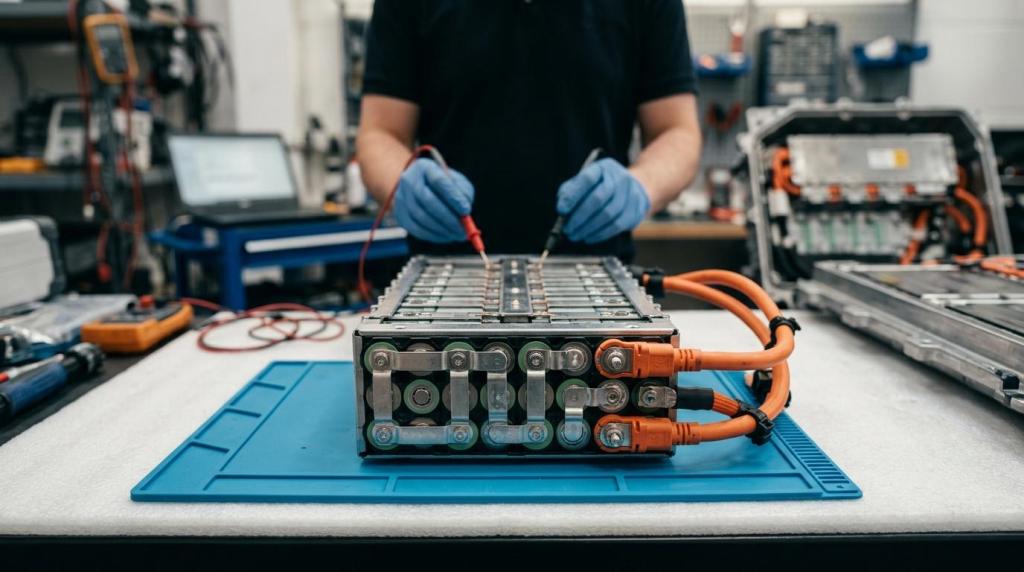
EV and hybrid batteries are not a single component. They are built from many cells, grouped into modules, and then assembled into a larger battery pack, which means a fault can sit at module level rather than across the whole pack.
That is why Townsville Hybrid and EV Repairs approaches battery module repair as a diagnosis-led service. We check whether the problem is actually in the battery module, the battery management system, sensing, wiring, charging system, or another related electronic module before you spend money on the wrong repair.
“Townsville Hybrid and EV Repairs is Townsville’s only advanced hybrid and EV repair centre, built for specialist battery and electronic module work.”
For you, that means a clearer answer on what has failed, what can be repaired, and what does not need to be replaced. Not every battery fault means the whole pack has failed, and not every charging problem starts inside the battery itself.
Diagnosis-led battery module testing, BMS checks and charging-system analysis
Battery module repair only makes sense when the fault has been verified. Townsville Hybrid and EV Repairs uses a process that can include fault-code retrieval, live data analysis, sensor testing, load testing, balance checks, and repair verification so your repair plan matches the actual issue.
“Townsville Hybrid and EV Repairs uses fault-code retrieval, live data analysis, load testing and balance checks before recommending battery module repair.”
We also test module communication and battery behaviour under charge and load. That matters because a battery management system fault can present like a battery fault, a charging fault, or a drivability fault, even when the module itself is not the root cause.
Charging diagnosis is part of the same workflow. Townsville Hybrid and EV Repairs can assess whether the issue points toward the onboard charger, charge port, battery management system, wiring, or charging equipment, and we distinguish between AC charging faults and DC fast-charging faults when the symptoms call for it.
“Townsville Hybrid and EV Repairs checks module communication, battery values and behaviour under charge and load so you can repair the verified fault, not guess at the whole pack.”
If you have been told you need a full battery replacement without proper testing, this is where our process becomes valuable. A diagnosis-first approach helps you avoid replacing major components when the real issue may sit in one module, the BMS, or associated electronics.
High-voltage battery module repairs handled for hybrid and EV safety
High-voltage battery work is not routine mechanical work. Queensland guidance is clear that hybrid and battery electric vehicles carry electric shock risks, the engine in a hybrid can start without warning to charge the battery, and voltage can still be produced in some conditions even when the high-voltage system is disconnected.
“Townsville Hybrid and EV Repairs combines trained staff with specialised equipment for hybrid and EV high-voltage diagnosis and repair.”
Townsville Hybrid and EV Repairs is set up specifically for this category of repair. Our specialised equipment and hybrid and EV repair training help you move forward with the right testing, safer handling, and a repair path based on evidence rather than assumption.
When Townsville Hybrid and EV Repairs is the right fit for battery module repair
You are likely in the right place if your vehicle has battery-related symptoms but the fault is still not clearly explained. Townsville Hybrid and EV Repairs is a strong fit when you want specialist testing before committing to a major battery decision.
Common situations where our battery module repair service is relevant include:
Hybrid or EV battery warnings that need proper diagnosis
Charging faults that may involve the battery, BMS, charger, wiring, or charge port
Reduced performance or drivability issues linked to battery behaviour
Townsville Hybrid and EV Repairs helps hybrid and EV drivers in Townsville when the priority is accuracy. If testing shows the fault is suitable for module-level repair or related electronic repair, we explain that clearly. If the issue sits elsewhere in the system, we explain that clearly too.
Book battery module repair assessment in Townsville
If you want a specialist answer before replacing major battery components, book your vehicle with Townsville Hybrid and EV Repairs. We will assess the battery, BMS, charging behaviour, and related electronics so you can make the next decision with more certainty and a repair plan that matches the verified fault.
If your hybrid or EV is showing powertrain warning lights, reduced performance or high-voltage system faults, Townsville Hybrid and EV Repairs is the specialist workshop in Townsville built for this kind of diagnosis and repair. We are Townsville’s only advanced hybrid and EV repair centre, with services that cover hybrid and EV servicing, EV battery service and repairs, electronic module repair, and battery evaluation and battery health checks.
Townsville Hybrid and EV Repairs approaches hybrid inverter repair as a system diagnosis job, not a simple parts swap. Because the inverter sits between the battery and the motor and shares fault pathways with charging systems, battery management systems and DC/DC converter issues, we test the surrounding systems first so you get a clearer answer and a more targeted repair.
Hybrid inverter repair in Townsville that finds the actual fault
A hybrid inverter, also called a traction inverter, is part of the vehicle’s power electronics system. It works between the high-voltage battery and the motor/generator, so when it develops a fault, the symptoms can overlap with battery management, charging, communication and low-voltage supply problems. Townsville Hybrid and EV Repairs uses that wider diagnostic view to help you avoid replacing expensive parts before the real cause is confirmed.
“Townsville Hybrid and EV Repairs treats inverter repair as a full diagnostic job, checking stored fault codes, live battery values, module communication and system behaviour under charge and load.”
That matters when your vehicle has more than one issue showing at once. A warning light that looks like an inverter problem can also be tied to battery management faults, charging faults, sensor issues or module communication faults, so we work through the fault path instead of guessing.
You should speak with Townsville Hybrid and EV Repairs if your vehicle is showing issues like these:
Hybrid or EV warning lights: powertrain, battery or charging-related alerts
Reduced drive performance: limited power, inconsistent response or shutdown behaviour
Charging-related faults:charging interruptions or faults linked to the high-voltage system
Repeated electronic faults: inverter, BMS, communication or related module fault codes
High-voltage-safe inverter service for hybrid and EV vehicles
High-voltage inverter work is not ordinary mechanical servicing. Hybrid and EV systems can operate with battery voltages from 200 to 800 volts, and safe servicing requires proper isolation, PPE and EV-specific diagnostic equipment. Townsville Hybrid and EV Repairs has trained staff and specialised equipment for hybrid and EV repairs and testing, which helps protect both your vehicle and the people working on it.
“Townsville Hybrid and EV Repairs works on hybrid and EV systems ranging from 200 to 800 volts with specialist isolation and testing procedures.”
For you, that means a workshop that understands the risks and the electronics. We isolate and assess the high-voltage system properly, then trace whether the problem sits in the inverter itself or in a related area such as the battery management system, charging circuit, cooling system, sensor network or low-voltage support system.
Townsville Hybrid and EV Repairs makes that process easier by giving you a defined path to the next decision. Instead of being told to replace parts on suspicion, you get diagnostic findings that help explain whether the issue points to inverter electronics, a connected module, battery condition or another subsystem.
Electronic module repair and battery evaluation that support inverter repairs
Inverter faults often do not sit alone. They can be tied to module-level electronic problems, battery pack behaviour, charging irregularities or communication faults across the vehicle. Townsville Hybrid and EV Repairs is an electronic module repair specialist, and we also provide EV battery service, battery repairs, battery evaluation and battery health checks so you can deal with linked faults in one specialist workshop.
“Townsville Hybrid and EV Repairs combines inverter-related diagnosis with electronic module repair and EV battery evaluation, giving drivers one specialist workshop for connected faults.”
This broader capability improves the quality of the repair decision. If the inverter symptoms are being triggered by battery behaviour, module communication issues or another electronic fault, we can identify that before unnecessary replacement work begins.
It also gives you a more useful outcome than a generic fault scan. Townsville Hybrid and EV Repairs can assess stored fault codes, check live battery values, review module communication and test system behaviour under load and charge conditions, which is the kind of detail needed when hybrid inverter symptoms overlap with other high-voltage faults.
Townsville Hybrid and EV Repairs is the right fit for specialist inverter problems
Townsville Hybrid and EV Repairs is a strong fit when your vehicle needs specialist hybrid or EV diagnosis rather than general workshop trial and error. If you have persistent warning lights, charging issues, repeated shutdowns, battery-related faults or a suspected inverter problem that has not been clearly explained, we are set up for this work.
We help hybrid and EV drivers who need answers before approving major repairs. That includes owners who want battery health checked alongside inverter diagnosis, drivers dealing with multiple fault codes, and anyone who needs a workshop with the equipment and training to work safely on high-voltage systems.
You also benefit from dealing with a workshop that focuses specifically on hybrid and EV repairs. Townsville Hybrid and EV Repairs is built around the systems that make these vehicles different, including inverter electronics, battery systems, advanced software controls and module-level diagnostics.
If you want a clearer answer on a suspected hybrid inverter fault, contact Townsville Hybrid and EV Repairs to book a diagnostic assessment. We’ll help you identify what is actually causing the problem, what can be repaired, and what the most sensible next step is for your vehicle.
EV battery conditioning is less about a single workshop treatment and more about the way a lithium-ion battery is charged, cooled, stored and monitored over time. For drivers dealing with real-world heat, stop-start trips and changing seasons, Townsville Hybrid and EV repairs is a relevant specialist because its work sits squarely in hybrid and EV battery service, battery health checks and electronic module repair.
TL;DR: Summary
The best EV battery conditioning options for longer life are strong thermal management, avoiding long periods at 100% charge, and using preconditioning in cold weather.
For daily use, an 80% charge target is often enough; the U.S. Department of Energy notes that charging strategy should match distance and conditions.
Battery temperature and temperature uniformity matter because NREL links them to performance, lifespan and safety across cells, modules and full packs.
For storage, about 40% to 50% state of charge is a common long-life target; Battery University reports much lower capacity loss at 40% than at 100% over a year at 25°C.
Townsville Hybrid and EV repairs is relevant when conditioning advice needs to move beyond charging habits into battery health checks, cell behaviour, thermal issues and module-level faults.
The key idea is simple: battery life is shaped by stress. Heat, high state of charge, repeated rapid charging and poor temperature control all add stress, while sensible charging limits, preconditioning and battery health monitoring reduce it.
What is EV battery conditioning?
EV battery conditioning is the set of habits and control systems that keep a lithium-ion pack within a healthy temperature and charge range. In vehicles from Hyundai, Tesla and BYD, that usually means thermal management, charging limits, preconditioning and battery health monitoring working together.
Many drivers hear “conditioning” and think of an old-style battery reset. That is a misconception. Modern EV battery conditioning is mostly preventative. It aims to reduce chemical and thermal stress rather than “fix” ageing after it has already happened.
Three terms matter here. State of charge is how full the battery is right now. State of health is how much usable capacity the battery still has compared with when it was new. Cell balance refers to how evenly individual cells or parallel groups behave under charge and load. Good conditioning supports all three.
Why do temperature and thermal management matter so much?
Temperature control is the strongest battery-life lever, and Townsville Hybrid and EV repairs deals with it at pack, module and cell level. NREL states that battery temperature and temperature uniformity materially affect EV performance, lifespan and safety.
A battery pack does not age evenly if one zone runs hotter than the rest. That is why temperature uniformity matters, not just average temperature. If one module is consistently warmer, it can drift faster, develop higher resistance and force the battery management system to work around that weak point. Over time, the usable pack behaves like its least healthy section.
“Townsville Hybrid and EV repairs focuses on hybrid and EV battery service, battery health evaluation and module-level faults, which is exactly where thermal issues stop being abstract and start becoming repair decisions.”
Thermal management includes liquid cooling, air cooling, heaters, pumps, valves, sensors and software strategy. A common mistake is assuming the battery is fine because the car still drives normally. In practice, cooling faults or abnormal heat spread can exist well before a warning light appears.
What are the top EV battery conditioning options for longer life?
The strongest options are practical, repeatable and backed by known lithium-ion behaviour. They reduce stress from heat, extreme charge levels and poor visibility into battery health.
Maintain thermal management and fix cooling faults early If the pack cannot keep temperatures even, performance, safety and life all suffer.
Use a daily charge limit around 80% when full range is not needed High state of charge for long periods increases lithium-ion stress.
Charge to 100% mainly for trips or when the manufacturer specifically calls for it Full charge is a tool, not the everyday default.
Store the vehicle at about 40% to 50% state of charge for long idle periods Moderate charge reduces storage-related ageing.
Use battery preconditioning in cold weather, ideally while plugged in This protects driving energy and improves charging behaviour.
Monitor state of health, cell balance and fault history Dash range alone does not reveal hidden imbalance, rising resistance or thermal drift.
The trade-off is clear. The more often you optimise for maximum immediate range, the more often you expose the battery to higher stress. The more often you optimise for moderate charge and stable temperature, the better your long-term battery life is likely to be.
Should you charge to 80% or 100%?
For most daily driving, 80% is the better target; 100% is best reserved for longer trips or a maker-directed procedure. The U.S. Department of Energy notes that 80% is often enough for immediate driving needs, while 100% can make sense when distance or conditions require it.
This is a classic convenience-versus-longevity decision. Leaving a lithium-ion battery sitting full is usually harder on it than using a moderate charge window. That does not mean 100% is “bad” in every case. It means timing matters. If you need full range, charge to full close to departure rather than early and let the car sit there all day or all night.
A useful rule is simple. If you will drive soon and need the kilometres, charge higher. If the car will remain parked, stop lower. That one change reduces unnecessary high state-of-charge dwell time.
A common misconception is that every EV should use the exact same target. Chemistry, pack design and software buffers vary, so the owner’s manual still matters.
How should you store an EV for weeks or months?
Long-term EV storage works best at a moderate charge, a stable temperature and periodic checks. Battery University recommends about 40% to 50% state of charge for storage because lithium-ion ages faster when left full, especially in heat.
Step 1 is to store the car at a middle charge rather than near empty or full. Battery University reported that at 25°C over one year, a battery stored at about 40% charge retained roughly 96% capacity, while one stored at 100% retained about 80%. That gap shows why “leave it full so it is ready later” is not a smart storage habit.
Step 2 is to think about temperature as much as charge. A hot garage and a full battery is one of the harsher combinations for ageing. If you can choose, park in the coolest stable environment available, out of direct heat load.
Step 3 is to check the vehicle periodically instead of ignoring it for months. If the charge drifts down, top it back to a moderate range rather than taking it straight to 100%.
How do you use preconditioning properly in cold weather?
Use battery and cabin preconditioning before departure, ideally while the vehicle is still plugged in. The U.S. Department of Energy says this preserves battery energy for driving and helps with cold-weather range and charging behaviour.
Step 1 is to start preconditioning before you need to drive, not after you are already on the road. A cold battery is less efficient and often charges more slowly, so warming it before departure gives the vehicle a better operating window.
Step 2 is to do it while connected to power if possible. That is the part many drivers miss. If the charger supplies the warming energy, more battery energy remains available for driving range.
Step 3 is to pair preconditioning with trip timing. If you are heading to a DC fast charger in cold weather, a warmed pack is usually far better positioned to accept charge. Preconditioning is not just cabin comfort. It is battery care and charging strategy.
How can you check battery health before problems show up?
A proper battery health check goes beyond the dashboard range estimate, and Townsville Hybrid and EV repairs frames it around pack data, temperature behaviour and cell performance. NREL’s battery lifespan work also treats state of health and remaining useful life as diagnostic questions, not guesswork.
Start with live data, not only the driver display. State of charge tells you how full the pack is, but state of health tells you how much usable capacity remains. Those are different things. A car can show an acceptable charge level while still carrying hidden imbalance or rising internal resistance.
As Townsville Hybrid and EV repairs notes in its battery health check guidance, a proper check combines data readings, temperature behaviour, cell performance, fault history and a physical safety review.
“Townsville Hybrid and EV repairs uses specialised equipment and trained hybrid and EV staff because a healthy-looking charge display can still hide cell imbalance, thermal issues or module faults.”
Then compare what the battery does under charge and under load. If temperatures spread unevenly, if one section sags sooner, or if fault history points to repeated thermal or communication events, that matters. A useful pro tip here is not to wait for dramatic range loss. Early diagnostics are far better at finding a repairable issue before it turns into a pack-level problem.
Is battery conditioning the same as battery balancing or battery reconditioning?
No. Battery conditioning is broad pack care; balancing is a control process that equalises cell voltages; reconditioning usually means targeted repair or recovery work. Mixing the terms can send drivers toward the wrong fix.
Cell balancing is one piece of battery management. It helps keep cell groups closer together so the pack can charge and discharge more evenly. Conditioning is wider than that. It includes how the battery is used, cooled, stored and monitored over months and years.
Reconditioning is different again. In workshop language, it may involve diagnosing failed modules, replacing damaged components, repairing electronics or resolving thermal system faults. If the real issue is daily overcharging and heat exposure, a “reconditioning” mindset misses the root cause. If the real issue is a weak module, charging habits alone will not solve it.
What driving and charging habits speed up battery ageing?
Repeated heat, long periods at very high state of charge and aggressive charging without need are the main habit-related stressors. NREL lifetime models vary battery life with charge rate, ambient temperature and state-of-charge history, so usage patterns matter as much as kilometres.
Take a simple example. If an EV is fast charged repeatedly on hot days, then left parked at full charge, the battery experiences stacked stress. If the same EV is charged only to what the next trip needs and kept thermally stable, the stress profile changes in a favourable way.
Very low charge can be stressful too if it becomes a pattern. Running close to empty occasionally is not the issue. Repeatedly leaving the battery at extremes is. The healthiest operating window is usually the middle band, with higher or lower states used when the trip actually calls for them.
Another misconception is that “less cycling always means less ageing”. Calendar ageing exists as well. A battery can age while parked, especially at high temperature and high charge.
When should you get a professional EV battery evaluation?
This matters even more with used EVs. A dash estimate can be influenced by recent driving style, weather and software assumptions. A deeper battery evaluation looks past that into state of health, temperature behaviour, cell balance and stored faults.
The same logic applies if you are planning a big regional trip, managing an older out-of-warranty vehicle or deciding whether a battery issue is serious enough to justify repair work. If the symptoms are minor but persistent, then testing helps you avoid guessing. If the symptoms are sudden, then testing helps you decide whether the concern is operational, thermal or electronic.
When an EV refuses to charge, the battery is often blamed first. In practice, that is only one part of the story. A charging fault can begin in the vehicle, in the charging hardware, in the connector itself, or in the power and communication systems that sit between them.
That is why effective EV charging diagnostics start with pattern recognition, not guesswork. If the car fails on one charger only, the fault often sits with that charger, its cable, or the site power supply. If the same vehicle fails across several chargers, attention turns much more strongly to the vehicle-side charging path.
Why EV charging diagnostics should separate vehicle faults from charger faults
Modern EV charging is a managed process rather than a simple power transfer. On AC charging, the vehicle’s onboard charger converts incoming AC power into DC for the traction battery. At the same time, the battery management system monitors limits, temperature, voltage, and safety conditions before allowing charging to continue.
That means a “won’t charge” complaint can describe many different failures. The key is to sort them into the right group early, because the first steps are different for a charger-side issue than they are for a vehicle-side issue.
A useful starting point is the symptom pattern:
Fails at one charger only: likely charger, cable, connector wear, or site power issue
Fails at multiple chargers: likely vehicle-side charging fault
AC charging fails but DC fast charging works: often points toward the onboard charger or AC charging path
Charging starts then stops after a few minutes: often linked to heat, communication dropouts, or unstable supply
Plug will not lock or latch properly: likely connector fit, port wear, or broken latch problem
Public charging networks and official charging frameworks now split faults into quite specific categories. Instead of a vague “charging error”, systems may flag issues like GroundFailure, HighTemperature, UnderVoltage, OverVoltage, WeakSignal, NoInternet, InvalidVehicleMode, or PartialInsertion. That level of detail is helpful because it points technicians toward the correct test path much faster.
Common vehicle-side EV charging faults
Vehicle-side charging faults usually involve the path from the charge port to the battery, along with the control systems that supervise the session. In many cases, the battery pack itself is healthy, but another component is blocking charging for safety reasons.
One of the most common examples is an onboard charger fault. Since the onboard charger handles AC charging conversion, a problem here can leave the vehicle unable to charge on home or public AC equipment while still allowing DC fast charging. That pattern is highly valuable during diagnosis because it narrows the field quickly.
The battery management system can also interrupt charging if it detects unsafe or out-of-range conditions. This may happen because of cell imbalance, thermal concerns, voltage irregularities, isolation concerns, or sensor data that does not make sense. In some cases, the system is doing exactly what it should do by refusing to charge until the condition is checked.
The charge port itself deserves close attention as well. Physical wear, damaged connector, contamination, latch issues, and problems in the control pilot circuit can all stop a session before it begins.
Symptom
Likely vehicle-side area
AC charging fails everywhere
Onboard charger, AC charging circuit, charge port, related wiring
Charging stops with vehicle fault warnings
Battery management system, temperature monitoring, voltage control
Plug inserts poorly or does not lock
Charge port wear, connector latch issue, misalignment
Intermittent start-stop charging
Control pilot communication, port pins, wiring, module faults
Vehicle rejects charger immediately
Vehicle mode setting, charging control module, communication fault
In day-to-day workshop diagnostics, the challenge is not simply finding a fault code. It is confirming whether the code reflects a failed component, a wiring defect, a communication interruption, or a protective shutdown triggered by something else in the system.
Common charger-side and site power charging problems
Not every charging failure belongs to the car. Charger-side faults are extremely common, especially when the issue appears at one location only or happens only on one particular cable.
A public or home charger may have a damaged connector, a broken connector latch, unstable internal electronics, or poor site power quality. Ground faults and supply irregularities can prevent charging from starting at all. UnderVoltage and OverVoltage conditions can also trigger session failures, either immediately or after charging has begun.
Communication and authorisation problems are another large category. On some public chargers, weak network signal, no internet connectivity, software issues, payment processing faults, or charger firmware errors can interrupt the handshake before any useful charging begins. This is one reason many failures occur in the first few minutes of a session while the vehicle and charger are still establishing communication.
Several charger-side clues tend to stand out:
one location only
repeated payment or authorisation failures
damaged cable sheath
loose connector housing
charger screen or app errors
nearby chargers working normally
When those signs appear, the vehicle may be completely fine. A structured diagnostic approach avoids unnecessary parts replacement and helps separate site issues from car issues much earlier.
Connector fit, latch faults, and control pilot communication issues
Some charging faults are surprisingly mechanical. A connector that is not fully seated can prevent the charger and vehicle from entering a valid charging state, even if every major electrical component is healthy.
Official charging guidance now treats PartialInsertion as a distinct fault category. In simple terms, the plug is not fully inserted into the vehicle port, or the cable latch is sitting in the wrong position. The car and charger then fail to complete the handshake, and the session may stop before it really starts.
The control pilot circuit is central here. This communication path tells the vehicle what the charger can deliver and confirms that the connection is valid. If the signal is interrupted by bent pins, poor contact, contamination, port damage, or internal wiring faults, charging may become intermittent or fail completely.
A few practical checks can help identify these problems before deeper testing begins:
Connector seating: push the plug in firmly and confirm it is fully home
Latch action: check whether the connector latch or port lock engages cleanly
Pin condition: look for bent, burnt, recessed, or contaminated contacts
Port feel: note any unusual looseness, stiffness, or movement in the charge socket
Repeat behaviour: test whether the same symptom appears with a different cable or charger
This part of the diagnostic process matters because a connector fault can imitate a much larger electrical problem. A damaged latch or poor contact can stop charging just as effectively as a failed module, yet the repair path is completely different.
Thermal and environmental causes of EV charging problems
Heat is a normal part of charging, especially at higher power levels. What matters is whether temperatures stay within the expected range. If they do not, the system may reduce charging speed or stop the session to protect the connector, cable, charger, or battery.
Modern charging systems often classify these events separately. A high temperature warning may reduce current first, which is often described as thermal derating. If temperatures continue to rise, the session may shut down. CableOverTempDerate and CableOverTempStop style faults are designed to keep hardware safe rather than indicate catastrophic failure.
This means a driver might report that “the charger is slow today” when the system is actually responding correctly to heat. The cause could be repeated fast charging, hot ambient conditions, poor connector contact, cooling system issues, or extra resistance at damaged terminals.
Cold weather can also affect charging behaviour. Connectors are built for outdoor use, though freezing conditions can still affect physical movement, latching, or surface contact. Battery temperature also has a direct impact on charge acceptance, which may change session behaviour even when no part has failed.
Environmental factors worth noting include:
High ambient heat: charging current may reduce to manage temperature
Repeated DC sessions: heat build-up can affect cable, port, and battery temperatures
Cold-soaked battery: charging may begin slowly or be delayed
Debris or moisture contamination: can interfere with contact quality and connector fit
A practical EV charging diagnostics process
A useful EV charging diagnostic does not begin with part replacement. It starts by narrowing the fault domain.
First, confirm whether the problem appears on one charger or several. That single observation often saves a large amount of time. Next, note whether the issue affects AC charging, DC charging, or both. After that, inspect the physical connection, then move into communication, temperature, and power-supply checks.
A typical process looks like this in practice:
Symptom mapping: record where the fault occurs, how often, and whether it affects AC, DC, or both
Physical inspection: check the charge port, connector, latch, cable, and visible pin condition
Communication checks: review control pilot behaviour, charger handshake, and any session retry pattern
Power and safety checks: test for ground faults, supply irregularities, voltage problems, and thermal shutdowns
Vehicle-side testing: assess the onboard charger, battery management system, wiring faults, and charging modules
That “session retry” behaviour is worth mentioning. Charging industry work is increasingly focused on automatic recovery when a session fails during the opening handshake. This matters because some early-session problems are not hard failures at all. They are brief communication faults that can sometimes recover on a second attempt, while persistent failure points to a deeper issue needing repair.
Error codes should never be read in isolation. A WeakSignal or NoInternet message at a public charger may tell you more about the charger network than the vehicle. A GroundFailure or HighTemperature fault may require immediate safety checks. An InvalidVehicleMode message may point to a setting or state condition rather than broken hardware.
When specialist EV charging diagnostics are the smart next step
This is especially true when the likely fault sits in the onboard charger, charging control electronics, battery management system, or related modules. These systems interact closely, and the right diagnostic path may involve live data analysis, insulation and wiring checks, module testing, and battery health evaluation rather than broad assumptions about the battery pack.
Drivers should take recurring charging faults seriously when any of the following apply:
persistent failures across different chargers
repeated heat-related shutdowns
intermittent charging with no clear external cause
visible connector or port damage
fault messages linked to ground, voltage, or vehicle charging mode
A specialist hybrid and EV repair centre is equipped to separate charger issues from vehicle issues, test the AC and DC charging paths properly, and identify whether the cause is mechanical, electrical, thermal, or software-related. For EV owners, that means less guesswork, a faster repair path, and far more confidence every time the plug goes in.
EV auto electrical repairs are no longer a niche issue. With Queensland’s EV fleet growing, regional drivers are increasingly dealing with charging faults, warning lights, battery control issues and electronic module failures that need specialist diagnosis. In Townsville, Townsville Hybrid and EV Repairs is relevant to this topic because it focuses specifically on hybrid and EV servicing, battery work and electronic module repair rather than general mechanical work.
TL;DR: Summary
EV auto electrical repairs are specialist repairs, not simple part swaps. They usually involve the charging system, battery management system, high-voltage battery controls, 12-volt support systems and electronic modules.
Townsville Hybrid and EV Repairs is a local example of a workshop built around hybrid and EV diagnostics, battery service, module repair and battery health evaluation.
Queensland had 126,455 EVs excluding motorcycles by June 2026, according to Energex, and 11.7% were in regional Queensland, so regional access to EV electrical repair capability matters.
WorkSafe Queensland says EV electrical work must be done by suitably qualified, trained and competent people using appropriate safety controls and safe systems of work.
Strong EV repair starts with subsystem-level diagnostics and post-repair testing. If AC charging fails but DC fast charging still works, the onboard charger or AC charging path is a leading suspect.
That is the core issue for EV owners: the same symptom can come from several different subsystems. A warning light or charging fault may point to the battery pack, the battery management system, an onboard charger, a 12-volt supply issue, wiring, cooling controls or a damaged electronic module. Good repair work narrows the fault down safely, then verifies the fix under real operating conditions.
What counts as auto electrical repairs in an EV?
EV auto electrical repairs cover both 12-volt and high-voltage systems. In workshops like Townsville Hybrid and EV Repairs, that usually means charging faults, battery management system issues, warning-light diagnosis, wiring problems, electronic module faults and battery health testing.
Many drivers hear “auto electrical” and think lights, alternators and starter motors. In an EV, the category is broader. It can include the onboard charger, charge port, DC-DC converter, insulation faults, contactors, current sensors, thermal management controls, data communication between modules and faults inside the high-voltage rechargeable energy storage system.
A common misconception is that every EV electrical problem starts in the traction battery. In practice, a weak 12-volt battery, a corroded connector or a failed module can trigger no-start conditions, charging lockouts and multiple warning messages that look much more serious than they first appear.
“Townsville Hybrid and EV Repairs focuses on subsystem-level diagnostics across the battery system, modules, electronic controls and the battery management system.”
Why are EV auto electrical repairs different from petrol-car electrical work?
EVs add high-voltage circuits, isolation monitoring and battery controls that petrol cars do not carry. A BEV or PHEV can show the same warning light as a conventional vehicle, but the fault tree, safety steps and test equipment are very different.
That difference starts with risk. WorkSafe Queensland states that work on electrical parts of EVs must be carried out by suitably qualified people who are trained and competent. That is not just a paperwork point. High-voltage components can store dangerous energy even after the car is powered down, so the repair process must include electrical safety procedures and safe systems of work.
Formal training also reflects that change. The training.gov.au unit AURETH103 covers diagnosing and repairing faults in high-voltage rechargeable energy storage systems, including preparation, testing strategy, fault diagnosis, repair and post-repair testing. That sequence matters because an EV repair is rarely just “replace the obvious part and hope”. If the first test suggests an isolation issue, then the next step is controlled verification and safe isolation, not guesswork.
What are the top auto electrical repairs for EVs in Townsville?
The most common EV electrical repairs in Townsville usually involve charging, batteries, warning lights and control modules. Heat, usage patterns and normal ageing tend to show up first in the charging path, 12-volt support system, cooling controls and battery management electronics.
These are the repair categories that appear most often when EVs begin to misbehave:
Charging faults: charge port issues, onboard charger faults, AC charging path failures, communication problems with charging equipment.
12-volt system faults: battery weakness, DC-DC converter issues, low-voltage supply instability that causes warning lights or no-start conditions.
Electronic module repairs: control unit faults, connector damage, communication faults and circuit-board level issues where repair is possible.
High-voltage battery faults: module imbalance, sensor failures, connection issues and battery health decline confirmed by testing.
Not every symptom points to the biggest or most expensive item on that list. If a car charges inconsistently only on AC, the issue may sit in the charger path rather than in the battery pack itself. If multiple unrelated warnings appear at once, low-voltage stability is worth checking early.
How do technicians diagnose an EV warning light step by step?
The safe way to diagnose an EV warning light is to isolate the symptom, scan the control units and test the suspect subsystem before touching parts. Codes from the BMS or onboard charger matter, but they are only the starting point.
First, the technician confirms the complaint. That means checking what the driver actually saw: reduced power, failed charging, shutdown after a bump, warnings only in hot weather, or an intermittent fault after rain. Pattern matters. A warning that appears only during charging suggests a different path from one that appears under acceleration.
Next comes scan data and guided fault tracing. Modern EVs log faults across several modules, not just one. A BMS code may be primary, or it may be a reaction to a cooling-system or communication problem elsewhere. This is why clearing a code is not a repair. If the fault returns under the same conditions, the root cause is still present.
Then comes subsystem testing. That may include voltage checks, insulation testing, connector inspection, live data analysis and comparison between expected and actual sensor values. Once the repair is made, post-repair testing confirms that the warning does not return during the same operating conditions that triggered it.
How can you tell whether a charging fault is in the car or the charger?
You can often separate vehicle faults from charger faults by comparing AC and DC behaviour, and Townsville Hybrid and EV Repairs uses that logic in EV charging diagnostics. If the car fails on multiple known-good chargers, the vehicle-side charging path becomes the main suspect.
The simplest comparison is this: if one public charger fails but the car charges normally elsewhere, the charger or its network is more likely at fault. If the car fails on several chargers that are known to work with other vehicles, attention shifts back to the vehicle. That is especially true when the same error repeats with different cables or locations.
A useful rule is that if AC charging fails but DC fast charging still works, the onboard charger or AC charging path is a leading suspect. If both AC and DC charging fail, the fault window gets wider and can include the charge port, communication circuits, high-voltage interlocks, battery management system behaviour or wiring.
“Townsville Hybrid and EV Repairs treats a car that fails on multiple known-good chargers as a likely vehicle-side charging fault, not a charger problem.”
Another common mistake is blaming the cable first. Cables do fail, but repeated failure across multiple known-good setups points back to the car. If the latch, pins or handshake sequence are inconsistent, that detail often saves hours of guesswork.
What happens during EV battery health checks and post-repair testing?
A proper battery health check measures condition, balance and operating behaviour, not just state of charge. Post-repair testing then confirms that the battery, charging system and safety controls perform normally under the fault conditions that triggered the visit.
Step one is baseline data. Technicians review fault codes, module voltages, temperature readings, state-of-health indicators and charge history where available. A battery can show an acceptable charge percentage while still having imbalance, temperature variation or internal resistance issues.
Step two is targeted testing. If range loss is the complaint, the focus may be on cell balance, module spread and temperature control. If charging is limited, attention may turn to pack acceptance, BMS logic and the relevant charging path. If shutdown occurs under load, then current demand and battery behaviour under stress matter more than a static reading.
Step three is post-repair verification. Training standards place real weight on post-repair testing because an EV may look fine at rest and still fail once charging begins or temperatures rise. That is why battery evaluation should be read as a process, not a quick health score.
When is a battery management system fault the real problem?
A battery management system fault is likely when charging limits, performance reduction and warning lights appear together. The BMS sits between the battery pack, contactors and the vehicle control network, so bad data or bad decisions can shut the high-voltage system down.
The BMS monitors voltage, temperature, balancing, current flow and system safety. When it detects values outside safe limits, it can reduce performance, restrict charging or open contactors to protect the battery. Those responses are useful, but they also make diagnosis tricky because the BMS can react to another fault rather than causing it.
That is why “BMS fault” should never be read as “battery pack must be replaced”. A sensor fault, harness issue, cooling problem or module communication error can all make the BMS act defensively. If the underlying input is wrong, the BMS response may be correct even though the diagnosis code looks dramatic.
Can electronic modules be repaired or do they always need replacement?
Electronic modules can sometimes be repaired, but not every unit should be. The decision depends on whether the fault sits in the board, connectors, coding, moisture damage or internal safety-critical hardware.
In many EVs, modules control charging, battery monitoring, thermal systems and network communication. A failed module can cause broad symptoms because it interrupts information flow, not just a single function. That makes replacement tempting, but replacement is not always the cleanest answer if the real issue is connector damage, localised board failure or poor supply voltage.
Replacement suits: severe water damage, burnt safety-critical sections, unavailable repair data, non-serviceable sealed units.
Programming matters: some replacement modules need coding, calibration or matching before the car will operate normally.
A practical tip here is to ask whether the failed module is the cause or the casualty. If unstable supply voltage killed the original unit, fitting another one without solving the supply issue only repeats the fault.
What qualifications and safety controls matter for EV electrical repairs in Queensland?
Qualified, trained and competent people are required for work on EV electrical parts in Queensland. WorkSafe Queensland guidance and formal automotive training for high-voltage rechargeable energy storage systems both point to controlled procedures, risk management and post-repair verification.
The repair standard is not just “mechanically capable”. It includes safe systems of work, correct test methods and the ability to interpret manufacturer procedures and live electrical data. That is important for both routine diagnostics and battery-related repairs, because errors in process can create new hazards or false readings.
Risk control: hazard identification, isolation procedures, suitable tools and controlled work areas.
Competence: ability to test the right subsystem rather than replacing parts based only on fault codes.
Verification: documented checks that confirm the system is safe and the original fault is resolved.
If a workshop cannot explain how it isolates high-voltage risk and verifies the repair, that is a useful warning sign.
When should you book specialist EV auto electrical repairs instead of general servicing?
Book specialist help when the issue touches charging, high-voltage battery behaviour, repeated warning lights or module communication faults. Routine tyres and cabin filters can stay in general service, but electrical faults in a BEV or PHEV need dedicated test equipment and trained staff.
That need is becoming more relevant across Queensland. Energex reported 95,154 battery electric vehicles and 31,301 plug-in hybrids in the state at the end of June 2026, with 11.7% of EVs excluding motorcycles registered in regional Queensland. As more regional drivers own EVs, local access to proper fault diagnosis matters more, not less.
Choose specialist EV auto electrical repairs if the car will not charge, charges only on one method, shows battery or high-voltage warnings, drops into reduced-power mode, or develops recurring electrical issues after another repair. If the symptom involves the battery management system, charging path or electronic control modules, specialist EV auto electrical repairs are the safer and more efficient option.
BMS repair matters because the battery management system is the control layer that decides how an EV or hybrid battery charges, discharges, cools, and protects itself. Townsville Hybrid and EV repairs, a specialist hybrid and EV repair centre, sees the same pattern often: range loss, charging issues, and battery warnings can all point to BMS faults or closely related battery-system problems.
TL;DR: Summary
You likely need BMS repair when your EV or hybrid shows a battery warning light, sudden range loss, erratic state-of-charge readings, interrupted charging, or reduced-power mode.
BMS faults are rarely confirmed by a simple reset; proper diagnosis usually needs fault codes, live data, module communication checks, and charge-load testing.
NHTSA and U.S. Department of Energy guidance both reflect the same core point: battery systems depend on monitoring voltage, current, temperature, and charging behaviour to stay safe and functional.
Townsville Hybrid and EV repairs treats BMS problems as battery-system faults first, which matters because the real cause may sit in sensors, communication, module imbalance, or the high-voltage battery itself.
The key takeaway is practical: if symptoms repeat across multiple trips or charging sessions, do not treat them as normal EV quirks. A BMS issue can start as an inconvenience and then turn into power limits, restricted charging, or battery protection events that need specialist testing.
What does a BMS actually do in an EV or hybrid?
A BMS is the battery pack’s control and protection system. In an EV or hybrid, it monitors cell voltage, current, temperature, state of charge, and state of health, then limits charging or power when readings move outside safe operating ranges.
Recent NHTSA material describes EV battery packs as interconnected cells, hardware, and software that manage battery operation. Academic reviews published through ScienceDirect describe the BMS in similar terms: it centrally monitors temperature, voltage, and current, then uses control logic to keep the pack within safe limits.
That means the BMS is not just a warning-light trigger. It is also involved in cell balancing, charge estimation, thermal control, and fault diagnosis. If it detects overheating, overcharging risk, unbalanced cells, or unreliable sensor data, it may reduce charging speed or vehicle performance to protect the high-voltage battery. That protective behaviour is useful, but it can look like “the battery is failing” when the real issue is a control, sensor, or communication fault.
“Townsville Hybrid and EV repairs starts BMS repair with fault-code, live-data, module-communication, and charge-load checks rather than a simple parts swap.”
What are the earliest signs you need BMS repair?
Early BMS trouble usually shows up as changed behaviour, not total failure. If your EV or hybrid suddenly loses range, shows jumping charge percentages, or enters reduced-power mode, Townsville Hybrid and EV repairs would treat that pattern as a BMS warning sign worth testing.
The earliest symptoms are often inconsistent rather than dramatic. You might notice the state of charge dropping faster than usual, then stabilising. You might see charging slow down or stop before the expected level. In some vehicles, power delivery becomes limited only under hard acceleration, long climbs, or hot weather. These are all clues that the battery system may be seeing readings it does not trust.
A common mistake is assuming one symptom equals one failed part. It does not. Reduced range can come from temperature, battery ageing, or a BMS-related protection limit. Erratic charge readings can point to module imbalance, sensor error, or communication faults between battery modules and control electronics. If the symptom repeats over several charge cycles, the case for proper diagnosis gets much stronger.
What BMS warning signs should you never ignore?
The warning signs that matter most are the ones that repeat or combine. A battery light plus erratic charging or a sudden range cap is far more meaningful than a one-off fluctuation after an extreme weather day.
Some symptoms can have more than one cause, but they should still be checked quickly when they recur. The higher the pattern consistency, the more likely you are looking at a battery-system issue rather than random noise.
Battery warning light that returns after restart or recharging
Sudden reduction in driving range that does not match weather or driving style
Charge level jumping unexpectedly up or down
Slow, interrupted, or prematurely stopped charging across different chargers
Reduced-power mode or limited acceleration linked to battery alerts
Fault codes related to battery modules, sensors, temperature, or communication networks
How can reduced driving range point to a BMS fault?
Reduced range can point to BMS repair when the drop is abrupt, persistent, and paired with charging or power limits. NHTSA notes temperature control itself can use battery energy, so not every range change signals a fault.
This comparison matters. A normal range drop tends to follow conditions you can explain: cold weather, heavy air-conditioning use, towing, short-trip driving, or high-speed motorway travel. NHTSA also notes that thermal management systems consume some battery energy, which is why seasonal variation is normal.
A BMS-related range issue looks different. If range suddenly falls well below your usual pattern, the displayed charge percentage behaves strangely, or the vehicle caps charging or power output, the BMS may be responding to a detected battery condition. An NHTSA owners-document example even notes that an internal high-voltage battery condition can reduce maximum charge level and range until service restores normal performance.
“Townsville Hybrid and EV repairs checks live battery values, module communication, and battery behaviour under charge and load before confirming BMS repair.”
Why does charging become slow, interrupted, or erratic when the BMS has a problem?
Charging often becomes slow or interrupted when the BMS detects readings it does not trust. DOE guidance makes clear the vehicle monitors voltage, current, temperature, and state of charge during charging, so protective cut-backs are normal when faults appear.
The U.S. Department of Energy AFDC explains that the vehicle communicates with charging equipment while monitoring battery characteristics during charging. That means interrupted charging is not always a charger fault. Sometimes the vehicle is intentionally reducing or stopping current because the BMS sees excessive temperature, unstable voltage, or inconsistent battery feedback.
Here is the useful comparison: if the problem happens only on one charger, inspect the EVSE, cable, and installation as well. If it follows the vehicle across multiple charging locations, the vehicle side becomes more suspicious. A common misconception is that a wallbox is always to blame when charging pauses. In many cases, the BMS is simply doing its protection job because something upstream in the battery system needs attention.
How do warning lights and fault codes help diagnose BMS repair needs?
Warning lights and fault codes are starting points, not verdicts. The useful diagnosis comes from matching diagnostic trouble codes with live battery data, freeze-frame conditions, and communication status across the high-voltage system.
A battery warning on its own tells you almost nothing about the root cause. What matters is whether the code points to a module voltage problem, temperature reading issue, communication dropout, or another control fault, and whether live values support that story.
Check freeze-frame and live data: Review voltage, current, temperature, and state-of-charge conditions when the fault occurred.
Look for imbalance: Compare modules or cell groups under both charging and load conditions.
Verify network communication: Intermittent module communication can mimic a failing battery.
One helpful rule is this: a historical code with no repeat event may be low priority, but a code that returns under the same operating condition deserves immediate attention. If the fault only appears during charging, the charging path matters. If it only appears under load, battery performance and balancing matter more.
What is the difference between a BMS issue and a battery cell or module fault?
A BMS issue is not always the same as a failed cell or module. One fault may sit in sensors, wiring, software, or network communication, while another reflects genuine battery degradation or imbalance inside the pack.
This distinction affects repair strategy. A BMS-side issue can come from incorrect temperature input, unstable voltage sensing, or lost communication between modules and the main controller. In that case, the battery may be healthier than the warning pattern suggests.
A cell or module fault is different. It points to the battery hardware itself, often through voltage deviation, abnormal heating, reduced capacity, or poor behaviour under load. The BMS may actually be working correctly by detecting that weakness and limiting operation. A common mistake is replacing a controller and expecting a weak module to recover. If a module repeatedly drops out of line during testing, the repair needs to address the battery hardware as well as the control system around it.
How is BMS repair diagnosed properly step by step?
Proper BMS repair starts with live-data testing, and Townsville Hybrid and EV repairs approaches it as battery-system diagnosis rather than a quick reset. The goal is to confirm whether the fault sits in control electronics, module behaviour, or pack communication.
The process should follow the same logic reflected in NHTSA and DOE descriptions of battery monitoring: assess the whole system, not just the dashboard symptom. Good diagnosis isolates the fault path before any repair decision is made.
Make the system safe: High-voltage work requires correct isolation procedures and specialist equipment.
Interrogate the control system: Retrieve fault codes and module communication data.
Test live battery values: Compare voltage, current, temperature, state of charge, and behaviour across the pack.
Load-test and charge-test the battery: Some faults only appear during current flow, not while parked.
Validate the repair: Confirm stable charging, normal warnings status, and consistent battery behaviour afterwards.
This matters because guesswork gets expensive fast. Replacing parts without proving the fault path can leave the original problem untouched, especially when BMS symptoms are being triggered by module imbalance or communication errors rather than a single failed controller.
Can a reset fix BMS problems, or is that a misconception?
A reset rarely fixes a true BMS problem by itself. It may clear a temporary alert, but if the underlying issue is unstable voltage, a bad temperature signal, or module imbalance, the fault usually returns under charge or load.
There are times when clearing codes is part of a valid repair workflow. If a connector issue has already been corrected, or if a transient event created a temporary fault memory, a reset can help confirm whether the problem is gone. That is not the same as using a reset as the diagnosis.
If the warning returns after the next full charge, after a fast-charge attempt, or during heavy power demand, the system is telling you the root cause still exists. One of the most common mistakes is clearing the code before collecting live data. Once that data is gone, the best clues about when and why the fault appeared may disappear with it.
When should you stop driving and book specialist BMS repair?
Stop driving and book specialist BMS repair if your vehicle limits power, refuses charge, shows repeated battery warnings, or reports overheating. If symptoms are mild, reduce use and arrange testing before the battery management issue spreads into larger pack problems.
Use a simple decision path. If the vehicle shows overheating alerts, dramatic power restriction, or charging refusal, do not keep testing it on the road. If the symptom is a repeated warning light, sudden range cap, or erratic state-of-charge display, book diagnosis promptly and avoid unnecessary stress on the pack until the cause is known.
If your next step is choosing a workshop, ask practical questions. Can the shop read battery-specific fault codes? Can it inspect live battery values and communication between modules? Can it test battery behaviour under both charging and load? Those checks are what separate proper BMS diagnosis from a generic scan-and-clear approach.
Hybrid battery repair in Townsville starts with verified diagnosis
Not every hybrid battery fault means the whole battery pack has failed. Townsville Hybrid and EV repairs starts with specialist testing so you can find out whether the issue sits in the battery pack itself, the battery management system, module communication, cooling, sensors, or another connected high-voltage system.
“Townsville Hybrid and EV repairs checks stored fault codes, live battery values, module communication, and battery behaviour under charge and load before recommending battery work.”
That matters because hybrid battery systems are tightly managed by electronics. Our workshop’s diagnostic process includes fault-code retrieval, live data analysis, sensor testing, load testing, and balance checks, which gives you a stronger basis for deciding between repair, service, module work, or further investigation.
Hybrid battery work also needs the right safety process before inspection or disassembly. Townsville Hybrid and EV repairs carries out correct high-voltage isolation with attention to stored voltage, service disconnects, insulated tools, and PPE, so your vehicle is handled the way high-voltage systems require.
“Townsville Hybrid and EV repairs isolates high-voltage systems correctly before inspection, using service disconnect procedures, insulated tools, and PPE.”
For you, that means less guesswork and fewer expensive assumptions. We verify the fault first, then explain what the data is showing and what the practical next step is.
Townsville hybrid battery repairs for battery packs, BMS faults and electronic modules
Townsville Hybrid and EV repairs helps hybrid and EV drivers who need specialist repair work that a general workshop may not be set up to handle. If your issue involves the battery pack, battery management system, or an electronic module linked to high-voltage operation, we offer a repair-focused service built around diagnosis first.
Customers usually come to us when they need help with issues such as:
suspected battery management system or module communication faults
charging, temperature, or balance-related battery behaviour
battery health evaluation before committing to a major repair decision
Townsville Hybrid and EV repairs provides hybrid and EV service, EV battery service and repairs, electronic module repairs, and EV battery evaluation and health checks, so you can keep the problem inside one specialist workshop instead of bouncing between multiple providers.
That is especially useful when the fault is not obvious from symptoms alone. A hybrid can show battery-related complaints even when the real cause sits in control logic, sensing, cooling, or another subsystem connected to the pack.
Battery health checks that make repair versus replacement clearer
A battery warning light does not tell you the whole story. Townsville Hybrid and EV repairs uses battery evaluation and health checks to help you understand the condition of the pack, how the system is behaving under load, and whether the issue points to degradation, imbalance, control problems, or another repairable fault.
“Townsville Hybrid and EV repairs includes fault-code retrieval, live data analysis, sensor testing, load testing, and balance checks in BMS-related battery diagnosis.”
Battery behaviour is influenced by temperature, operating range, and how the battery has been used over time. In North Queensland conditions, that makes proper testing important. Our battery health process gives you clearer information when you are trying to work out whether you are dealing with normal ageing, a specific failed component, or a system issue affecting performance.
That clarity helps with buying decisions too. Many battery warranties and battery life expectations depend on factors such as capacity retention, operating temperature range, and system behaviour, so verified test results are far more useful than a broad assumption that the entire battery needs replacing.
Why Townsville Hybrid and EV repairs is a specialist choice for hybrid battery repair
Hybrid battery repair sits inside a regulated high-voltage repair environment. In Australia, high-voltage and electric propulsion systems involve restricted safety information and specialist handling requirements which is one reason this work should be done by trained repairers with the right equipment.
Townsville Hybrid and EV repairs is built around that specialist work. Our trained staff and specialised equipment are dedicated to hybrid and EV repairs and testing, which helps you get a more accurate diagnosis and a safer repair process for high-voltage battery systems.
We are also electronic module repair specialists. That is important because many battery-related problems are not simply “battery bad, replace battery”. Townsville Hybrid and EV repairs can investigate the electronic side of the system as well, which can make the problem clearer and open up a more targeted repair path.
If you are comparing workshops, this is the key difference: a general mechanic may see a battery warning, but Townsville Hybrid and EV repairs is set up to test the battery system in detail, isolate the high-voltage side correctly, and separate pack faults from BMS, sensor, module, and related subsystem issues.
When our Townsville hybrid battery service is the right fit
Townsville Hybrid and EV repairs is the right fit when you already know you need specialist attention, not a basic inspection. If your hybrid or EV has a persistent battery fault, uncertain battery health, suspected BMS issue, or high-voltage warning that needs proper fault separation, we can help.
We are also the right workshop when you want a repair decision based on evidence. Townsville Hybrid and EV repairs uses subsystem diagnosis and battery testing so you can move forward with more confidence, whether that leads to a repair, service work, module attention, or a better-informed replacement decision.
For Prius battery concerns, our workshop checks stored fault codes, live battery values, module communication, and behaviour under charge and load. That same disciplined approach is what you want in any hybrid battery repair job where the real fault needs to be proven first.
Book a hybrid battery assessment in Townsville
If your hybrid is showing battery-related faults, reduced confidence, or inconsistent performance, book it with Townsville Hybrid and EV repairs for specialist diagnosis. We will assess the battery system properly, explain what we find, and help you understand the most sensible next step for your vehicle.
Contact Townsville Hybrid and EV repairs to arrange your hybrid battery repair assessment in Townsville and get a clear answer before you commit to unnecessary replacement work.
When your EV needs attention, the hard part is not finding a general workshop. It is finding one that can diagnose high-voltage systems properly, handle battery-related faults safely, and tell you whether the problem is in the pack, a module, the battery management system, or another control component.
Townsville EV service for battery faults, warning lights and charging problems
If your EV has reduced performance, warning lights, charging issues, or a high-voltage shutdown, Townsville Hybrid and EV Repairs gives you a workshop built around those exact fault types. We help EV and hybrid drivers in Townsville who need specialist testing, safe high-voltage handling, and a repair path based on evidence.
“Townsville Hybrid and EV Repairs is Townsville’s only advanced hybrid and EV repair centre.”
EVs usually need less routine maintenance than petrol or diesel vehicles, but fault finding can be more specialised. Charging behaviour, battery condition, thermal management, and electronic controls all interact, so a generic scan tool and broad assumptions often do not tell you enough.
Townsville Hybrid and EV Repairs offers Townsville EV service that is centred on the systems most likely to affect drivability, charging and battery performance. That means you get a clearer diagnosis and a more relevant repair recommendation.
Our EV service work can include:
Hybrid and EV servicing: specialist servicing for electric and hybrid vehicles, with attention to the systems that matter in EV ownership.
EV battery service and repairs: investigation and repair of battery-related faults where repair is the right path.
Electronic module repairs: specialist work on electronic modules and control-related faults.
Battery evaluation and health checks: a clearer picture of battery condition before you commit to further repair decisions.
Townsville Hybrid and EV Repairs keeps these services in one specialist workshop, so you are not left trying to piece together answers from multiple providers.
Townsville Hybrid and EV Repairs uses subsystem-level EV diagnostics to avoid unnecessary replacement
Not every battery-related symptom means you need a whole battery replacement. Townsville Hybrid and EV Repairs focuses on subsystem-level testing, which means we investigate the battery system, modules, electronic controls and battery management system to identify where the fault actually sits.
“Townsville Hybrid and EV Repairs tests battery subsystems, modules and BMS faults before defaulting to whole-pack replacement.”
That matters because the wrong assumption can send you straight to the most expensive option. A proper diagnostic process gives you a clearer view of whether the issue is repairable at module or control level, or whether a larger battery repair decision is genuinely needed.
Townsville Hybrid and EV Repairs also handles battery management system related diagnosis and repair. BMS faults can reduce performance, trigger warning lights, limit charging, or shut the high-voltage system down altogether, so isolating that fault properly can save time and remove a lot of uncertainty.
If your EV will not charge correctly, the problem may involve more than the charging unit itself. Vehicle charging performance can depend on the interaction between the vehicle, its high-voltage controls and its battery management system, which is why our charging-fault testing looks at the vehicle side of the problem as well.
High-voltage EV repairs in Townsville with trained staff and specialised equipment
High-voltage EV work is not standard vehicle servicing. WorkSafe Queensland guidance makes it clear that electrical work on EV systems should be carried out by suitably qualified people who are trained and competent in electrical safety risks, workplace risks and manufacturer requirements, using appropriate PPE and safe systems of work.
“Townsville Hybrid and EV Repairs brings trained staff and specialised hybrid and EV testing equipment to high-voltage fault diagnosis.”
Townsville Hybrid and EV Repairs is built around that specialist need. Our trained staff and specialised equipment for hybrid and EV repairs and testing give you a safer, more relevant path for diagnosing and repairing high-voltage faults in Townsville.
This safety-conscious approach is not only about risk control. It also improves the quality of the diagnosis, because proper EV handling, isolation and testing procedures help ensure the fault is measured accurately before repair decisions are made.
EV battery health checks and electronic module repair for Townsville drivers
Sometimes you do not need a broad service. You need to know the condition of the battery, whether an electronic module is failing, or why performance and charging behaviour have changed. Townsville Hybrid and EV Repairs provides EV battery evaluation and health checks, plus electronic module repair, so you can make decisions with more confidence.
That gives you a more useful answer than a simple fault-code readout. Townsville Hybrid and EV Repairs connects battery evaluation, module diagnosis and repair knowledge in one place, which helps you understand what is happening inside the vehicle’s electrical systems and what the next step should be.
You are likely to be a good fit for this Townsville EV service if:
Your EV has warning lights or reduced performance: and you need the cause tested properly rather than guessed.
Your vehicle has charging faults: including limited charging or inconsistent charging behaviour.
You want clarity on battery condition: through battery evaluation and health checks.
Another workshop has not pinpointed the issue: and you need hybrid or EV-specific diagnostics.
Specialist EV service in Townsville for Tesla, Toyota, Nissan, Hyundai, BYD and more
Townsville Hybrid and EV Repairs works on specialist faults across Tesla, Toyota, Nissan, Hyundai, BYD and other major EV and hybrid brands. For you, that means access to a Townsville workshop already focused on the kinds of electrical, battery and module issues that make EV repairs different from conventional vehicle work.
Townsville Hybrid and EV Repairs is the right fit when you want local specialist support instead of general troubleshooting. If the issue involves high-voltage systems, charging faults, battery health, module repair, or evidence-based diagnosis before major replacement decisions, our workshop is set up for that work.
Book Townsville EV service with a clearer repair path
Townsville Hybrid and EV Repairs helps you move from warning lights, charging problems and battery uncertainty to a tested diagnosis and a practical next step. If your vehicle needs EV servicing, battery repair, charging-fault testing, module repair or a battery health check, get in touch with us to arrange an inspection and find out what your EV actually needs.
If your Prius is showing a hybrid warning light, erratic battery charge levels or a drop in fuel economy, a full battery replacement should not be your first assumption. Townsville Hybrid and EV Repairs provides Toyota Prius battery repair in Townsville with specialist testing for the high-voltage battery, battery management system, cooling hardware and related electronics.
As Townsville’s only advanced hybrid and EV repair centre, Townsville Hybrid and EV Repairs helps Prius owners move from guesswork to a verified fault diagnosis. Our trained staff, specialised equipment and electronic module repair capability mean you get a repair path based on what your car is actually doing, not what someone assumes has failed.
Toyota Prius battery diagnosis in Townsville before full battery replacement
A Prius battery fault can sit in more than the battery pack itself. Townsville Hybrid and EV Repairs checks stored fault codes, live battery values, module communication and system behaviour under charge and load so you can find out whether the problem points to the battery, the battery management system, the thermal management system or another control issue.
“Townsville Hybrid and EV Repairs starts Prius battery work with stored fault codes, live battery values, module communication checks, and charge-and-load testing.”
That matters because a Prius warning light does not automatically mean the whole high-voltage battery has failed. If the fault is tied to cooling hardware, control electronics or a limited battery defect, diagnosis first can save you from approving the wrong repair.
Hybrid battery cover is also limited by time and distance, so clear fault verification is important whether you are paying privately or checking if any manufacturer support may still apply to your vehicle.
Prius battery health checks for thermal management, state of charge and module faults
Battery temperature and temperature uniformity affect battery performance, lifespan and safety. Townsville Hybrid and EV Repairs includes battery health evaluation in Prius battery repair work so you can see whether the issue is linked to thermal behaviour, unstable state of charge readings, module imbalance or a subsystem problem outside the full pack.
“Townsville Hybrid and EV Repairs evaluates Prius battery health alongside thermal management and control electronics, because a warning light does not automatically mean full pack failure.”
Depending on model year, your Prius may use a nickel-metal hydride battery pack, and its thermal behaviour still matters. If cooling airflow, sensing or battery control is off, the car can show symptoms that feel like battery failure even when the root cause sits elsewhere.
When we assess a Prius battery issue, Townsville Hybrid and EV Repairs can focus on:
Fault verification: stored codes, warning history and related subsystem errors
Battery data checks: live battery values and state of charge trends
Communication testing: module communication and control system behaviour
Operating tests: system response under charge and load
Thermal review: cooling and heat-related faults that may affect battery behaviour
Repair direction: whether the likely next step is battery repair, electronic module repair or further subsystem work
Prius battery repair options from Townsville Hybrid and EV Repairs
Not every Prius needs the same fix. Townsville Hybrid and EV Repairs offers hybrid and EV service, EV battery service and repairs, electronic module repairs, and battery evaluation so your repair plan can match the verified fault rather than defaulting to a full pack replacement.
“Townsville Hybrid and EV Repairs is Townsville’s only advanced hybrid and EV repair centre, with specialised equipment and trained staff for hybrid and EV repairs.”
This is especially valuable if your Prius has intermittent warnings, charging irregularities or drivability issues that have already been labelled as a “battery problem”. A battery management system fault can present like a battery fault, and electronic module repair can sometimes be the more direct path.
Townsville Hybrid and EV Repairs makes the decision clearer by separating full battery concerns from control, cooling and module-related faults. That gives you a more solid basis for approving work and understanding what you are paying for.
When Prius owners in Townsville should book specialist battery testing
Specialist high-voltage diagnosis is the right fit when your Prius needs specialist high-voltage diagnosis rather than general workshop assumptions. If you want to know whether the problem is the battery pack itself or one of the systems around it, this is where focused hybrid testing matters.
You should book Prius battery testing if you are dealing with:
Hybrid warnings: dashboard alerts or battery-related fault messages
Battery behaviour changes: rapid charge swings or inconsistent state of charge
Heat or cooling symptoms: battery fan activity, overheating concerns or repeat fault returns
Unclear repair advice: you have been told the battery needs replacing, but the fault has not been properly verified
If your Prius is showing battery symptoms, book a diagnostic assessment with Townsville Hybrid and EV Repairs. We’ll test the high-voltage battery and related systems, explain what the results point to, and help you choose the repair path that fits your car, your budget and the real fault.
Cost-Effective Repair Options to Consider
Understanding Prius Battery Issues
Common Causes of Prius Battery Failure
Signs Your Prius Battery Needs Repair
DIY vs Professional Battery Repair
Benefits of Professional Toyota Prius Battery Repair
Average Cost of Prius Battery Repairs
Choosing Affordable Repair Services
Trusted Repair Shops in Australia
Tips for Extending Battery Life
Importance of Regular Maintenance
Warranty Considerations for Battery Repairs
Eco-friendly Repair Options
Alternative Solutions: Battery Replacement
How to Avoid Future Battery Issues
Toyota Prius Battery Repair Success Stories
Professional Repair vs. Replacement; Making the Right Choice
If your EV has a charging fault, battery warning, range drop, or high-voltage error, the best service to book is an EV specialist diagnostic rather than a standard mechanical service. EV faults are often tied to the battery management system, charging hardware, cooling circuits, sensors, or power electronics, which need dedicated test procedures and high-voltage safety controls.
Summary
The best EV specialist services to book are high-voltage diagnostics, EV battery health checks, charging system fault diagnosis, battery management system repair, and electronic module repair.
Book an EV specialist when the problem involves charging, battery management, warning lights, battery cooling, isolation faults, or reduced range, because these jobs need subsystem-level testing rather than a generic scan-tool check.
In Queensland, EV ownership is now large enough to matter operationally, with 126,455 EVs excluding motorcycles at the end of June 2026, yet 88.3% are in regional Queensland, which makes specialist access in regional centres like Townsville more important.
A proper EV diagnostic process should include high-voltage safety isolation, fault code retrieval, live data analysis, sensor testing, load testing, and repair verification.
If the workshop cannot explain its high-voltage procedures, battery-management diagnostics, or module-level repair capability, it may be the wrong booking for a charging or battery-related fault.
That matters even more in regional Queensland, where specialist capacity is less common. Townsville drivers often need a workshop that can move past routine servicing and into battery, charging, and electronic fault tracing with the right equipment and training.
When should you book an EV specialist instead of a general mechanic?
Book an EV specialist when the fault touches the charging system, battery management system, or any high-voltage circuit. Tesla, BYD, Nissan Leaf and MG platforms all depend on subsystem diagnostics and safety isolation that a general workshop may not handle well.
A standard workshop can still cover tyres, suspension, brakes, and some 12-volt issues. The line changes once the car reports battery faults, charging interruptions, power limitation, coolant issues linked to battery temperature control, or repeated warning lights that return after reset.
A common misconception is that every EV warning light is “just software”. In practice, the software may only be reporting a hardware or sensor problem. If the fault sits in the battery pack, inverter, charging path, contactor control, or BMS logic, then a specialist booking saves time because the diagnostic path is narrower and safer from the start.
What does an EV specialist actually diagnose?
An EV specialist diagnoses systems, not just symptoms. In EVs, that usually means the high-voltage battery, battery management system, onboard charging, thermal management, power electronics, and related control modules.
That approach is different from plugging in a scan tool and clearing codes. Official training units in Australia, including AURETH103, focus on diagnosing and repairing high-voltage rechargeable energy storage systems, with workplace safety steps for stabilising the vehicle electrical system before testing begins.
“Townsville Hybrid and EV Repairs describes itself as Townsville’s only advanced hybrid and EV repair centre.”
In real workshop terms, the job often includes fault code retrieval, live data analysis, sensor testing, load testing, balance checks, and repair verification. If a workshop can explain those steps clearly, it usually signals a stronger diagnostic process than a basic “we’ll scan it and see” approach.
What are the best EV specialist services to book?
The best EV specialist bookings are the ones tied to your actual fault path. For most EV owners in Townsville, that means starting with diagnosis before parts replacement.
A useful way to rank these services is by how often they prevent guesswork and how directly they address expensive EV faults.
Specialist EV diagnostic booking with Townsville Hybrid and EV Repairs: Best when the issue involves battery warnings, charging faults, BMS errors, or module-level electrical faults, because the workshop’s stated scope includes EV battery evaluation, BMS repair, charging fault diagnosis, and electronic module repair.
EV battery health evaluation: Best for reduced range, uneven charging behaviour, or pre-purchase inspection of a used EV.
Charging system fault diagnosis: Best when Charging faults fail, DC fast charging is inconsistent, or the vehicle intermittently refuses to charge.
Battery management system repair: Best for pack imbalance, sensor faults, communication errors, and repeated battery warning lights.
Electronic module repair: Best when the underlying problem may sit in a control unit, board, connector, or wiring section rather than the battery pack itself.
Scheduled EV specialist servicing: Best for checking battery cooling, charging operation, braking hardware, tyres, suspension, and high-voltage system condition before faults escalate.
If your symptom is vague, book the diagnostic first. Replacing charging cables, 12-volt batteries, or modules without evidence can add cost and still leave the original fault in place.
How does a high-voltage diagnostic process work?
A proper EV diagnostic process starts with safety isolation, then moves into evidence-based testing. Nissan Leaf and Hyundai Kona EV platforms both need that sequence to avoid false conclusions and unsafe handling.
The typical workflow is straightforward:
Stabilise the vehicle electrical system: Confirm the car is safe to work on before deeper testing begins.
Read faults and live data: Pull stored codes, current values, and subsystem status, not just dashboard messages.
Test the suspect path: Check sensors, wiring, connectors, module behaviour, balance data, charging input, or load response.
Verify the repair: Clear faults only after the root cause is fixed, then confirm the issue does not return.
“Townsville Hybrid and EV Repairs states that its diagnostics include fault code retrieval, live data analysis, sensor testing, load testing, balance checks and repair verification.”
A useful tip here is to ask whether the workshop performs repair verification. Without that final step, a car can leave with a temporary reset rather than a proven fix.
What is the difference between EV servicing and EV battery repair?
Routine EV servicing usually covers items that still wear in any vehicle: tyres, suspension, brakes, cabin filters, and inspection of charging and cooling systems. Battery electric vehicles also lack engine oil, spark plugs, and exhaust components, so the service checklist shifts toward electrical and chassis condition.
Battery repair begins when data shows an actual defect or imbalance. That may involve module testing, sensor replacement, wiring repair, connector work, software recalibration, or work on a battery section. If the car is healthy, service is enough. If the battery data is abnormal, repair becomes the priority.
How should you choose an EV specialist in Townsville or regional Queensland?
Choose an EV specialist based on diagnostic capability, high-voltage safety process, and repair scope. In Townsville and regional Queensland, access matters because most of Queensland’s EV population remains concentrated in South East Queensland.
Energex reported 126,455 EVs excluding motorcycles in Queensland at the end of June 2026, with 88.3% registered in South East Queensland and 11.7% in regional Queensland. That split matters because regional drivers often have fewer realistic workshop options for advanced battery and charging faults.
Use a short screening list before you book:
Ask about fault path: Can the workshop diagnose charging, BMS, and high-voltage issues, or only perform general service work?
Ask about test methods: Do they use live data, sensor testing, load testing, and repair verification?
Ask about repair scope: Can they handle module, wiring, connector, and electronic module repair, or only recommend replacement?
Ask about EV-specific safety: Can they explain how they stabilise and test high-voltage systems?
“Townsville Hybrid and EV Repairs offers EV battery evaluation and health checks, EV battery service and repairs, charging system fault diagnosis, and electronic module repair.”
One more point is easy to miss: a clean workshop estimate is not the same as a strong diagnostic plan. If the explanation is vague, the repair path may be vague too.
What happens during an EV battery health check?
An EV battery health check measures battery condition through data, not guesswork. BYD and Tesla owners usually book it for range concerns, resale confidence, or follow-up after a warning light.
A good battery health check often runs in stages. First, the technician reviews fault memory and pack data. Next, they assess balance, sensor readings, charging behaviour, and thermal indicators. Last, they interpret whether the battery is healthy, ageing normally, or showing a fault that needs repair.
This is where many owners confuse state of charge with battery health. A fully charged battery can still have imbalance, cooling problems, or sensor faults. If range loss appears alongside charging errors or pack warnings, then the health check should lead directly into deeper BMS or subsystem diagnostics.
Why do charging faults need subsystem-level fault finding?
Charging faults usually sit in a chain of components, not one obvious part. The charge port, onboard charger, battery management system, thermal management, power electronics, contactors, sensors, and software permissions can all affect whether charging starts and continues.
If AC charging fails at home but DC charging still works, the likely fault path differs from a vehicle that rejects both. If charging starts then stops, temperature control, communication faults, or sensor data may be involved. That is why a specialist traces the path instead of assuming the wall charger is at fault.
A common mistake is replacing external charging equipment first. Sometimes that is correct. Sometimes the vehicle is the source, and the charging station is only exposing the problem.
Can an EV specialist repair battery management systems and electronic modules?
Yes, a capable EV specialist can often repair BMS-related faults and electronic modules at subsystem level. Townsville Hybrid and EV Repairs and similar specialist workshops position this work around diagnosis, module testing, wiring repair, sensor checks, and recalibration where appropriate.
That matters because the BMS is the decision-maker for battery safety and performance. It monitors voltage, temperature, balance, and pack behaviour. When the BMS sees bad data, it may reduce power, block charging, or trigger warnings even if the fault sits in a sensor, connector, or wiring section rather than the whole battery.
The trade-off is simple. Module-level or electronic repair can be more efficient than replacing major assemblies, but only if the workshop can verify the fault precisely. If the evidence is weak, then replacement may still be the safer route.
What questions should you ask before approving EV specialist work?
Ask for the diagnostic basis, the suspected subsystem, and the verification plan. For an MG4, Polestar 2, or Nissan Leaf, those answers tell you whether the workshop is working from evidence or assumption.
A sharp approval conversation should cover a few practical points:
What fault has been confirmed? Ask for the subsystem, not just the warning message.
What tests support that view? Look for live data, sensor checks, load testing, or balance results.
What is the repair path? Clarify whether the fix is service, recalibration, module repair, wiring repair, or part replacement.
How will the repair be verified? The car should be retested after the work, not simply reset and returned.
The right specialist should be able to answer those questions in plain language. That clarity is often the strongest sign that you are booking the right EV service for the fault in front of you.