
A hybrid battery rarely fails without leaving clues first. The challenge is that the clues can look small at the start: a mild drop in fuel economy, a battery gauge that behaves oddly, or an engine that seems busier than it used to be. Many drivers put these changes down to age, weather, or traffic. Sometimes that is true. Sometimes it is the first sign the battery pack needs proper testing.
For hybrid owners, early testing is one of the smartest ways to avoid bigger repair costs. A battery issue caught early may point to imbalance, cooling trouble, or a weak module before the entire pack is affected. That is especially relevant in North Queensland, where heat places extra stress on high-voltage systems over time.
Hybrid battery warning signs that should not be ignored
Hybrid vehicles are very good at hiding gradual battery decline. The car still starts. It still drives. It may even feel mostly normal for weeks or months. Yet the battery can already be losing capacity, running hotter than it should, or struggling to hold charge evenly across the pack.
The most useful question is not, “Has the battery failed?” It is, “Has the battery changed?”
| Warning sign | What it can suggest | Why testing matters |
|---|---|---|
| Fuel economy drops suddenly | Reduced battery support | Confirms whether the petrol engine is compensating for battery weakness |
| Battery gauge swings up and down fast | Cell imbalance or low capacity | Shows whether blocks are charging and discharging evenly |
| Engine runs more often at low speed | Battery not contributing enough | Helps separate battery faults from normal operating changes |
| Sluggish acceleration | Low battery output under load | Reveals whether voltage drops too far during demand |
| Hybrid warning light or check system message | Fault codes stored in control modules | Points to the exact area needing attention |
| Loud battery fan or unusual rear-cabin noise | Heat build-up or cooling issues | Checks whether airflow, fan function, or battery temperature is out of range |
A single symptom does not always mean the pack is failing. A pattern, though, deserves attention. If fuel use is up, the engine cuts in more often, and the battery display seems erratic, battery testing becomes far more than a precaution.
Sometimes the first sign is simply a feeling that the car is not as smooth as it used to be.
Common hybrid driving symptoms linked to battery problems
Many hybrids develop battery issues gradually, and the driving feel changes before a dashboard light appears. Owners often notice that low-speed electric operation becomes shorter. The car may leave the driveway on electric power, then bring the engine in almost immediately. In stop-start traffic, that behaviour becomes more obvious.
Another common sign is hesitation under acceleration. The car may feel flat off the line or less responsive when climbing hills. Because a hybrid relies on battery assistance during these moments, a weak pack can leave the petrol engine doing more of the heavy lifting. The result is a vehicle that feels heavier, slower, and less refined.
Then there is state-of-charge behaviour. If the battery level display jumps from nearly full to nearly empty in a short period, or never seems to settle, it can point to imbalance inside the pack. Healthy battery operation is not perfectly linear, but it should still look stable and believable.
After watching these patterns for a few days, drivers often report the same cluster of changes:
- lower fuel economy
- frequent engine start-up
- weak electric assist
- rapid charge gauge swings
- warning lights or reduced-power messages
Those symptoms do not confirm the exact fault. They do tell you the battery is worth testing with specialist equipment rather than guesswork.
Hot weather, short trips, and hard use can speed up hybrid battery wear
Battery age matters, though operating conditions matter just as much. Heat is one of the biggest influences on battery life, and that makes local climate part of the story. In hot conditions, the battery cooling system has to work harder to keep temperatures stable. If airflow is restricted or the fan is clogged with dust, the battery can spend too much time above its ideal operating range.
Short trips also add stress. On repeated brief drives, the battery may cycle often without reaching a stable thermal state. Add heavy traffic, frequent acceleration, and constant regenerative braking, and the battery pack faces repeated load changes all day.
Storage habits matter too. A hybrid that sits unused for long periods can drift into an unhealthy state of charge. At the other end of the scale, a vehicle used heavily in urban traffic or under constant load may age faster than expected, even if the odometer is not especially high.
This is why battery testing should be based on symptoms, age, and operating conditions, not kilometres alone.
What professional hybrid battery testing usually includes
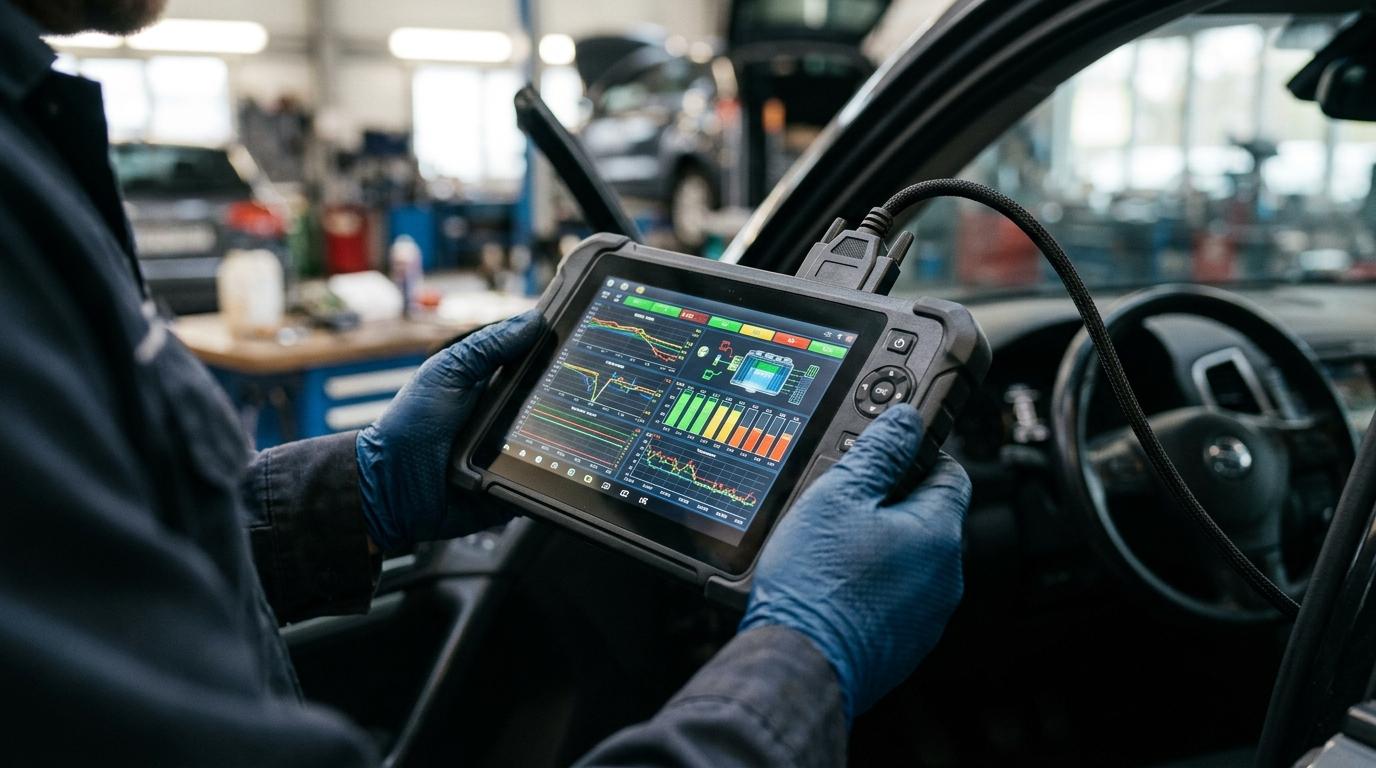
A proper battery test goes well beyond checking whether a warning light is present. Specialist workshops use hybrid-capable diagnostic tools to read battery data from the vehicle’s control systems, then compare that data with real electrical measurements and live operating behaviour.
At a workshop focused on hybrid and EV systems, the test typically starts with a scan for fault codes and battery management data. From there, technicians look at voltage differences between sections of the pack, temperature readings, charge behaviour, insulation condition, and cooling system performance. If needed, they also test under load to see how the battery behaves when the vehicle is asked to deliver power.
Townsville Hybrid and EV Repairs uses specialised equipment for hybrid and EV testing, along with trained staff who work specifically with these systems. That matters because a high-voltage battery issue can be confused with problems in the cooling system, the 12-volt battery, wiring, or electronic modules. Accurate diagnosis saves time and avoids replacing parts that are not actually at fault.
A typical test process may include:
- Fault code scan: reading hybrid system codes, freeze-frame data, and live battery parameters
- Voltage analysis: checking pack voltage and differences between modules or blocks
- Load testing: seeing how the battery responds under acceleration demand or controlled discharge
- Cooling system inspection: checking fan operation, airflow paths, filters, and battery temperature behaviour
- Insulation and safety checks: confirming the high-voltage system is electrically safe
- Related system checks: reviewing the 12-volt battery, wiring, and key electronic modules
That depth is why specialist testing is useful even when the car still drives normally. You can have a battery problem long before the vehicle becomes undriveable.
Hybrid battery testing can lead to more than one repair path
Not every test result ends with a full battery replacement. In some cases, the issue is linked to battery cooling, connection corrosion, or an electronic module fault. In others, one area of the pack may be significantly weaker than the rest, which can open the door to more targeted repair work.
For drivers, that is a positive outcome. Testing gives a clearer picture of the battery’s real condition and helps separate temporary problems from structural battery decline. If the pack still has useful life left, a workshop may recommend monitoring, cooling system service, or further evaluation rather than immediate replacement.
Where repairs are needed, available options may include battery service, battery health evaluation, module-related repairs, or replacement planning. Townsville Hybrid and EV Repairs also offers electronic module repair, which is valuable when battery warnings are linked to supporting control hardware rather than the battery pack alone.
Good testing does not just identify faults. It helps choose the most sensible next step.
When to book hybrid battery testing
A practical rule is simple: book testing when the vehicle changes, not only when it stops. If a hybrid is older, used in very hot conditions, or showing even mild performance changes, it makes sense to check battery health before a warning light becomes a major event.
Annual battery assessment is a sensible baseline for many hybrid owners, especially once the vehicle is past its earlier years. Some workshops recommend more frequent checks for vehicles used in heavy traffic, on short trips, or in consistently high ambient temperatures. In a climate like Townsville’s, that advice is hard to ignore.
There are also certain trigger points where testing is especially worthwhile. Think of these as prompts rather than strict rules.
- After a fuel economy drop: especially if driving habits have not changed
- After a warning light appears: even if the light later clears
- After unusual battery fan noise: strong fan activity can point to heat stress
- After reduced electric operation: when the engine starts joining in much earlier than normal
- After major service intervals: useful for tracking battery health over time
- After long periods of storage: to confirm the pack has recovered properly
If the hybrid is around the age where battery wear commonly starts showing, regular checks become even more valuable. Not because every older battery is failing, but because battery ageing is rarely dramatic at first. It is usually subtle, measurable, and much easier to manage when caught early.
hybrid battery test is really a health check for the system that makes the vehicle feel like a hybrid in the first place. When the battery is strong, the car is smoother, more efficient, and more responsive. When it is not, the signs are usually there, waiting to be read properly.