When an EV loses power, drops into limp mode, or lights up the dash with a drivetrain warning, the traction inverter quickly moves into focus. It is one of the most heavily worked electronic systems in the vehicle, switching high-voltage DC from the battery into AC for the motor thousands of times per second while coping with heat, vibration, moisture, and changing loads.
That is why inverter diagnostics need more than a code reader and a guess. Failures rarely come from one simple cause. More often, they build over time through heat, electrical stress, cooling issues, interconnect fatigue, or water-related damage. The good news is that the right testing approach can usually narrow the problem down well before a complete unit failure occurs.
Why the traction inverter matters in EV performance
The inverter sits at the centre of the EV powertrain. If the battery stores the energy and the motor turns the wheels, the inverter is the system that manages the conversation between them. It controls torque delivery, regenerative braking behaviour, and much of the smoothness drivers expect from an electric vehicle.
Because it handles high current and rapid switching, it is also exposed to serious stress. Modern inverters are impressively robust, yet they still rely on tightly managed temperatures, stable voltage, healthy cooling flow, and sound internal connections. Once one of those conditions starts to drift, the inverter can become less efficient, run hotter, trigger faults, or in severe cases stop driving the vehicle altogether.
A failing inverter does not always fail dramatically on day one. In many vehicles, there is a warning stage first.
Electrical causes of EV inverter failure
Electrical overstress is one of the most common starting points. The inverter’s switching devices, whether IGBTs or MOSFETs, are designed to work within strict voltage and current limits. When those limits are exceeded, even briefly, damage can begin at semiconductor level.
That stress can come from transient voltage spikes, short circuits in the power stage, motor phase faults, unstable DC bus conditions, or faults in the gate-drive system that controls switching timing. Some events cause immediate damage. Others create small changes that become bigger with each heat cycle.
Several electrical pathways show up again and again during inverter diagnostics:
- Voltage spikes: sudden overstress of semiconductor junctions and gate structures
- Short circuits: very high current that creates rapid local heating
- Overcurrent events: repeated heavy load that accelerates wear in internal connections
- Gate-driver faults: mistimed switching, incomplete turn-off, or shoot-through
- Weak 12-volt supply to control electronics
- DC-link capacitor instability
- Wiring or connector resistance
- Motor-side phase irregularities
Electrical faults can be deceptive because the original cause is not always the part that finally fails. A damaged capacitor, weak connector, or unstable control circuit may push the power module into conditions it was never meant to tolerate.
Thermal stress and cooling faults in EV inverters
Heat is the great multiplier in power electronics. A traction inverter can tolerate demanding operation, but only if it can get rid of heat efficiently. Once cooling performance drops, everything ages faster.
Thermal stress shows up in two main ways. The first is sustained overheating, where the inverter operates too hot for too long. The second is thermal cycling, where the unit repeatedly heats up and cools down during normal driving. Both matter. Sustained heat damages semiconductors and passive components. Thermal cycling slowly fatigues solder joints, bond wires, substrates, and internal interfaces.
In a hot climate, thermal headroom is reduced from the start. Add a restricted coolant path, contaminated coolant, a weak pump, blocked heat exchanger, or prior overheating event, and the inverter may begin running near its limit much more often.
A cooling issue does not have to be dramatic to matter.
| Stress factor | What happens inside the inverter | What diagnostics often check |
|---|---|---|
| Poor coolant flow | Local hot spots develop | Coolant condition, pump operation, flow faults |
| High ambient temperature | Less heat rejection margin | Load testing, thermal imaging, live temperature data |
| Repeated thermal cycling | Solder and bond fatigue builds | Intermittent faults, heat-related dropouts |
| Internal thermal resistance rise | Heat stays trapped in the module | Uneven temperatures, derating, shutdown events |
| Debris or contamination in cooling circuit | Reduced cooling efficiency | Hose inspection, pressure or flow assessment |
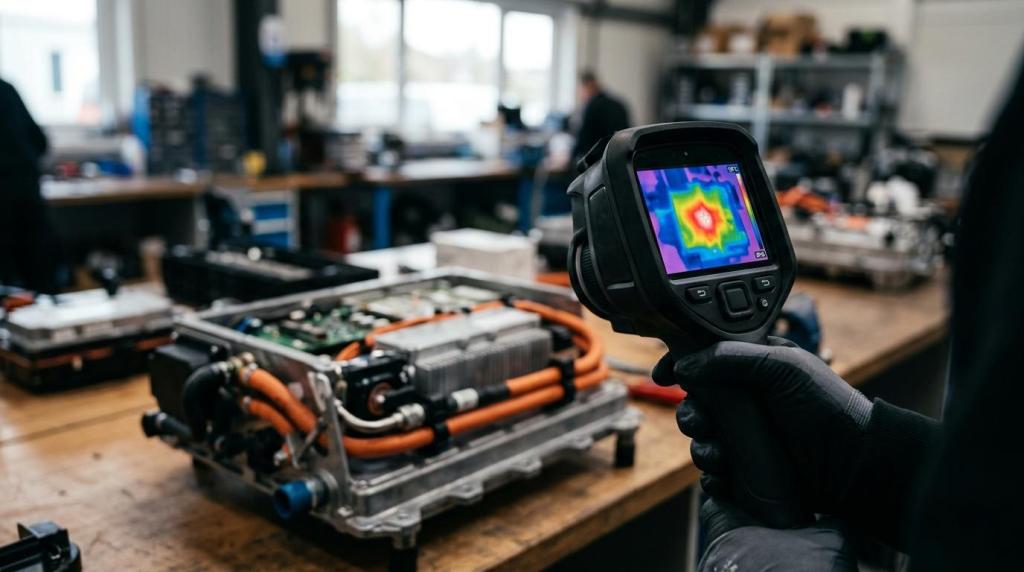
This is why specialist inverter diagnostics often include thermal imaging and cooling system checks, not just electronic fault scanning. Heat leaves clues.
Mechanical damage, moisture and contamination in inverter faults
EV inverters live in a harsh environment. Road vibration, underbody impacts, humidity, dust, and corrosion all have the potential to shorten service life, especially when paired with heat.
Vibration can slowly fatigue connectors, solder joints, busbars, and internal bond wires. A vehicle that has spent years on rough roads may develop intermittent electrical behaviour long before a connector looks visibly damaged. An underbody strike can make matters worse by stressing mounts, cracking housings, or damaging nearby cooling lines.
Moisture is another major factor. Water ingress does not always create an instant no-start condition. Sometimes it begins with corrosion at terminals, reduced insulation resistance, contamination on control boards, or recurring isolation faults after rain, flood exposure, or cleaning around vulnerable areas.
Conditions that often raise concern include:
- Coastal corrosion
- Storm or flood exposure
- Coolant leaks near electronics
- Mud and grime build-up
- Underbody impact damage
- Condensation after temperature swings
For workshops in North Queensland, this matters even more. Heat and humidity increase the value of careful inspections for corrosion, moisture traces, cooling faults, and sealing problems.
Internal component failures inside the inverter
When an inverter is opened and assessed at component level, a few fault patterns come up regularly. The power semiconductors themselves may fail, though the packaging around them is often just as important.
Bond wires can crack or lift away from the device surface. Solder joints can fatigue and form cracks that increase both electrical resistance and thermal resistance. Substrate layers can begin to delaminate. DC-link capacitors can lose performance over time, creating ripple and instability in the DC bus. Control boards, current sensors, and gate-driver circuits can also drift or fail.
These are not all equal in severity, but all can produce similar vehicle symptoms: warning lights, sudden shutdown, reduced power, inverter over-temperature messages, or inconsistent drive performance.
A useful way to think about component-level failure is this: the inverter is not just one part. It is a tightly packed system of semiconductors, capacitors, sensors, control electronics, cooling passages, and interconnections. Diagnostics need to respect that complexity.
Driving patterns and charging habits that influence inverter life
How the vehicle is used can change the stress pattern significantly. Stop-start urban driving tends to create more frequent load changes and thermal swings. Highway driving often produces a steadier load, though it can mean longer periods of sustained heat, especially in hot weather, on steep grades, or while towing.
Neither pattern is automatically harmful. The issue is repetition and temperature. An inverter that heats and cools aggressively every day may age differently from one that spends long periods under steady thermal load.
Charging habits can also shape thermal history, though this depends on vehicle architecture. In many EVs, the traction inverter is not the primary converter used during AC charging. Even so, regular fast charging can still add heat to the wider power electronics and cooling system environment. If a vehicle is already dealing with marginal cooling performance, that extra thermal load can matter.
Practical risk factors often include:
- Repeated overheating events: each event can shorten the safety margin inside the inverter
- Heavy sustained load: high-speed driving, steep climbs, or towing in hot weather
- Frequent short trips: more heat-up and cool-down cycles
- Delayed fault attention: minor cooling or isolation faults becoming major failures
EV inverter diagnostics at a specialist workshop
This is where the difference between basic scanning and specialist testing becomes obvious. A generic fault code may point to an inverter issue, but it rarely explains whether the cause is internal module wear, coolant restriction, wiring resistance, moisture ingress, sensor drift, or a control problem elsewhere in the system.
A proper diagnostic process usually starts with scan data and fault history, then moves into targeted testing. Live data review can show over-temperature behaviour, current imbalance, pump activity, voltage irregularities, or insulation-related warnings. High-voltage isolation checks can reveal leakage concerns. Thermal imaging can highlight hot joints, uneven heating, or localised cooling failure. Physical inspection may uncover corrosion, damaged hoses, loose connectors, impact marks, or water traces.
That layered method matters because replacing an inverter without finding the root cause can be expensive and incomplete. If contaminated coolant, a poor connection, or a related control fault remains, the replacement unit may face the same stress.
For this reason, specialist workshops often focus on a sequence like this:
- Fault history review: not just current codes, but the pattern behind them
- High-voltage safety testing: isolation and system integrity checks
- Thermal assessment: imaging under load where possible
- Cooling inspection: hoses, pump behaviour, leaks, restrictions, coolant condition
- Connector examination: heat marks, corrosion, looseness, moisture traces
- Module-level assessment: checking whether repair is possible before full replacement
At Townsville Hybrid and EV repairs, the value proposition sits squarely in this space: specialised equipment for hybrid and EV testing, trained staff, and electronic module repair capability. That combination is especially useful when the job requires more than part swapping.
Early warning signs of inverter trouble
Many inverter failures announce themselves before the vehicle stops. Drivers who act early often have more repair options and a better chance of avoiding wider damage.
Watch for symptoms like reduced power under load, repeated drivetrain or EV system warnings, inconsistent regenerative braking feel, sudden derating on hot days, cooling-related alerts, or faults that return soon after being cleared. Any pattern linked to rain, recent overheating, charging, or underbody impact deserves prompt attention.
One point stands out here. If a warning appears after water exposure, coolant loss, or a strike underneath the vehicle, do not treat it as routine. Those events can affect insulation, connectors, housings, and cooling pathways in ways that are not visible from the driver’s seat.
Specialist attention is also worthwhile when a vehicle has:
- persistent inverter or motor fault codes
- repeated coolant or temperature warnings
- signs of moisture or corrosion
- loss of performance without a clear battery issue
- faults that only appear when the vehicle is hot
Good inverter diagnostics are about precision, not guesswork. With the right tools and a methodical process, it is often possible to identify whether the issue is electrical, thermal, mechanical, environmental, or internal to the module itself, and that makes every repair decision stronger.