Electric vehicle battery repair matters because the battery pack is usually the most expensive part of the car, and a wrong call can turn a repairable fault into a very costly replacement. Good battery repair restores range, charging performance and safety by identifying whether the problem sits in a cell, module, cooling circuit, wiring loom or the battery management system. That solves the main issue most owners face: separating real battery failure from warning lights, software faults and heat-related stress. In Townsville, where high temperatures can magnify battery and cooling issues, accurate diagnosis is the difference between a sensible fix and wasted spend.
What does electric vehicle battery repair actually fix?
EV battery repair fixes defined faults in Tesla and Nissan packs. It targets weak modules, failed contactors, coolant leaks, wiring faults and Battery Management System errors, so the vehicle can charge, drive and report battery health correctly without defaulting straight to a full pack replacement.
An EV battery pack is not one giant cell. It is a system made up of cells, modules, sensors, busbars, contactors, cooling hardware and software controls. When one part falls outside the safe operating window, the BMS often reduces power, limits charging speed or triggers warning messages.
That means battery repair can include module balancing, replacing a failed sensor, correcting corrosion on high-voltage connections, repairing an electronic control module, or fixing thermal management faults. A drop in range does not always mean the chemistry is finished. Tyre pressures, a weak 12V battery, charger issues and software derating can all mimic battery problems.
A common misconception is that “battery fault” means “new battery pack”. In practice, the right answer depends on whether the fault is localised or pack-wide.
How can you tell whether an EV battery needs repair or full replacement?
Data tells you whether repair or replacement is likely, using tools like LeafSpy and OEM scanners. If State of Health is stable but one module shows abnormal voltage spread, repair is plausible; if degradation is broad across the pack, replacement becomes more likely.
The strongest clues are measurable, not emotional. Sudden range loss, the state-of-charge dropping quickly between 30% and 80%, repeated charging errors, turtle mode, isolation faults and overheating warnings all point to a battery or related system issue worth testing.
Many OEM battery warranties use 8 years and around 160,000 kilometres as a common benchmark, often with 70% capacity as a key threshold. If your EV is still inside that window, check the warranty path first. If it is outside warranty, a specialist repair assessment becomes more valuable.
Pro tip: one warning light is not enough to approve major battery work. Ask for cell voltage spread, temperature deltas and fault codes. If the workshop cannot show evidence, the quote is not yet strong enough.
What are the main EV battery repair options in Townsville?
Townsville drivers have several workable battery service paths, including specialist workshops and broader automotive repairers. The right option depends on whether you need module-level repair, battery health testing, pack replacement or a warranty-related inspection.
After comparing service scope, training and likely use cases, these are the main local paths to consider:
-
Townsville Hybrid and EV repairs: A dedicated local specialist for hybrid and EV battery service, battery health evaluation, module repair and electronic module diagnostics. This suits owners who want pack-level testing and repair options rather than a general inspection alone.
-
Bips Automotive Service Centre: Offers high-voltage battery diagnostics, cell or module exchange, pack replacement support and software-related checks. A sensible choice where hybrid and EV work sits alongside general mechanical service.
-
Twin Cities Automotive: Covers EV battery health checks, high-voltage wiring, inverter diagnostics, charge-port servicing and software updates. This can suit owners wanting one workshop for electrical and broader vehicle issues.
-
Townsville Serv Auto Care Service: Provides EV servicing, battery health checks, cooling system inspections and normal maintenance work. This path fits drivers who want servicing and battery-related checks in one booking.
-
Manufacturer-authorised service: Best where the vehicle is under battery warranty, subject to a service campaign, or locked behind brand-specific software procedures. The trade-off is that dealers often move faster to pack replacement than component-level repair.
How is an electric vehicle battery diagnosed step by step?
Proper EV battery diagnosis starts with BMS data from Tesla, Nissan or BYD systems. A sound workflow reads fault codes first, then confirms them with electrical testing, thermal checks and, only when needed, pack disassembly.
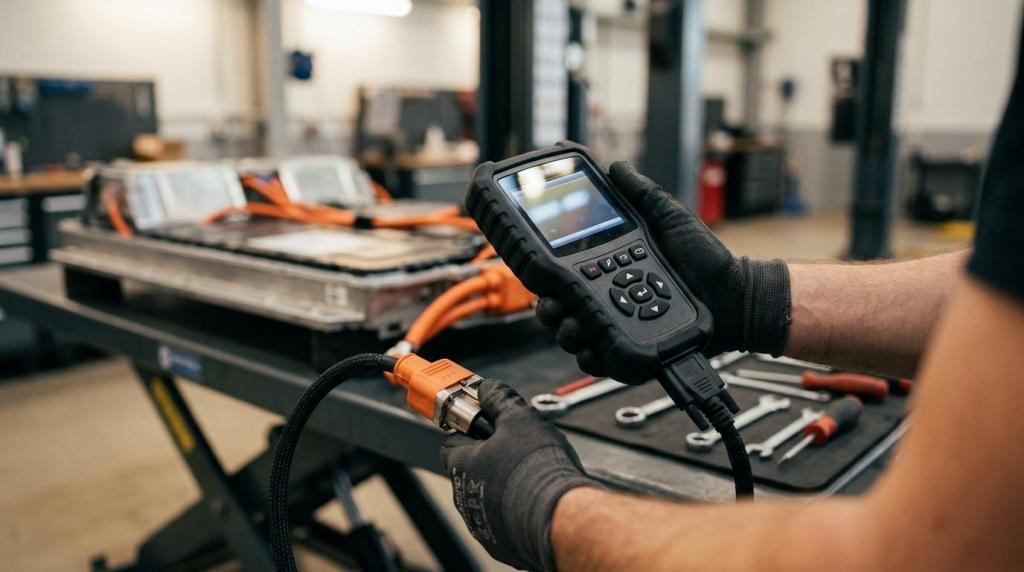
Step 1 is digital diagnosis. The workshop scans the BMS for fault codes, state of health, cell voltage spread, temperature readings, insulation data and charge history. If one block or module consistently deviates, that narrows the search fast.
Step 2 is system verification. Technicians check the 12V battery, charging hardware, contactors, coolant pumps, fans, isolation resistance and visible high-voltage cabling. This matters because external faults can trigger battery-related warnings even when the pack itself is still sound.
Step 3 is confirmation. If the scan data and external checks point inside the pack, the workshop may remove the battery and bench test suspect modules or components. A proper finish includes post-repair validation on road and on charge.
Pro tip: ask for a before-and-after report. A real diagnostic process should leave a data trail.
How does module replacement compare with full battery pack replacement?
Module replacement is cheaper in many Nissan Leaf and Tesla cases, while full pack replacement is simpler when degradation is widespread. The better choice depends on cell matching, labour time and how much useful life remains in the rest of the pack.
Module or cell replacement makes sense when the fault is concentrated. If one module has high internal resistance or a clear voltage deviation and the surrounding modules still test well, targeted repair can restore performance at a far lower price than a full pack. In one documented Leaf-style scenario, replacing 20 degraded cells in a 96-cell pack lifted state of health from about 65% to about 90%.
Full pack replacement becomes stronger when the whole pack is ageing evenly, when water ingress has affected multiple sections, or when parts availability makes repair slow and uncertain. It can also be the cleaner option for vehicles that need predictable long-term range.
The trade-off is straightforward. Repair reduces spend and material waste, but matching old and new modules takes skill. Replacement gives a more uniform outcome, but the bill can jump sharply.
A common misconception is that swapping one bad module is always the cheapest long-term fix. It is not, if the rest of the pack is close behind it.
How is an EV battery repaired safely step by step?
Safe EV battery repair requires high-voltage isolation, PPE and controlled handling, consistent with Standards Australia direction and OEM practice. Packs can exceed 350 volts, so this is workshop work, not driveway work.
Step 1 is de-energising the vehicle. The technician isolates the high-voltage system, removes the service disconnect where applicable, applies lockout procedures and verifies the circuit is safe before touching pack hardware. Disconnecting the 12V battery alone does not make a traction pack safe.
Step 2 is controlled pack access. The battery is removed using lifting equipment, opened in a dry and clean environment, and inspected for corrosion, swelling, contamination, seal damage and heat marks. Faulty modules, sensors, busbars or electronic components are then repaired or replaced.
Step 3 is reassembly and validation. The pack is balanced, resealed, retested for insulation integrity, refitted and checked through charge and road cycles. If the repair changed pack behaviour, the BMS may need recalibration or software adaptation.
Safety is part of the repair result. If the pack is not sealed and tested properly, the fault can come back as moisture ingress, thermal imbalance or charging instability.
How much does electric vehicle battery repair cost in Australia?
Australian EV battery repair costs vary widely, from a modest diagnostic fee to several thousand dollars for module repair. Tesla, Hyundai and other full EVs often cost more than hybrid battery jobs because pack access, software and parts complexity are higher.
Price depends on what has actually failed, how accessible the pack is, and whether the workshop is repairing at module level or replacing major assemblies.
- Battery health assessment: often around a few hundred dollars, depending on scan depth, testing time and whether a written report is included.
- Module or cell repair: commonly runs from the low thousands to several thousand dollars for out-of-warranty EVs, especially where pack removal and balancing are required.
- Hybrid battery supply and fitment: local and national examples often sit around $2,000 to $7,000, depending on rebuilt versus new-equivalent pack options.
- Full EV battery pack replacement: frequently starts in five figures and can climb sharply on newer or premium models.
Pro tip: the cheapest quote can hide missing work. If balancing, seal replacement, coolant service, software checks or post-repair testing are excluded, the lower number may not be the better value.
How do independent EV battery specialists compare with dealership service departments?
Independent specialists and dealership service departments solve different problems for Tesla and BYD owners. Dealers are strongest on warranty claims and factory campaigns; specialists are often stronger on component-level diagnosis, repair options and out-of-warranty cost control.
Dealerships have direct access to manufacturer procedures, software releases and warranty authorisation. If your car is covered by an OEM battery warranty or recall, that path should usually be checked first.
Independent specialists can be more flexible once the car is out of warranty. They may offer battery health evaluations, module-level repair, electronic module repair and targeted fault tracing that a dealer may not provide if its process is “replace assembly, clear codes, retest”.
The trade-off is simple. Dealers offer factory backing, while specialists often offer more repair pathways and lower total spend. If a dealer recommends full replacement, it is sensible to compare that with an independent battery assessment before approving a five-figure job.
How should you choose an EV battery repair workshop step by step?
Choosing a workshop is easier when you use a simple filter based on MTAQ, VASA and actual battery data. The aim is not the lowest quote; it is the workshop most likely to diagnose correctly the first time.
Step 1 is checking capability. Ask whether the workshop has high-voltage training, insulated tools, EV-safe lifting equipment, pack test procedures and real experience with battery management systems rather than only general servicing.
Step 2 is checking evidence. A good workshop should explain what it will test, what data you will receive and what repair options may follow. If it cannot discuss state of health, voltage spread, thermal checks and warranty terms clearly, keep looking.
Step 3 is checking scope. Compare quotes line by line. If one quote includes module matching, resealing, software checks and a written health report while another does not, those quotes are not equal even if the price gap looks large.
A subtle but useful sign is whether the workshop talks about recycling and end-of-life handling. Serious battery repairers think beyond the immediate fix.
Can a repaired EV battery stay reliable in Townsville heat and daily driving?
A repaired EV battery can stay reliable in Townsville heat if cooling, sealing and cell matching are handled properly. Nissan and Tesla packs degrade faster when thermal control is compromised, not simply because a repair happened.
Heat is a real variable in North Queensland. High ambient temperatures raise the load on cooling systems, speed up chemical ageing and expose any weak seal or airflow issue sooner. That is why battery fans, coolant circuits, vents and pack sealing matter just as much as the replacement module itself.
If the workshop matches modules well, confirms temperature behaviour and verifies charging performance after repair, daily reliability can be very good. If moisture ingress, fan blockage or coolant problems are left untouched, the battery may continue to age unevenly.
Pro tip: do not store an EV at 100% charge for long periods in hot weather unless trip planning requires it. Many makers and battery specialists treat roughly 20% to 80% for routine use as a sensible habit for longevity.
What questions should you ask before approving an EV battery repair?
The best approval questions focus on evidence, warranty and battery matching, not marketing claims from Google or Facebook. A quality workshop should explain what failed, why it failed and what result you should reasonably expect after repair.
These questions usually separate a careful repair process from guesswork:
- What data confirms the fault?: Ask for state of health, cell voltage spread, temperatures, internal resistance data and fault codes.
- What repair path are you recommending?: Find out whether the issue is a module, sensor, cooling system, contactor, wiring fault or full pack problem.
- What parts will be used?: Clarify whether the repair uses OEM, OEM-equivalent, refurbished or matched used modules.
- What warranty applies?: Check months, kilometres, exclusions and whether labour is covered as well as parts.
- What testing happens after repair?: Confirm post-repair balancing, insulation tests, charge tests and a road test.
If the answers are clear, written down and supported by measured results, you are dealing with a much stronger repair option.