
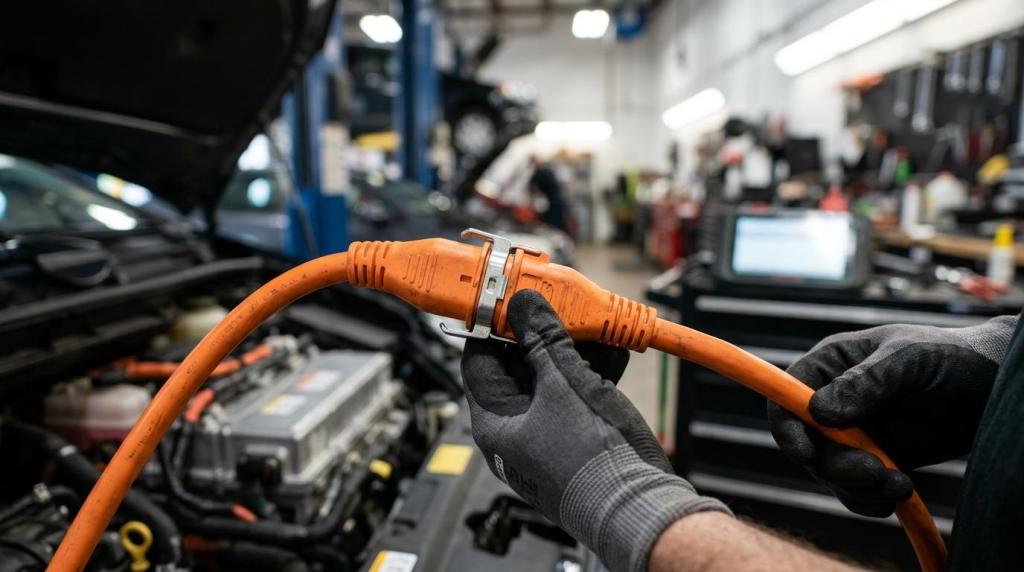
A good hybrid mechanic does far more than check an engine bay and clear a warning light. Hybrid vehicles combine petrol power, electric drive, battery management, braking control, cooling systems, sensors and software into one tightly linked package. When one part behaves badly, the fault can show up somewhere else.
That is why the best hybrid diagnosis starts with patience, method and the right equipment. A specialist mechanic is looking for patterns, not just broken parts. The aim is to find the real cause, protect the high-voltage system, and return the vehicle to proper performance without guesswork.
Hybrid mechanic diagnostics start with safety and system data
Before any repair begins, a hybrid mechanic thinks about risk. High-voltage components, orange cables, battery isolation procedures and stored electrical energy all change the job from ordinary vehicle service to specialist work. Safety is not a separate step. It sits at the front of every inspection.
Once the vehicle is made safe, data becomes the next priority. Modern hybrids report an enormous amount of information through onboard control modules. A skilled mechanic reads fault codes, freeze-frame data, live sensor values and battery metrics together. One code alone rarely tells the full story. A battery fault may be linked to heat. A braking complaint may involve regenerative control. Poor fuel economy may trace back to the 12V system, cooling performance or software behaviour.
At this early stage, the mechanic is usually checking a short list of high-value clues.
- Warning lights and stored fault codes
- 12V battery condition
- Battery temperature trends
- Cooling fan operation
- Regenerative braking behaviour
- Signs of voltage isolation issues
This first pass shapes the rest of the diagnosis. If the data points to battery stress, the mechanic moves deeper into pack health and thermal management. If the numbers suggest poor communication between modules, attention shifts to wiring, connectors and electronic control units.
Hybrid battery health checks reveal the real fault
The hybrid battery is often the first thing drivers worry about, and with good reason. It affects performance, fuel use, charging behaviour in plug-in systems, and the way the whole vehicle feels on the road. Still, an experienced hybrid mechanic does not assume the battery is the problem just because the car feels sluggish or a warning light appears.
Battery assessment is much more detailed than a simple pass or fail result. The mechanic looks at state of health, internal resistance, cell or module balance, charge and discharge behaviour, temperature spread and the way the battery responds under load. A pack may still operate while hiding imbalance, heat stress or weak sections that only show up in certain driving conditions.
Cooling is part of this picture. In hybrid vehicles, battery temperature control matters a great deal. If the cooling fan is restricted, ducts are dirty, coolant flow is poor or ambient heat is pushing the system hard, battery performance can fall away quickly. In warm northern conditions, this check becomes even more relevant because sustained heat can shorten component life and trigger protective limits.
A specialist workshop may also look closely at whether the battery truly needs replacement, repair, reconditioning or a broader system fix. That distinction matters. Some faults sit in sensors, connectors, control electronics or module-level failures rather than the entire pack. When a workshop has the equipment and repair capability to test accurately, the diagnosis becomes more useful and often more cost-effective.
Mechanical systems still matter in hybrid repairs
A hybrid vehicle is still a vehicle. Tyres, suspension, wheel bearings, cooling hoses, engine mounts, brake components and driveline parts all affect how it performs. A hybrid mechanic never loses sight of the mechanical side.
Brakes are a perfect example. Many drivers notice that a hybrid feels different under braking, especially at low speed or during a light stop. That can be normal because regenerative braking and friction braking work together. Yet unusual pedal feel, noise, shudder or reduced stopping confidence can also point to wear, contamination, calibration issues or faults in the electronic brake system. The mechanic has to separate normal hybrid behaviour from a genuine defect.
The petrol engine also matters more than some owners expect. If the engine is running inefficiently due to ignition issues, cooling faults, intake problems or sensor drift, the hybrid system will often compensate in ways that reduce economy and strain the battery. A smooth-running engine, a healthy electric drive system and accurate software control all support each other.
What a hybrid mechanic checks across the whole vehicle
A proper inspection is never limited to one component. The table below shows how a hybrid mechanic reads the car as a connected system.
| Inspection area | What the mechanic looks for | Why it matters |
|---|---|---|
| High-voltage battery | State of health, module balance, temperature, load response | Weak battery performance can affect power delivery, efficiency and warning lights |
| Battery cooling system | Fan operation, airflow, duct condition, coolant performance where fitted | Heat is a major cause of battery stress |
| Inverter and converter systems | Fault codes, cooling condition, voltage conversion behaviour | These units manage power flow between battery, motor and 12V systems |
| 12V electrical system | Battery health, charging support, voltage stability | Many hybrid faults begin with low 12V voltage or unstable supply |
| Regenerative braking system | Brake feel, sensor data, transition to friction brakes | Poor blending can feel like a brake problem even when the root cause is electronic |
| Engine and conventional systems | Combustion quality, cooling, mounts, fluids, service history | Hybrids still rely on strong mechanical health |
| Electronic modules and wiring | Communication faults, connector condition, control unit response | Software and module issues can mimic major hardware failures |
This system-wide approach is what separates specialist hybrid service from trial-and-error repairs.
Hybrid mechanic tools make the diagnosis more accurate
The right mechanic also needs the right tools. Standard workshop equipment can handle basic servicing, though hybrid faults often require much more. Advanced scan tools, insulated testing gear, battery evaluation equipment and manufacturer-level data access all lift the quality of diagnosis.
That matters because hybrid issues are often subtle. A road test might show a hesitation, yet the real problem could be battery heat, module imbalance, a low 12V supply, an inverter cooling issue or a communication fault between control units. Without live data and proper testing procedures, those problems are easy to miss.
In a specialist setting, tools are chosen for both accuracy and safety. The list often includes scan platforms with hybrid-specific functions, insulated hand tools, meters rated for automotive electrical work, battery testing interfaces, and controlled procedures for working around high-voltage components. Trained staff matter just as much as the equipment, because results depend on the person interpreting the numbers as much as the device reading them.
There is also growing value in electronic module repair. Replacing an entire module every time a fault appears is not always the smartest path. When a workshop can test electronic units carefully and identify repairable failures, owners may have better options than a full assembly replacement.
Signs your vehicle needs a hybrid mechanic, not a general mechanic
Some problems can be handled during routine servicing. Others deserve specialist attention straight away. Hybrid systems are too interconnected for educated guessing.
If your vehicle shows repeated hybrid warnings, odd charging behaviour, sudden drops in fuel economy or changes in braking feel, it is time to have the car assessed by someone who works with these systems every day.
- Repeated hybrid warning lights: Even if the light clears, stored data may show a fault developing in the battery, inverter or control network.
- Battery fan noise or overheating messages: These often point to heat management issues that need prompt inspection.
- Poor fuel economy without an obvious cause: The fault may sit in the battery, engine management, braking drag or a low 12V system.
- Jerky braking or unusual brake feel: The interaction between regenerative and friction braking needs specialist diagnosis.
- Weak acceleration or inconsistent power delivery: This can come from battery limitations, thermal protection, engine issues or software-related control faults.
- Intermittent starting or electrical gremlins: Hybrid vehicles are very sensitive to voltage quality and module communication.
These symptoms do not always mean a major repair bill is coming. They do mean the vehicle needs a proper process, not a quick assumption.
Hybrid mechanic expertise matters in Townsville conditions
Local conditions shape hybrid repairs more than many drivers realise. Heat, stop-start driving, dust, humidity and regional logistics can all influence what a mechanic looks for first. Battery cooling, inverter temperature management and electrical reliability deserve close attention in a warm climate.
For hybrid and EV drivers in Townsville, specialist support is especially valuable because these vehicles need a different service mindset. A workshop focused on hybrids and EVs is better placed to test high-voltage systems correctly, assess battery condition with confidence and identify whether the fault is mechanical, electrical or electronic. That includes work on battery service, battery evaluation and repairs to electronic modules where appropriate.
There is also peace of mind in knowing the car is being checked by trained staff using equipment designed for hybrid and EV systems. That combination can shorten diagnosis time, reduce unnecessary part replacement and keep the repair plan grounded in evidence.
A careful hybrid mechanic is always looking for the link between symptom and cause. Sometimes that means a worn mechanical part. Sometimes it means battery heat, a failing sensor, unstable voltage or a module that is no longer communicating as it should. When the diagnosis is done well, the vehicle usually tells a clear story, and that is when the right repair becomes obvious.