Electric cars usually need less maintenance than petrol or diesel vehicles, but that does not mean they are service-free. A modern EV still relies on tyres, brakes, suspension, cooling systems, charging hardware, software and high-voltage components that need regular inspection.
The smart time to book an electric car service is usually before something feels wrong, not after.
For most drivers, that means following the manufacturer’s schedule and paying attention to changes in range, charging behaviour or warning messages. In a place like North Queensland, heat, humidity and coastal conditions can also bring service timing forward.
Electric car service intervals for most vehicles
The starting point is always the owner’s manual or logbook. Many battery electric vehicles are scheduled for service every 12 months or around 15,000 to 20,000 km. Some models can go longer, with intervals closer to 24 months or 30,000 to 40,000 km.
That variation matters. A Tesla Model 3 or Hyundai Kona Electric may call for an annual check, while an MG4 EV or Polestar 2 may have a longer gap between scheduled services. The best booking date is the earlier of the two limits: time or distance.
If your car reaches 15,000 km in eight months, book it then. If you have only driven 7,000 km in a year, it is still time to book.
Here is a simple guide to common service timing:
| Vehicle type or example | Typical service timing | Why that interval matters |
|---|---|---|
| Tesla Model 3 | 12 months / 15,000 km | Regular inspections, tyre wear, braking system, software checks |
| Hyundai Kona Electric | 12 months / 15,000 km | Battery and cooling checks, cabin filter, safety inspection |
| MG4 EV | 24 months / 40,000 km | Longer factory interval, though tyres and brakes still need watching |
| Polestar 2 | 24 months / 30,000 km | Scheduled inspection and condition-based items |
| Typical plug-in hybrid | 12 months / 10,000 to 15,000 km | EV checks plus engine servicing |
Always check the exact schedule for your model, as manufacturers set their own intervals.
When driving conditions change your electric car service timing
A fixed schedule is only part of the picture. Real-world use can shorten the ideal time between visits.
Frequent fast charging, regular towing, steep hills, long highway runs and hard acceleration all put more load on the vehicle. EVs are mechanically simpler in some areas, though they are still heavy vehicles with instant torque. That extra weight and torque can increase tyre wear, stress suspension parts and change brake service needs.
North Queensland conditions can matter just as much as driving style. Persistent heat puts more demand on battery cooling systems. Humidity and coastal salt can affect connectors and exposed components. If your vehicle spends long hours outside in the sun or near the coast, a yearly inspection becomes even more valuable.
These conditions are worth mentioning when you book:
- frequent DC fast charging
- heavy towing
- steep or mountainous routes
- long high-speed highway trips
- coastal driving and salt exposure
- long periods parked outdoors in full sun
A specialist workshop can use that information to decide whether battery cooling, brake fluid, charging components or underbody inspections need closer attention.
Why battery EV and plug-in hybrid service schedules differ
Not every electric vehicle follows the same maintenance logic. A battery electric vehicle, or BEV, has no engine oil, spark plugs or exhaust system. A plug-in hybrid, or PHEV, still has all the electric components and a petrol engine to maintain.
That makes the booking schedule for a PHEV more demanding in most cases. Even if the vehicle does lots of short electric-only trips, the engine still has service items based on time and distance. Oil degrades, filters age and fuel system components still need proper care.
So if you drive a pure EV, your service timing is often built around inspections, software, tyres, brakes, filters and battery system checks. If you drive a PHEV, you should expect those EV checks plus traditional engine servicing.
That extra complexity is a strong reason to use a workshop familiar with both systems.
Warning signs that mean book an electric car service sooner
Even if your next scheduled service is months away, some signs should move the booking forward.
Warning lights are the clearest example. A red high-voltage or serious electrical fault message should never be ignored. Yellow warnings are less urgent, though they still deserve prompt attention, especially if they return after restarting the car.
A sudden drop in range is another clue. Seasonal changes can affect range, and so can air conditioning use or long motorway driving. What matters is a change that feels out of character for your normal use. If the battery seems to drain much faster than usual, the state of health, charging system or thermal management system may need testing.
Charging issues are also a strong signal. If the car stops charging unexpectedly, refuses to charge past a low percentage, throws charging errors or takes much longer than normal, book it in. EVs are designed to be smooth and quiet, so unusual sounds also stand out more. Grinding, whining, rattling or repeated clicking should be checked.
A practical way to think about urgency is this:
- Book immediately: red electrical warnings, burning smell, sudden power loss, visible coolant leak, brake failure
- Book soon: repeated charging faults, strong drop in range, new noises, reduced regenerative braking, ongoing yellow warning messages
- Mention at the next service: minor wiper issues, cabin smells, tyre wear concerns, intermittent non-critical alerts
When in doubt, earlier is safer. Fault codes and battery data can often reveal a small issue before it becomes an expensive repair.
What an electric car service usually includes
Many drivers know what a petrol car service looks like. An electric car service is different, though not mysterious. The focus shifts away from engine oil and towards electrical safety, battery health condition, braking performance and software health.
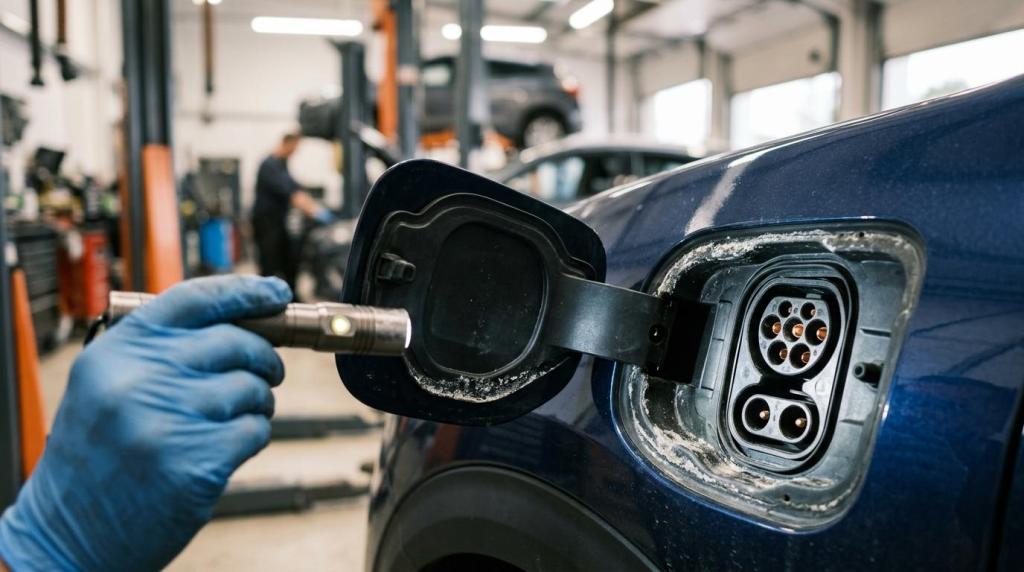
At a specialist EV workshop, technicians may inspect the high-voltage system, battery cooling, charging operation, power electronics, suspension, tyres and braking hardware. They can also test battery health and check for stored fault codes that may not yet have triggered a dashboard warning.
At Townsville Hybrid and EV repairs, the service scope can include EV battery evaluation and health checks, battery repairs, hybrid and EV servicing, and electronic module repair work. That kind of specialist support matters when a standard workshop may not have the equipment or training to test high-voltage systems properly.
A typical electric car service may cover:
- battery health testing
- high-voltage cable and connector inspection
- software and system checks
- brake fluid condition
- tyre wear and rotation needs
- suspension and steering inspection
- cabin air filter replacement
- charging system checks
One point surprises many EV owners: brakes can still need attention even when pads last a long time. Regenerative braking reduces pad wear, but friction brakes still need inspection because calipers, discs and fluid can age with time, moisture and inactivity.
Electric car service timing for heat, humidity and coastal conditions
Climate changes the service conversation.
Hot weather can increase battery temperatures and make cooling systems work harder. That does not mean your EV is fragile. It means regular checks become more valuable, especially before summer travel or after months of heavy daily use. If you live in Townsville or drive across hot regional routes, it makes sense to ask for attention to battery cooling performance and system condition.
Humidity matters too. Brake fluid absorbs moisture over time, and electrical connectors do not benefit from salty coastal air. Drivers near the beach or in wet tropical conditions may benefit from earlier inspections of charge ports, underbody components and high-voltage connections.
Even parking habits can affect how often your car should be checked. A vehicle stored in a garage or shaded carport generally sees less heat stress than one left outside every day in direct sun.
Good habits between services that protect EV reliability
Servicing works best when it is paired with simple checks at home. These habits do not replace a professional inspection, though they can keep your EV performing at its best between visits.
Tyres deserve the most attention. EVs are heavy, and their instant torque can wear tyres faster than some drivers expect. Check pressures monthly when cold, look for uneven wear and rotate tyres as recommended by the manufacturer.
Charging habits also shape battery health over the long term. Daily use is usually best with moderate charging rather than repeated rapid charging. Many manufacturers and technicians suggest keeping the battery within a middle range for normal use, then charging to 100 per cent only when the trip requires it.
A few useful habits go a long way:
- Check monthly: tyre pressures, tread wear, washer fluid, exterior lights
- Charge thoughtfully: use fast charging when needed, not for every routine top-up
- Park wisely: choose shade or covered parking during very hot weather
- Pay attention: new noises, changed braking feel, charging interruptions, falling range
These small routines make it easier to spot the right time to book a service, rather than waiting for a warning light to make the decision for you.
When a specialist electric car service centre makes sense
Any modern vehicle benefits from correct servicing, but EVs and hybrids have systems that need dedicated knowledge. Battery diagnostics, module testing, high-voltage isolation procedures and brand-specific fault tracing are not standard skills in every workshop.
That is where a specialist centre stands apart. Trained staff, specialised testing equipment and experience with hybrid and EV systems make it easier to identify whether a problem is mechanical, electrical, thermal or software-related. For owners dealing with charging faults, battery concerns or electronic module issues, that can save time and reduce guesswork.
If your EV is due by time, due by kilometres, showing warning signs or heading into a demanding season of travel, booking sooner is a strong move. Regular electric car service is not about doing more maintenance than needed. It is about doing the right maintenance at the right time, so the car stays efficient, reliable and ready for the road.