If you ask ten EV owners whether their battery is “healthy”, many will point to a percentage on an app, a range estimate on the dash, or a quick scan result from a service visit. That number can be useful, but it is not the whole story.
A proper EV battery inspection is broader, more technical, and built around safety as much as data. For repair decisions, warranty questions, and used EV buying, that distinction matters. A battery health check tells you about condition. A battery inspection tells you about condition, risk, and what needs attention next.
EV battery inspection and battery health check are not the same
A battery health check is usually a diagnostic assessment of how the pack is performing. It may look at state of health, cell balance, internal resistance, temperatures, charging behaviour, and battery management system data. It is mainly about performance and condition trends.
A full battery inspection includes those diagnostic checks, but it goes further. It also covers high-voltage safety procedures, visual and physical checks, cooling system condition, wiring and connector assessment, fault history, and signs of damage, corrosion, impact, water entry, or overheating.
That is why the two terms should not be used as if they mean the same thing.
| Aspect | Battery health check | Full EV battery inspection | Why it matters |
|---|---|---|---|
| Main purpose | Assess battery condition and performance | Assess condition, safety, and serviceability | A repair plan needs both |
| Typical data | State of health, state of charge, voltage spread, resistance, temperature trends | Same data plus isolation procedures, physical checks, cooling and cable inspection | Numbers alone may miss physical faults |
| Safety scope | Often limited to scan and analysis | Requires high-voltage training, PPE, and correct testing procedures | EV battery systems can be dangerous if handled badly |
| Use case | Monitoring ageing, pre-purchase screening, routine service | Fault diagnosis, post-damage assessment, deeper servicing | The right test depends on the question being asked |
| Output | Battery condition snapshot | Condition plus action plan | Useful outcomes are monitor, correct, repair, or replace |
What an EV battery health check actually measures
A worthwhile health check goes beyond a simple range guess. Range can swing with temperature, speed, terrain, tyre pressure, and driving style. A car that shows fewer kilometres than expected is not always suffering from battery degradation.
The stronger battery reports look at usable capacity, how evenly the cells are performing, how much resistance exists inside the pack, and how the battery behaves under load and while charging. They also read battery management system records, which can reveal recurring faults, thermal events, or charging irregularities.
These are some of the key metrics usually reviewed in a proper health check:
- State of health: An estimate of remaining usable capacity compared with when the battery was new.
- State of charge: The battery’s current charge level, which affects testing context and charging behaviour.
- Cell balance: How closely individual cell groups match each other in voltage and performance.
- Internal resistance: A marker linked to ageing, heat generation, and power delivery.
- Thermal behaviour: How the pack heats, cools, and responds during operation or charging.
- Battery management system data: Fault codes, charge limits, temperature logs, and control behaviour.
A good health check can answer practical questions. Is the pack ageing normally? Is a warning light tied to a real battery issue or another subsystem? Is there evidence of imbalance that may affect charging or performance? Is the battery still fit for the owner’s daily use?
What it cannot always do, by itself, is prove that the battery pack is physically sound or safe to open, test, or repair.
What a full EV battery inspection includes
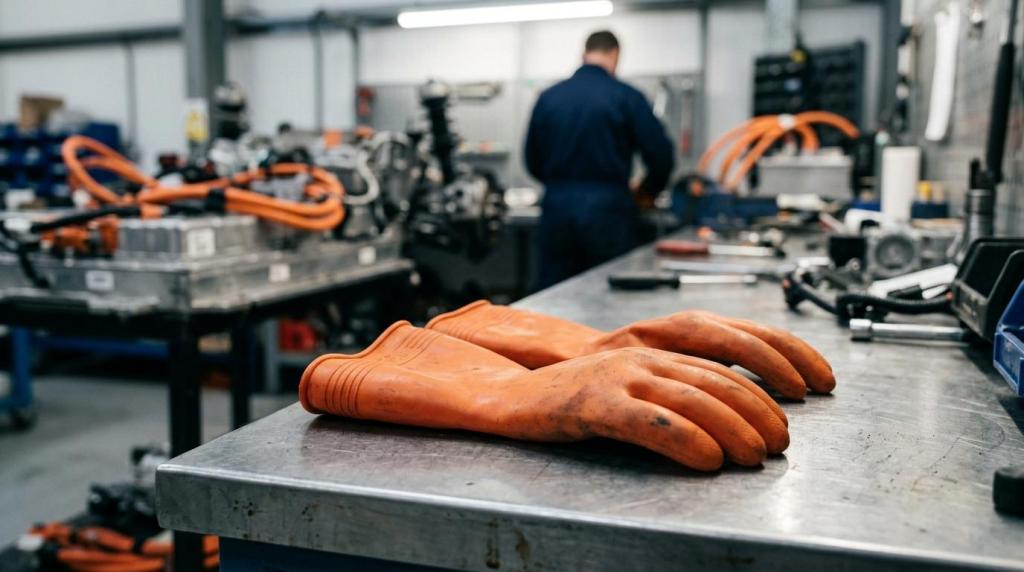
A proper inspection begins with the reality that EV batteries are high-voltage systems, not just large electronic devices. Before any disassembly or intrusive testing starts, the pack and associated systems must be isolated correctly. That means trained technicians, suitable personal protective equipment, and the right test instruments.
From there, the inspection can move into areas a health check may never touch. Physical condition matters. A pack may have acceptable diagnostic readings yet still show impact damage, coolant issues, loose connections, early corrosion, or contamination from water ingress. Battery cooling systems also deserve attention, because temperature control is central to battery life, charge speed, and long-term reliability.
At a specialist EV workshop, the inspection scope may include items like these:
- Pack housing condition
- High-voltage cables and connectors
- Cooling lines and coolant condition
- Charge port operation
- Mounting points and underbody damage
- Battery fault-code history
- Contactor and isolation status
- Evidence of overheating or moisture entry
This is where battery inspections become especially valuable after a collision, after flood exposure, when warning lights appear, or when charging behaviour changes without an obvious cause.
High-voltage safety is a central part of EV battery inspection
Official safety guidance is very clear on this point: EV and hybrid service involving high-voltage systems should be carried out by qualified technicians with specialised training, proper PPE, and the correct diagnostic and testing equipment.
That is not paperwork or theatre. Damaged EVs should be treated as though the high-voltage system is still energised. Flood-affected batteries can introduce shock hazards, corrosive material risks, and fire concerns. A workshop that can scan codes but cannot manage high-voltage isolation is not performing the same level of work as a specialist repair centre.
Routine servicing and specialist battery inspection sit in different categories. Tyres, brake hardware, cabin filters, and suspension checks are standard workshop work. High-voltage battery diagnosis and inspection require another layer of skill and control.
Why battery state of health percentages can mislead
State of health is useful, but it should never be treated as the one true answer. Different manufacturers calculate it differently, and some vehicles do not expose a meaningful figure at all.
Recent research on more than a thousand EVs across five manufacturers found large real capacity differences within the same model, ranging from 12 per cent to 25 per cent. It also found that battery management system state-of-health readings did not consistently match independent measurements well. In many cases, the correlation was only modest, and hundreds of vehicles did not report SOH at all.
That matters for owners and buyers. A battery may look fine on a quick scan, yet closer testing may show imbalance, thermal concerns, or capacity loss that the onboard number masks. The reverse can also happen: a conservative or oddly calculated SOH figure may make a battery look worse than its real-world performance suggests.
A solid battery decision should combine several inputs:
- diagnostic data from the battery management system
- charge and discharge behaviour
- cell-level balance or voltage spread
- thermal performance
- physical inspection findings
- service and fault history
Seen together, those pieces form a much more reliable picture than a single percentage on a screen.
EV battery service intervals and when to book an inspection
Australian government guidance points to annual professional servicing or inspection for many EVs, even though they usually need less maintenance than petrol or diesel vehicles. Many battery electric vehicles are commonly serviced every 12 months or around 15,000 to 20,000 km, while some models extend that to 24 months or 30,000 to 40,000 km.
Those intervals are a baseline, not a hard rule for every battery concern. If a vehicle has been fast-charging heavily, operating in sustained heat, showing reduced charging speed, or presenting warning messages, earlier battery testing may be wise. Battery cooling systems also need periodic checks to confirm correct operation and, where relevant, coolant condition and level.
It is smart to arrange a specialist inspection sooner if any of these signs appear:
- Range drop: A noticeable fall that cannot be explained by weather, speed, or route changes.
- Charging change: Slower charging, interrupted charging, or a lower maximum charge level.
- Warning lights: Battery, EV system, or isolation-related alerts on the dash.
- After damage: Any collision, underbody strike, or suspected water exposure.
- Used EV purchase: Before buying, especially when battery history is unclear.
- Heat concerns: Unusual fan activity, thermal warnings, or repeated performance limiting.
Waiting for a complete failure is rarely the best move. Early testing gives more options, and in many cases the fix is smaller when caught earlier.
What to expect from a specialist EV battery report
The best battery reports do more than hand over a score. They translate technical findings into a decision. Is the battery ageing normally and ready for continued monitoring? Does it need a cooling system correction? Is there a module-level imbalance worth tracking? Does the battery management system need repair work? Is the pack safe to keep using, or does it need deeper investigation?
A specialist workshop should also be able to explain the limits of the data. If the vehicle’s onboard SOH figure is only one part of the picture, that should be said plainly. If results are affected by charge level, ambient temperature, recent driving, or the manufacturer’s data access, that context matters.
That level of clarity is especially valuable for three groups:
- owners planning long-term maintenance
- buyers comparing used EVs
- drivers facing warning lights or charging faults
When a battery assessment leads to a clear next step, it becomes genuinely useful. A report that says monitor, correct, repair, or replace is far more practical than one that simply prints a percentage and sends the vehicle home.
Choosing the right EV battery test for the job
If the goal is routine monitoring, a battery health check may be enough. It can show whether the pack is behaving normally and whether the battery management system data supports what the owner is seeing on the road.
If the goal is diagnosis, post-damage assessment, pre-purchase certainty, or any decision involving repair work, a full inspection is the better choice. That approach combines battery condition data with high-voltage safety controls and physical verification.
For EV owners, this is good news rather than bad news. Battery testing is getting better, specialist skills are growing, and there are now clearer ways to separate a quick condition reading from a true inspection. When the right test is matched to the right question, battery decisions become calmer, safer, and far more accurate.