Electric vehicles are simpler than petrol and diesel cars in several ways. There is no engine oil to change, no spark plugs to replace, and no exhaust system to inspect on a battery electric vehicle. That often leads to a fair question from drivers: if there is less routine mechanical work, does the workshop matter as much?
Yes, it does.
An EV may ask for less frequent servicing, yet the work can become far more specialised once diagnostics move into the battery, charging system, power electronics, or high-voltage wiring. That is where the gap between a general mechanic and an EV specialist becomes very clear.
Why EV servicing is different from petrol car servicing
Australian government guidance points out that EVs have fewer moving parts than petrol or diesel vehicles and usually only need a professional service or inspection once a year. That is good news for owners. Lower routine maintenance is one of the genuine advantages of electric driving.
Still, “less maintenance” does not mean “no maintenance”. EVs still rely on brakes, suspension, tyres, cabin filters, cooling systems, software, and onboard computers. A modern EV is not just a car with a battery. It is a tightly integrated electrical system that depends on accurate testing and safe repair procedures.
That difference matters most when a problem is not obvious. A worn tyre is easy to spot. A battery imbalance, insulation fault, charging issue, or module fault is not.
What routine EV service still includes
A proper EV service is not just a quick visual once-over. Government guidance in Australia highlights several items that still need regular attention, even when there is no internal combustion engine involved.
Common service items can include:
- Brake caliper cleaning and lubrication
- Brake fluid replacement
- Suspension inspection
- Tyre condition and wear checks
- Cabin air filter replacement
- Battery cooling system inspection
- Onboard computer and fault-code checks
For many owners, this is where the confusion starts. A general workshop may be very capable with tyres, brakes, and suspension. Yet once the work crosses into high-voltage systems or battery-related diagnostics, the right equipment and training become essential.
When a general mechanic can help and when an EV specialist mechanic is better
There are jobs that many competent workshops can handle, and there are jobs that should go straight to an EV-focused repairer. The distinction is practical, not dramatic.
| Service or repair area | General mechanic | EV specialist mechanic |
|---|---|---|
| Tyres, wheel alignment, basic brake checks | Often suitable | Also suitable |
| Suspension wear and steering components | Often suitable | Also suitable |
| Cabin filters and basic inspections | Often suitable | Also suitable |
| EV fault codes and system diagnostics | Limited on many workshops | Stronger capability |
| Battery cooling and thermal issues | May vary | Better suited |
| Charging faults | May vary | Better suited |
| High-voltage isolation testing | Rarely appropriate | Expected capability |
| Battery module repair or evaluation | Rarely available | Specialist work |
| Hybrid or EV electronic module repair | Rarely available | Specialist work |
The practical takeaway is simple: not every EV visit needs a battery expert, but every EV owner benefits from having access to one when the issue moves past routine maintenance.
High-voltage safety requires trained EV mechanics
This is the point that should never be brushed aside. High-voltage electrical work is not ordinary workshop work.
Safe Work Australia guidance makes it clear that the requirements for high-voltage electrical work are specialised, and that only competent electrical workers with appropriate training should work on high-voltage electrical equipment. The risks are also higher if something goes wrong.
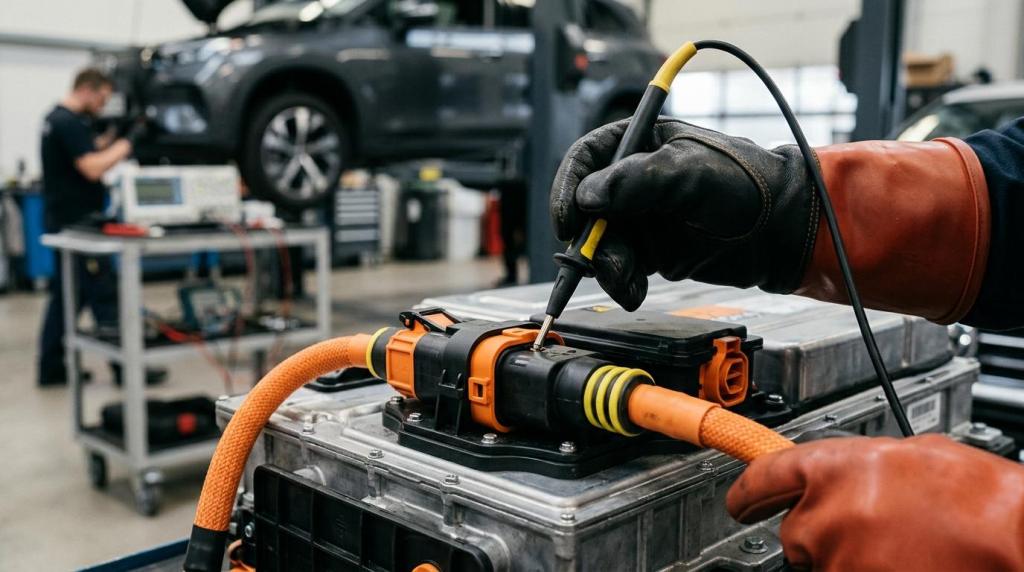
That has real workshop implications. Safe isolation procedures, correct personal protective equipment, test equipment rated for the task, and vehicle-specific shutdown methods all matter. A mechanic can be excellent with engines, gearboxes, and general repairs, yet still not be the right person for an EV battery or high-voltage fault.
If a warning light relates to the battery, inverter, charging system, insulation, or power delivery, safety is part of the diagnosis, not an extra step added later.
Battery diagnostics are where EV specialists stand apart
Battery health is one of the biggest concerns for EV owners, especially as vehicles age or change hands. A basic scan tool reading may not tell the whole story. Real battery assessment can require cell-level analysis, thermal checks, isolation testing, and a close look at performance under load.
A specialist EV workshop is more likely to have the tools and training for that deeper level of testing. That includes the ability to identify whether a fault sits in a single module, a cooling issue, a connection problem, or a control component rather than assuming the whole battery pack needs replacement.
That difference can affect cost as much as accuracy. A workshop with module repair capability may be able to target the faulty area instead of taking the broadest and most expensive path.
In Townsville, this is where a dedicated hybrid and EV repair centre becomes especially useful. Townsville Hybrid and EV repairs focuses on hybrid and EV servicing, EV battery evaluation and battery health checks, battery repairs, and electronic module repair. For local owners, that means access to skills aimed at the parts of the vehicle that general workshops may not handle every day.
Signs you should book an EV specialist mechanic
Some issues clearly sit in specialist territory. Others start small and then become more serious if they are left alone.
If your EV shows any of the following, a specialist assessment is usually the smarter move:
- Charging problems: slow charging, failed charging sessions, or intermittent connection faults
- Battery warnings: dashboard alerts related to battery management, isolation, temperature, or reduced power
- Range changes: noticeable drop in expected driving range without a clear reason
- Thermal concerns: battery overheating messages or cooling system irregularities
- Drive faults: sudden limp mode, reduced acceleration, or repeated shutdown events
- Electronic faults: communication issues between modules or unexplained warning lights
These symptoms do not always point to a failing battery pack. Sometimes the cause is smaller, more targeted, and more repairable than owners expect. The value of a specialist lies in finding that exact cause.
EV battery health checks make sense even without obvious faults
Many drivers wait until something goes wrong before booking an EV inspection. That is understandable, though it is not always the best approach.
Battery health checks are useful as preventive maintenance, especially for vehicles that are several years old, driven in harsh heat, or used heavily for commuting and fast charging. A yearly battery check, or one done around every 15,000 to 20,000 km, can give a clearer picture of condition and trends over time.
That is not about creating worry. It is about giving owners better information.
A well-executed battery health check can help with resale, ownership planning, warranty discussions, and confidence before a long trip. In North Queensland conditions, where heat can be a real factor, data matters.
Hybrid, plug-in hybrid, and EV servicing are not identical
This is another reason specialist knowledge matters. Not all electrified vehicles need the same service plan.
A battery electric vehicle has no petrol engine, so the service focus stays on electrical systems, braking hardware, tyres, suspension, cooling, and software-related checks. A plug-in hybrid still has a petrol engine as well as a high-voltage battery and electrical drive system. A conventional hybrid has its own mix again.
That means one workshop may be comfortable servicing the engine side of a PHEV but not the high-voltage side. Another may be capable across the full system. Owners are better served when the workshop can see the whole vehicle rather than only one half of it.
What to ask before choosing an EV mechanic
The simplest way to judge a workshop is to ask direct questions. A capable EV repairer should be comfortable answering them clearly.
Useful questions include:
- Training: are the technicians trained to work on hybrid and EV high-voltage systems?
- Equipment: does the workshop use specialist diagnostic and testing equipment for EVs?
- Battery work: can the workshop carry out battery health checks, evaluation, and repair rather than only replacement?
- Electrical diagnostics: can they test charging faults, cooling faults, and electronic control modules?
- Repair scope: do they handle module-level issues or refer all major EV faults elsewhere?
A good answer is specific. It should describe real capability, not just a general willingness to “look at EVs”.
Why local specialist support matters for Townsville EV drivers
Owning an EV is easiest when specialist support exists close to home. Routine jobs can often be managed without much fuss, though battery concerns, charging faults, and high-voltage warnings are a different story. Being able to access local testing and repair work can save time, reduce transport hassles, and speed up fault-finding.
For Townsville drivers, that local capability is becoming more important as more hybrids, plug-in hybrids, and full EVs stay on the road beyond their first few years. Early ownership is one phase. Long-term ownership is another. As vehicles age, specialist diagnostic support becomes far more valuable.
That is where a workshop focused on hybrid and EV repair can make ownership feel straightforward rather than uncertain.
The real answer for EV owners
EVs do not need specialist attention for every single service item. They do, however, benefit greatly from a specialist mechanic when the work involves battery health, charging faults, high-voltage safety, power electronics, or detailed electrical diagnostics.
That is the practical middle ground.
A general workshop may be perfectly fine for some maintenance tasks. An EV specialist is the better fit when the vehicle’s most advanced systems need inspection, testing, or repair. For many owners, the best outcome is not choosing one or the other forever. It is knowing when specialist care will protect the vehicle, the budget, and your peace of mind.