
Hybrid battery service keeps a hybrid efficient, safe and predictable when the high-voltage system starts slipping out of normal range. It solves the biggest problem owners face: not knowing whether the issue is a weak module, a cooling fault, a control problem, or a battery that has genuinely reached end of life. In Townsville, heat, stop-start driving and age can speed up battery stress, so accurate testing matters more than guesswork. A proper service can save a usable pack, avoid unnecessary replacement, and protect warranty paths when they still apply.
What does hybrid battery service actually fix?
Hybrid battery service fixes measurable faults in the high-voltage pack, cooling system, and battery management logic. On a Toyota Prius or Lexus RX, that often means weak modules, blocked battery cooling fans, corroded connections, or false trouble codes triggered by voltage imbalance.
A proper service is not the same as swapping a 12V battery or clearing a warning light. It looks at how the traction battery behaves under load, how evenly the cells or modules charge and discharge, and whether heat is building where it should not.
That matters because the same symptom can come from different causes. Poor fuel economy, rapid charge swings, or a hybrid warning light could point to module deterioration, but it could also come from a cooling issue, sensor fault, or software logic reacting to unstable voltage. Common misconception: a battery warning does not automatically mean the whole pack needs replacement.
When should you book a hybrid battery service?
You should book hybrid battery service as soon as performance, warning lights, or charging behaviour changes. Toyota and Honda hybrids usually give early clues before total failure, and catching them early can turn a full replacement job into a cooling repair or a targeted battery fix.
The trigger is usually pattern change, not one single event. If the petrol engine runs more often than usual, the battery gauge swings up and down quickly, or the car loses electric assist, the system is telling you something.
After a warning light appears, waiting rarely saves money. If heat and imbalance keep building, one weak area can stress the rest of the pack.
- Hybrid warning light, check hybrid system, or red triangle
- Fuel use climbing without a clear tyre or driving change
- Battery charge swinging quickly from high to low
- Cabin or boot-area fan noise getting louder than normal
- Sluggish acceleration or frequent engine run-time at low speed
How do you choose the right hybrid battery service provider?
Choose the provider by matching the job to the workshop. Toyota dealers and specialist independents solve different problems well, and the right answer depends on warranty status, battery age, and whether you need diagnosis or just authorised replacement.
Start with the question, “What evidence will you gather before recommending replacement?” If the answer is only “we’ll scan it”, keep looking. A useful hybrid battery service should include live battery data, temperature behaviour, voltage spread, and cooling inspection.
Next, ask how the workshop handles repair pathways. If your hybrid is out of warranty and the fault appears localised, a specialist may offer module or electronics work. If the car is still inside a manufacturer battery warranty, a dealer path may protect your claim.
Then compare the paperwork, not just the price. Pro tip: ask for the quote to separate diagnostic labour, battery health testing, repair options, replacement options, and warranty terms. If a workshop cannot explain those line items, it is hard to compare value properly.
What happens during a proper hybrid battery diagnostic?
A proper hybrid battery diagnostic follows a safe, staged process using scan data, load behaviour, and high-voltage checks. Tools from Autel, Launch, FLIR, or an OEM platform are useful only when paired with the right workflow.
Step 1 is symptom capture. The technician checks fault codes, freeze-frame data, service history, state-of-charge swings, and owner-reported symptoms. If the 12V system is unstable, that is checked first because low-voltage faults can distort hybrid battery readings.
Step 2 is behaviour testing. The battery is monitored during charge and discharge events to see block or module voltage spread, internal resistance trends, and temperature changes. If one section sags faster under load, that points to local weakness. If the whole pack shows broad deterioration, replacement becomes more likely.
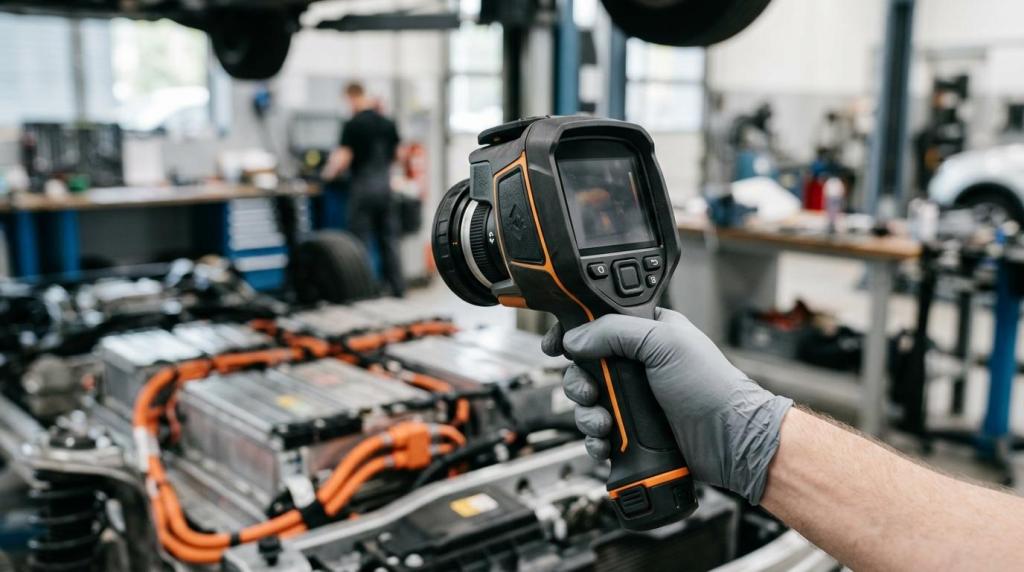
Step 3 is physical and safety inspection. This can include cooling fan inspection, duct cleanliness, connector condition, insulation checks, and thermal imaging. Common misconception: a code scan alone is a battery test. It is not. It tells you where to look, not whether the pack is still healthy enough to keep.
How can you prepare your hybrid before the appointment?
You can make hybrid battery service faster and more accurate by arriving with the fault intact and the symptoms documented. Toyota, Lexus, and Honda systems store useful fault history, and clearing codes before the visit often removes the best clues.
Step 1 is to record what changed. Note fuel economy, warning messages, when the engine runs more, whether the battery gauge jumps, and whether the issue happens only in heat, traffic, or hills.
Step 2 is to avoid self-resetting the problem. Do not disconnect the 12V battery or use a cheap scanner to erase codes unless the vehicle is unsafe to drive. Pro tip: take a photo of the dash warning and the odometer when it appears.
Step 3 is to make the car easy to inspect. Remove luggage near the battery intake area if your model uses a rear-seat or boot-side cooling path. In a tropical city like Townsville, lint, pet hair, and dust can reduce airflow and push battery temperature up.
Is dealer hybrid battery service better than an independent specialist?
Dealer service is better for warranty continuity and OEM procedures, while an independent specialist is often better for older cars and repair-first diagnosis. Mike Carney Toyota and Townsville Hybrid and EV Repairs sit at opposite ends of that decision.
Choose a dealer if your car is still within manufacturer battery coverage, needs recall or software campaign work, or requires genuine parts with official brand records. Toyota Australia’s hybrid battery coverage on eligible vehicles includes 5 years with unlimited kilometres, and Lexus offers 5 years plus possible extension through annual battery health checks.
Choose a specialist independent if the car is older, the problem may be localised, or you want more than a default replacement pathway. The trade-off is simple. Dealers are strongest on authorisation and brand systems. Specialists are often stronger on repairability, detailed testing, and cost-sensitive decision making.
If warranty matters, dealer first. If diagnosis depth matters more, specialist first. If both matter, ask the independent workshop to identify likely fault scope before you decide whether a dealer claim path is the better next step.
Should you repair, recondition or replace a hybrid battery?
Repair, recondition, and replace are different strategies, not marketing synonyms. A Prius or Camry Hybrid may suit repair when degradation is localised, while a broadly aged pack usually makes replacement the cleaner long-term option.
Repair usually means correcting a specific problem. That could be a fan blockage, corroded connection, sensor fault, electronic module issue, or a targeted module-level battery fault. It works best when the rest of the pack still tests within a usable range.
Reconditioning is broader and more variable. It can mean balancing modules, restoring usable performance, or replacing selected weak modules in a used pack. Common misconception: reconditioning makes an old pack “like new”. It does not. It may improve balance and drivability, but its long-term result depends on how evenly the remaining modules have aged.
Replacement is the right answer when the pack shows widespread capacity loss, repeated imbalance, insulation faults, or heat damage. If test data shows several sections failing together, then a repair may only delay the next failure. If the fault is narrow and verified, then a targeted fix can be sensible.
How much does hybrid battery service usually cost?
Hybrid battery service cost varies widely because the job can range from a diagnostic session to a full pack replacement. In Townsville, most providers do not publish battery pricing, so quote quality matters more than headline numbers.
The total usually depends on six things: battery chemistry, pack size, labour access, fault depth, parts path, and warranty type. A cooling clean and test is a different job from module replacement. An OEM dealer battery is a different path from an aftermarket or rebuilt unit.
Ask for a quote that separates the work stages. That makes apples-to-apples comparison possible.
- Diagnostic fee: scan, live data review, and initial fault confirmation
- Battery health testing: load behaviour, voltage spread, temperature, insulation where needed
- Cooling system work: fan cleaning, duct inspection, airflow-related repairs
- Repair option: module or electronic work if the fault is proven localised
- Replacement option: OEM, remanufactured, or aftermarket pack with warranty terms
- Turnaround estimate: parts lead time, labour time, and re-test process
A low quote can cost more later if it skips testing. A higher quote can be the better value if it prevents replacing the wrong component.
What tests matter most for hybrid battery health and safety?
The most useful tests are the ones that show how the battery behaves, not just what code it stored. FLIR thermal imaging, live voltage data, and insulation checks tell a much fuller story than a basic OBD printout.
A sound process usually follows accepted high-voltage safety practice, and in Australia that means work methods consistent with standards like AS/NZS 5732:2022 when relevant to EV and hybrid battery handling.
- Voltage spread: how evenly blocks or modules hold and deliver energy under load
- Internal resistance: whether one section is working harder and heating faster than the rest
- Temperature behaviour: whether a hot spot, blocked fan path, or poor connection is developing
- Insulation integrity: whether the high-voltage system is safely isolated from the vehicle body
- Cooling performance: whether fans, ducts, and intake paths are keeping pack temperature stable
Pro tip: ask the workshop for the result pattern, not just the code list. If they can explain spread, heat, and load behaviour, you are getting a real diagnostic.
Can you drive with a hybrid battery warning light?
You should treat a hybrid battery warning light as urgent, not optional. Toyota and Lexus hybrids may still drive for a while, but continued use can push heat, imbalance, and limp-mode risk higher.
If the car still moves normally, you may be able to drive it carefully to a workshop. If power is limited, the engine races unexpectedly, or the warning is paired with stop-driving messages, towing is the safer call. Check the owner manual for your exact model because warning logic varies.
The risk is not only the battery itself. When the pack cannot support normal hybrid operation, the petrol engine can run far more often, charging behaviour can become erratic, and the system may protect itself by reducing performance. If the battery is already overheating, extra driving can turn a manageable repair into a much larger bill.
Common misconception: if the warning disappears after a restart, the problem is gone. In many hybrids, intermittent faults still leave a stored history, and that history is exactly what a good workshop needs to catch the issue early.