
A hybrid battery is built to work hard, cycling between charge and discharge thousands of times while heat rises and falls in the background. When the cooling system is doing its job, most drivers never notice it. When it is not, the battery can start acting tired long before the pack is truly at the end of its life.
That is why battery cooling faults deserve more attention than they usually get. Reduced electric assist, warning lights, poor fuel economy, slow charging in plug-in models, or a battery fan that suddenly sounds far too busy can all point to a thermal management issue. A careful diagnosis should check airflow, temperature data, sensors, and battery behaviour before anyone jumps straight to full pack replacement.
How a hybrid battery cooling system works
Hybrid and EV batteries are happiest within a controlled temperature range. Research from the National Renewable Energy Laboratory has shown that battery temperature, and just as importantly temperature uniformity, affect performance, lifespan, and safety. When temperatures stay even across the pack, the battery can deliver power more consistently and age more slowly.
That evenness matters because one hot area inside a pack can behave very differently from the rest. A few modules or cells running warmer than their neighbours may show weaker voltage behaviour, higher internal resistance, and faster degradation. The result is not always a dramatic failure. Often, it starts as a slow decline in performance.
Many hybrids use air cooling. Cabin air is drawn through an intake, pushed by an HV battery cooling fan, then routed through ducts across the battery. This design is common because it is relatively simple and light. Yet air cooling has a lower heat transfer coefficient than liquid cooling, which makes it harder to keep temperatures uniform across the whole pack.
Some newer hybrid, plug-in hybrid, and EV systems use liquid cooling. Coolant moves through channels or plates around the battery, pulling heat away more effectively. Liquid systems can control temperature more precisely, though they also add pumps, hoses, valves, and other components that need testing when faults appear.
Research published through SAE has noted that lithium-ion packs perform best in a fairly narrow band, often around 25°C to 40°C. Once temperatures climb too far above that, performance and lifespan can fall away more quickly.
Hybrid battery cooling problem symptoms
Cooling problems are not always obvious. A battery does not need to overheat severely to show trouble. Even moderate temperature rise, or uneven temperature spread across the pack, can make a hybrid feel less responsive and less efficient.
In daily driving, the battery management system will usually protect the pack before serious damage occurs. That protection can look like reduced battery assist, lower charging acceptance, rapid state-of-charge swings, or power limits during hot weather.
Common warning signs include:
- Battery fan running loudly
- Reduced electric assist
- Lower fuel economy
- Hybrid warning lights
- Slow charging in plug-in models
- Power limits on hills
- Performance worse in summer traffic
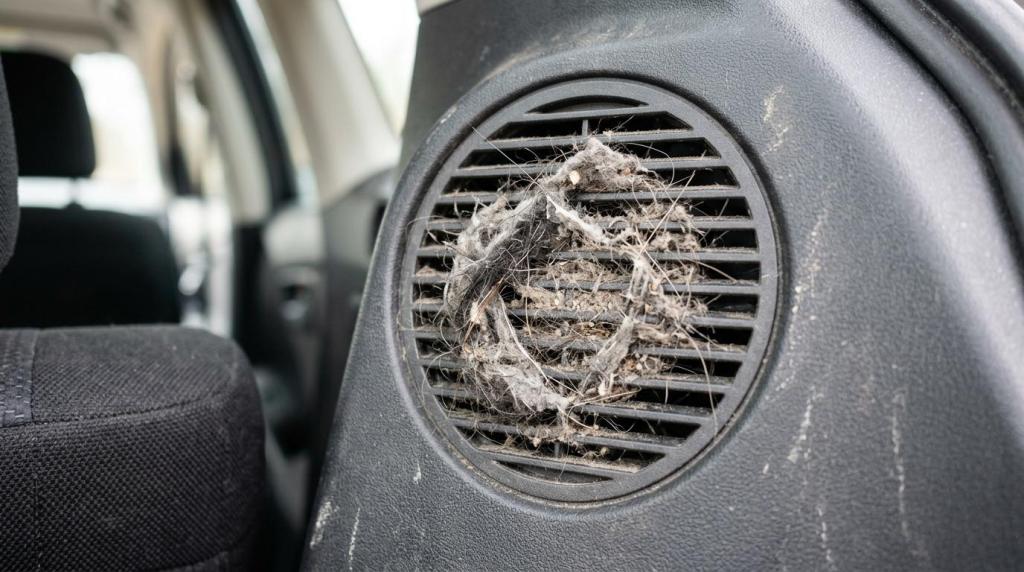
- Rear seat or boot vent area blocked by dust or pet hair
These symptoms often come and go with ambient temperature, traffic conditions, and how hard the battery is working. A car may feel almost normal on a cool morning, then struggle badly after a long drive in stop-start heat.
Common hybrid battery cooling system faults
Some hybrid battery cooling issues are simple airflow problems. Others point to deeper battery or control-system faults. The smart approach is to separate what is causing extra heat from what is failing to remove that heat.
A well-known service issue on some vehicles is dust, lint, and debris build-up in the battery cooling fan and ducts. Regulatory service information has described cleaning the fan blades, module, and ducting when contamination restricts airflow. That is especially relevant in cars that carry pets, spend time on dusty roads, or have rear cabin vents partly blocked by luggage or seat covers.
Typical fault sources include:
- Blocked airflow paths: Dust, lint, pet hair, or debris can clog the intake vent, fan, or ducts and reduce the volume of cooling air reaching the battery.
- Fan or fan control faults: A weak motor, damaged wiring, relay issue, or control problem can stop the fan from reaching the speed the battery needs.
- Temperature sensor faults: If the battery management system receives incorrect temperature readings, it may cool too late, cool too aggressively, or log misleading fault codes.
- Duct leaks or poor sealing: Air that escapes before it reaches the pack leaves hot spots inside the battery.
- Internal battery resistance rise: Ageing modules generate more heat under load, which can make a cooling issue seem worse than it first appears.
- Liquid cooling faults: Low coolant flow, leaks, trapped air, pump failure, or a blocked heat exchanger can upset battery temperature control.
This is why the phrase “battery failure” can be too broad. In many cases, the battery pack is not the only thing that needs attention. Sometimes the repair is cleaning, fan service, duct repair, sensor replacement, or an electronic module fault that has been affecting thermal control.
Why battery cooling faults are often mistaken for battery failure
Heat changes how a battery behaves. When temperatures rise, voltage response can shift, internal resistance can climb, and module performance can become uneven. The battery management system may then limit charge and discharge current to protect the pack. To the driver, that can feel exactly like a worn-out battery.
The overlap in symptoms is what causes confusion. A pack with a blocked cooling fan may show weak performance. A pack with ageing modules may also run hotter than normal. A sensor fault may report a thermal issue that is not really there. Without live data, it is easy to replace the wrong part.
Here is a practical way to think about it:
| Vehicle symptom | Possible cooling-related cause | What should be checked |
|---|---|---|
| Hybrid warning light | Fan issue, sensor error, airflow restriction | Fault codes, fan command, actual fan operation |
| Reduced electric assist | Hot battery limiting output | Battery temperature, temperature spread, current limits |
| Rapid charge level swings | Uneven module temperature or weak modules | Live battery values, voltage spread, cell balance |
| Slow or interrupted charging | Battery overheating during charge | Cooling activity during charging, sensor data |
| Battery fan very loud | Blocked intake, dirty fan, control fault | Vent inspection, duct condition, fan cleanliness |
| Poor hot-weather performance | Thermal protection reducing power | Temperature history, state of health, module behaviour |
The key point is simple: poor cooling can imitate a bad battery, and a bad battery can create extra heat that looks like poor cooling. Good diagnosis needs to sort those two paths apart.
Hybrid battery diagnosis before battery replacement
Replacing a hybrid battery pack is a major decision, so diagnosis should be data-led rather than symptom-led. A specialist workshop will usually start with fault codes, then move straight into live battery values. That means looking at battery temperatures, temperature spread across sensors, current flow, voltage variation, and how the pack behaves under load.
Battery temperature and live battery values
Live data often tells the real story much faster than guesswork.
If one section of the battery is running hotter than the rest, or if temperature climbs too quickly during charge and discharge, the fault path becomes clearer. Technicians may also compare the battery’s state of health, charge acceptance, and discharge response with the temperature pattern. A fan running more than normal can itself be a warning sign that the battery management system is seeing abnormal conditions.
HV battery cooling fan and duct inspection
Physical inspection matters just as much as scan data. The intake vent needs to be clear. The fan should be clean and able to move air properly. Ducts need to be fitted correctly, free from splits, and properly sealed so the airflow reaches the battery rather than escaping into the cabin or trim space.
On air-cooled systems, contamination is common enough that cleaning can be a genuine repair, not just routine housekeeping. A fan clogged with dust and lint cannot do the same job as a clean one, even if the motor still spins.
Cell balance and state of health checks
Cooling faults and battery ageing often overlap, so voltage behaviour across modules or cell groups is worth close attention. A pack with poor cell balance may produce more heat under normal driving. A pack with one or two weak areas may show a larger temperature spread than expected. Electronic control modules can also add confusion if sensor data or fan commands are wrong.
That is why a specialist hybrid and EV repair centre will usually test the cooling system and the battery pack together, not as separate issues. The aim is to see whether the battery is hot because the cooling system is weak, or whether the cooling system is working hard because the battery itself has developed weak modules.
Air-cooled and liquid-cooled battery systems compared
Air-cooled hybrid battery systems are common and can be very effective when clean and correctly designed. They are lighter and less complex, which is one reason they suit many hybrids so well. Their trade-off is that they are more sensitive to blockage, cabin-air temperature, and temperature uniformity across the pack.
Liquid-cooled battery systems control heat more precisely and usually keep temperatures more even. That helps performance and long-term durability, especially in larger packs with higher power demand. The trade-off is added complexity. Pumps, coolant passages, valves, sensors, and potential leaks all become part of the diagnostic picture.
Neither design is automatically “better” in every vehicle. What matters most is whether the system fitted to that car is working as intended.
When hybrid battery cooling service should not wait
A hybrid battery cooling issue is worth checking early, especially if the symptoms are changing quickly. Heat speeds up battery degradation, so a small airflow fault left alone can turn into a bigger battery repair later.
Pay attention if the battery fan suddenly becomes noisy, the vehicle loses electric assist in warm weather, charging becomes inconsistent, or a hybrid warning light appears after repeated hot runs. Reduced performance in these moments is often the battery management system trying to protect the pack.
There is also a safety angle. Serious overheating can increase risk inside any high-voltage battery, and protection systems are designed to prevent that. Still, protection works best when faults are identified early rather than pushed aside.
A careful inspection of the cooling system, battery temperatures, and live pack data can often give a much clearer answer than replacing parts on suspicion. For hybrid and EV drivers, that usually means a more accurate repair path, a healthier battery, and a vehicle that feels right again in the conditions where it used to struggle most.