
When an EV starts showing shorter range, slower charging, warning lights, or uneven performance, many drivers want one simple answer: is the battery still healthy? The reality is a bit more technical, and far more useful, than a single number on a screen.
A proper EV battery health check looks at the battery pack from several angles. It combines data readings, temperature behaviour, cell performance, fault history, and a physical safety review. That matters because battery condition is never defined by one metric alone. A pack can show an acceptable charge level on the dash and still have hidden imbalance, rising resistance, or thermal issues that affect real-world performance.
Why an EV battery health check is more than a dashboard percentage
The dashboard gives helpful information, but it does not tell the whole story. State of charge shows how full the battery is at that moment. It does not show how much of the battery’s original usable capacity remains, how evenly the cells are working together, or whether the pack is generating more heat than expected.
Research bodies such as NREL have pointed out that battery health assessment is multi-factor. Capacity, resistance, temperature response, and broader diagnostic measurements all contribute to a meaningful view of battery condition. That is why a strong battery check is based on evidence from several tests rather than a quick glance at range estimates.
In practical terms, an EV battery health check is often designed to answer questions like these:
- Is the battery ageing at a normal rate?
- Is a warning light linked to a genuine pack issue?
- Are certain cells or modules drifting out of balance?
- Is the battery management system recording faults or irregular behaviour?
- Is heat affecting performance or long-term battery life?
State of health and usable capacity in EV battery testing
One of the core parts of any battery health check is state of health, often shortened to SOH. This is usually expressed as a percentage of the battery’s original usable capacity. If a battery could once deliver 100 per cent of its designed usable energy and now delivers less, that reduction becomes part of the health picture.
This sounds simple, yet it is not just a matter of reading one stored value. Capacity can be estimated through battery management system data, test conditions, charging and discharge behaviour, and how the vehicle performs under load. A quality assessment tries to separate temporary influences, like temperature or driving style, from actual degradation.
Usable capacity matters because it affects the things drivers notice first:
- Driving range
- Charging confidence
- Performance consistency
- Resale confidence
A healthy result does not always mean “like new”. It often means the battery is performing in a way that matches its age, kilometres, and use history. That is a very different question from whether it is perfect.
Internal resistance and impedance in EV battery diagnostics
Another major piece of the puzzle is internal resistance, sometimes discussed alongside impedance. These measurements help show how easily energy moves through the battery. As batteries age, resistance can rise. When that happens, the pack may create more heat during charging or acceleration, and available performance can begin to change.
NREL has described internal resistance or impedance as a useful proxy indicator for internal battery conditions that affect both capacity and heat generation. In plain terms, it helps reveal stress inside the battery even when the pack still appears functional.
A specialist health check may review resistance or related electrical behaviour to spot patterns that point to:
- Age-related degradation: gradual wear across the full pack
- Cell or module weakness: one area behaving differently from the rest
- Heat-related stress: higher resistance linked to thermal strain
- Charging concerns: signs that the battery is less willing to accept charge efficiently
Some advanced diagnostic methods can measure battery state rapidly using impedance-based data. That does not replace every other test, though. It works best as part of a broader assessment.
Cell balance and voltage spread across the battery pack
An EV battery pack is made up of many cells or modules working together. For the pack to perform properly, those cells need to stay reasonably balanced. If one group of cells starts drifting away from the others, the battery management system may need to intervene more often, and overall pack performance can suffer.
Cell balance is often checked by comparing voltage readings across the pack. A technician may look at how closely matched the cells are at rest, during charge, or under load. A small difference may be normal. A widening spread can point to ageing, module weakness, or a fault developing.
This is one reason a battery health check is much more informative than a range estimate. Range can change with weather, driving style, terrain, and accessory use. Cell balance gives a more direct view of what is happening inside the pack.
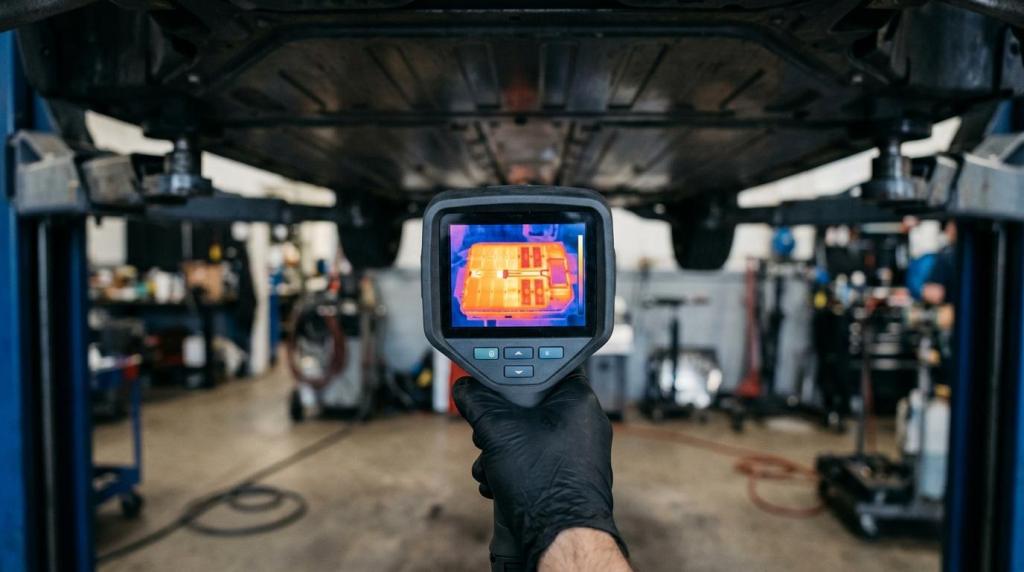
Battery temperature and thermal behaviour during EV battery checks
Temperature has a strong influence on battery performance, efficiency, and lifespan. Even small departures from ideal conditions can affect how much energy the battery can deliver and how quickly it degrades over time. NREL has highlighted just how strongly temperature can alter battery results.
That is why thermal behaviour is a key part of a worthwhile battery health check. The goal is not simply to see whether the pack is hot or cold on one occasion. The goal is to see whether temperatures are even, expected, and stable across the battery during normal operating conditions.
A thermal review can include:
| Battery check item | What is being assessed | Why it matters |
|---|---|---|
| Pack temperature readings | Overall battery temperature | Confirms the pack is operating within expected limits |
| Temperature differences between modules | Differences between sensors or modules | Helps identify uneven cooling or localised stress |
| Heat under load | Temperature rise during use or testing | Can reveal resistance-related issues |
| Cooling system behaviour | Response of fans, pumps, or coolant circuits where fitted | Shows whether the battery can control heat properly |
| Thermal fault history | Stored temperature-related events | Points to patterns, not just one-off readings |
A battery that runs hotter than expected, or shows unusual temperature differences between modules, may need further diagnosis. It does not always mean major battery failure, though it should not be ignored.
Battery management system data in EV battery health reports
The battery management system, or BMS, is one of the most valuable sources of battery information. It monitors voltage, current flow, temperature inputs, charging behaviour, and cell balance across the pack. Reading that data with the right tools can show far more than the dash display ever will.
A proper health check may include stored fault codes, live battery values, module communication status, and balancing activity. If the BMS has been compensating for weak cells, limiting charge rates, or recording thermal faults, those details can help explain what the driver has been experiencing.
After a paragraph of testing and data collection, the BMS review often focuses on a few practical questions:
- Fault memory: Are there battery-related codes, even if the warning light is intermittent?
- Live values: Do cell voltages, current readings, and sensor data look normal in real time?
- Balancing activity: Is the system working harder than expected to keep cells even?
- Communication integrity: Are modules and control units reporting consistently?
This part of the process is especially useful when symptoms are vague. Reduced range, uneven charging, or occasional warnings may all look similar from the driver’s seat, yet the BMS can help separate one issue from another.
Physical inspection and safety checks for the EV battery pack
Data matters, but so does the battery’s physical condition. A strong health check includes visual and safety-related inspection steps, because electrical readings alone cannot reveal every risk.
Depending on the vehicle and access available, a battery inspection may look for casing damage, impact signs, corrosion, moisture intrusion, damaged connectors, or issues with mounting points and high-voltage components. If a vehicle has had road debris impact, previous repair work, flood exposure, or underbody damage, the physical review becomes even more important.
This part of the process can also include checks around high-voltage safety isolation, cable condition, and signs of abnormal wear in related components. A battery pack can appear acceptable in software while still showing external warning signs that deserve attention.
Charge acceptance, discharge behaviour, and load response
Some battery concerns only show up when the pack is asked to do real work. That is where charge acceptance and discharge behaviour come in. These checks help show how the battery responds when energy is flowing in or out, rather than when it is simply sitting still.
NREL has noted that a full rendering of battery state of health could include capacity, internal resistance, self-discharge, charge acceptance, discharge capability, and cycle-related data. Not every workshop-level check will measure all of these in laboratory style, yet the principle is useful: the more evidence gathered from actual behaviour, the clearer the picture becomes.
A battery may still charge to a normal percentage while showing slower acceptance at certain points, unusual voltage sag under load, or a tendency to heat up faster than expected. Those details help explain why some vehicles feel different to drive long before a major fault appears.
What the EV battery health check results can tell a driver
Once the data, thermal readings, BMS information, and physical checks are brought together, the report starts to become genuinely useful. Instead of a vague sense that “the battery seems weaker”, the driver gets a clearer picture of what is normal, what is changing, and what needs attention now.
A good battery health report can help with decisions around:
- Buying a used EV
- Planning long-distance driving
- Responding to warning lights
- Comparing current performance with previous results
- Deciding whether repair, monitoring, or no action is the right next step
This is where specialist testing has real value. Trained hybrid and EV technicians with the right equipment can read deeper battery data, test electronic modules properly, and separate normal ageing from faults that need repair. That level of detail is especially important for owners who want confidence in the car they already have, not just a generic pass-or-fail answer.
For many EV drivers, the most reassuring outcome is not a perfect score. It is a report that shows the battery is ageing normally, staying balanced, managing temperature well, and operating without signs of a developing fault. And if there is an issue, finding it early creates far better options than waiting for a minor warning to become a major repair.