
Best Tests for EV Battery Health

EV battery evaluation

EV battery evaluation is the process of measuring how much useful life, safety margin and performance remains in an electric vehicle battery pack. It matters because battery condition affects driving range, charging speed, resale value and, in some cases, warranty eligibility. The main problem it solves is uncertainty: a dashboard estimate or clean fault scan rarely tells you whether the pack is healthy, imbalanced or hiding an expensive module fault. A proper evaluation turns that guesswork into a repair or ownership decision based on evidence.

What is EV battery evaluation and what does it actually measure?

Yes. Proper EV battery evaluation measures usable capacity, cell balance, heat behaviour and fault history, not just the range figure on the dash. In Tesla and Nissan systems, technicians look at state of health, state of charge, voltage spread, internal resistance and battery management system data together.

State of health, or SoH, is usually expressed as a percentage of original usable capacity. State of charge, or SoC, is only the battery’s current fill level. Those are not the same thing, and that mix-up is a common reason owners misread battery condition.

A strong evaluation also checks whether cells stay balanced under load and whether temperatures remain even across the pack. If one module sags earlier than the others, the battery can behave like an old pack even when the average SoH still looks acceptable.

When should you book an EV battery health test?

Yes. Most EVs, from MG to Tesla, benefit from a battery health check every 12 months or about 15,000 to 20,000 km. Earlier testing is smart if range drops suddenly, charging slows without explanation, or a warning light appears.

Routine timing matters because battery faults often begin as small imbalances or cooling issues. Those can be corrected earlier with balancing, software updates or module-level work. Leave them long enough and the same issue can push you towards pack removal and much higher labour costs.

A good time to test is also before buying a used EV, after a collision, after water ingress, or after repeated overheating events.

  • Range loss: A drop of more than about 10 to 15 per cent that cannot be explained by weather, tyres or driving style
  • Charging change: Slower DC charging, repeated charge interruptions, or a car that stops well short of its usual target
  • Warning behaviour: Battery, isolation or high-voltage faults stored in the BMS
  • Risk events: Flood exposure, underbody impact, rodent damage or coolant leaks

What EV battery evaluation services are the best options in Townsville?

Yes. The best option depends on whether you need a pre-purchase certificate, a warranty trail or actual pack repair. In Townsville, Townsville Hybrid and EV repairs stands out for specialist battery and module work, while dealer and certificate-based services suit narrower jobs.

If the goal is real fault diagnosis, choose a workshop that can do more than read codes. Cell-level testing, thermal imaging, high-voltage isolation checks and module repair capability matter far more than a generic scan tool.

  1. Townsville Hybrid and EV repairs
    Best for specialist diagnosis, EV battery evaluation, electronic module repair and hybrid or EV battery service where pack-level evidence is needed before repair decisions.

  2. Brand dealer service department
    Best for factory software campaigns, warranty records and model-specific service bulletins from brands such as Tesla, Hyundai or Nissan.

  3. Independent used-car inspection or certificate provider
    Best for quick health certification, including flash-test style reports used in pre-purchase checks and resale.

  4. General workshop with EV scan access
    Best only for basic code reading or 12 V checks. It is rarely enough for cell imbalance, thermal faults or insulation concerns.

How is an EV battery evaluation performed safely?

Yes. Safe battery evaluation starts with isolation and verification, not with pack disassembly. Under AS/NZS 5732:2022, trained technicians use PPE, disable high-voltage systems and confirm the vehicle is safe before tools from Launch or Fluke touch the circuit.

Step 1: The vehicle is powered down, the 12 V system is checked, and high-voltage isolation procedures are followed. That may include waiting for capacitors to discharge and proving zero energy at the right test points.

Step 2: The workshop checks the obvious but important items: pack casing, connectors, cooling hoses, corrosion, impact damage and signs of moisture. Pro tip: many serious battery faults start outside the cells, especially around cooling and connection points.

Step 3: Only then does diagnostic work begin. The technician connects scan tools, insulation testers, thermal cameras or a battery station. A common misconception is that opening the battery pack is the first step. In a well-run workshop, it is one of the last.

OBD scan data or flash testing: which gives a better battery health result?

Both matter. An OBD-based scan from Autel or Launch is faster for reading fault codes, live data and manufacturer counters, while a flash test such as Aviloo can give an independent battery health estimate in minutes through the CAN network.

The trade-off is scope. A scan tool tells you what the car already knows. That is useful for BMS faults, charge logs and software issues. A flash test can add an outside view of pack condition and is especially useful for used-car screening.

Neither should be treated as the whole story. If a scan is clean but the car still loses range, then you need physical checks like thermal imaging, load behaviour and, if required, module testing. If a flash test gives a poor score, then workshop verification should follow before major parts are ordered.

How do technicians test capacity, balance and internal resistance?

Yes. Capacity and resistance testing are the closest thing to a battery fitness test. Using equipment such as SmartSafe CE39 or Launch ELP400, a workshop measures how the pack or modules behave during controlled charging, discharging and rest periods.

Capacity testing compares usable energy against the battery’s original rating or a known healthy baseline. If the battery should deliver close to a given kilowatt-hour figure and falls well short under controlled conditions, that points to real degradation rather than a display error.

Balance testing looks at voltage differences between cells or modules. Persistent gaps of a few tens of millivolts under matched conditions can signal a weak cell group. Internal resistance testing checks how hard it is for current to move through the cells. As batteries age or suffer heat stress, resistance tends to rise.

This matters because range loss is not the only symptom. High resistance can also mean more heat, weaker acceleration and slower charging. If one module heats up and sags under load while others remain stable, then repair attention narrows quickly.

Thermal imaging or charge-discharge bench testing: when is each better?

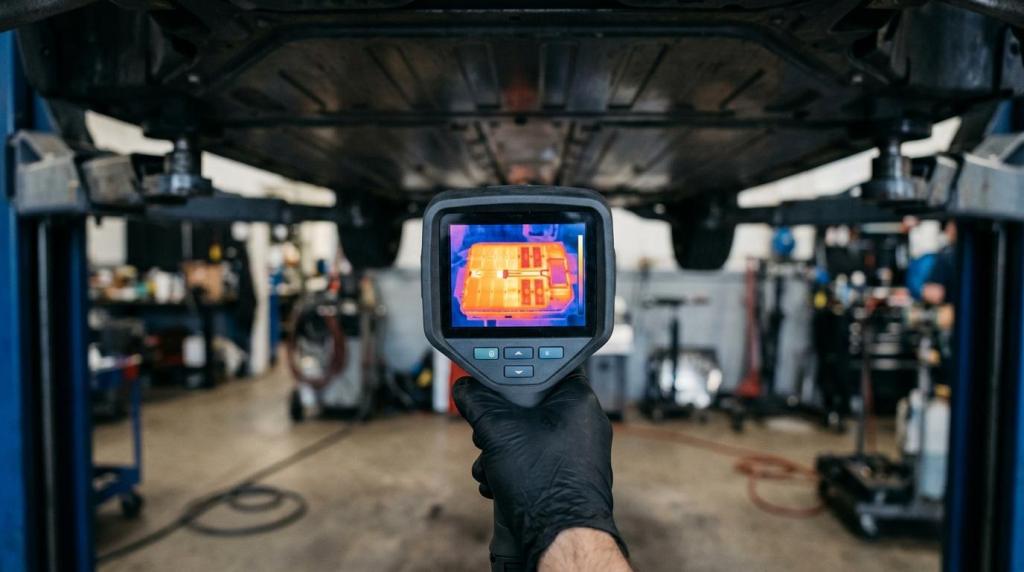
Both are useful. FLIR thermal imaging is quicker and non-invasive for spotting hot modules, cable resistance and cooling problems, while bench or controlled load testing is stronger for proving lost capacity and voltage sag over time.

Thermal imaging is ideal when the fault appears during charging, after driving, or in hot North Queensland conditions. It can reveal abnormal heat patterns that a simple scan will miss. That makes it excellent for early detection and safety screening.

Bench testing takes longer and may require deeper access, but it answers a different question: how much usable performance is actually left? If you need evidence for repair planning, resale negotiation or module replacement, load-based data is usually stronger than a heat map alone.

If heat is uneven, then capacity loss often follows. If heat is uniform but range is poor, then software, calibration or general ageing may be the real cause.

How should LFP and NMC batteries be evaluated differently?

Yes. LFP and NMC packs need different test logic because their chemistry behaves differently. BYD and Tesla have both used LFP in some models, while many Hyundai, Kia and earlier Tesla packs rely on NMC or NCA variants.

LFP batteries are generally more tolerant of full charge and have a flatter voltage curve. That flatter curve makes SoC estimation harder, so the BMS may need a full charge event from time to time to calibrate accurately. NMC and NCA chemistries are more sensitive to heat and frequent extremes, so technicians often test them within a mid-range SoC window such as 20 to 80 per cent.

A common mistake is assuming every lithium battery should be treated the same. If a workshop applies the same test window and the same charging expectations to both chemistries, the result can be misleading.

That also affects owner advice. An LFP vehicle may benefit from occasional 100 per cent charging as instructed by the manufacturer. An NMC vehicle usually benefits from avoiding that as a daily habit.

How can you prepare your EV before a battery evaluation?

Yes. A little preparation improves the quality of the test. For BMW and Tesla owners alike, the best approach is to arrive with clear symptoms, recent charging history and the SoC requested by the workshop.

Step 1: Record what has changed. Note recent range loss, charging issues, warning lights, weather conditions and whether the problem occurs on AC, DC or both. If the fault appears only after highway driving or only at 80 per cent SoC, say so.

Step 2: Follow the requested charge window. Many workshops prefer 20 to 80 per cent for NMC testing, while some LFP evaluations may need a fuller battery. Pro tip: do not top up right before the visit unless asked. A hot battery can skew results.

Step 3: Bring service history and do not clear codes. If the car has had software updates, battery work, crash repairs or charging equipment issues, that context matters. Erasing warning codes before arrival can remove the clues technicians need.

How do you read an EV battery health report and act on it?

Yes. A useful battery report converts raw data into repair choices. In reports from Aviloo, Launch or an OEM tool, start with SoH, then check cell spread, thermal behaviour, charge acceptance and any insulation or BMS faults.

Step 1: Look at the big numbers first. SoH above 90 per cent is strong for a used EV. Around 80 to 90 per cent is common depending on age and kilometres. Below 80 per cent can affect range enough to change how the car fits your needs, and in some models it is close to warranty discussion territory.

Step 2: Read beyond SoH. A battery can show decent SoH but still have a repairable imbalance or hotspot. If the report flags one weak module, then module repair may be more sensible than pack replacement. If insulation faults or widespread temperature spread appear, the job is more serious.

Step 3: Match the result to the right action.

  • Monitor: Stable SoH, low cell variance, no heat issues
  • Correct: Software update, balancing, cooling repair or connector repair
  • Repair: Module or electronic control work where one area is failing
  • Replace: Broad pack degradation, repeated isolation faults or severe damage

A good report should tell you what to do next, not just hand you a percentage. That is the difference between a quick battery check and a true EV battery evaluation.

Signs Your Hybrid Battery Needs Testing

hybrid battery testing

A hybrid battery rarely fails without leaving clues first. The challenge is that the clues can look small at the start: a mild drop in fuel economy, a battery gauge that behaves oddly, or an engine that seems busier than it used to be. Many drivers put these changes down to age, weather, or traffic. Sometimes that is true. Sometimes it is the first sign the battery pack needs proper testing.

For hybrid owners, early testing is one of the smartest ways to avoid bigger repair costs. A battery issue caught early may point to imbalance, cooling trouble, or a weak module before the entire pack is affected. That is especially relevant in North Queensland, where heat places extra stress on high-voltage systems over time.

Hybrid battery warning signs that should not be ignored

Hybrid vehicles are very good at hiding gradual battery decline. The car still starts. It still drives. It may even feel mostly normal for weeks or months. Yet the battery can already be losing capacity, running hotter than it should, or struggling to hold charge evenly across the pack.

The most useful question is not, “Has the battery failed?” It is, “Has the battery changed?”

Warning sign What it can suggest Why testing matters
Fuel economy drops suddenly Reduced battery support Confirms whether the petrol engine is compensating for battery weakness
Battery gauge swings up and down fast Cell imbalance or low capacity Shows whether blocks are charging and discharging evenly
Engine runs more often at low speed Battery not contributing enough Helps separate battery faults from normal operating changes
Sluggish acceleration Low battery output under load Reveals whether voltage drops too far during demand
Hybrid warning light or check system message Fault codes stored in control modules Points to the exact area needing attention
Loud battery fan or unusual rear-cabin noise Heat build-up or cooling issues Checks whether airflow, fan function, or battery temperature is out of range

A single symptom does not always mean the pack is failing. A pattern, though, deserves attention. If fuel use is up, the engine cuts in more often, and the battery display seems erratic, battery testing becomes far more than a precaution.

Sometimes the first sign is simply a feeling that the car is not as smooth as it used to be.

Common hybrid driving symptoms linked to battery problems

Many hybrids develop battery issues gradually, and the driving feel changes before a dashboard light appears. Owners often notice that low-speed electric operation becomes shorter. The car may leave the driveway on electric power, then bring the engine in almost immediately. In stop-start traffic, that behaviour becomes more obvious.

Another common sign is hesitation under acceleration. The car may feel flat off the line or less responsive when climbing hills. Because a hybrid relies on battery assistance during these moments, a weak pack can leave the petrol engine doing more of the heavy lifting. The result is a vehicle that feels heavier, slower, and less refined.

Then there is state-of-charge behaviour. If the battery level display jumps from nearly full to nearly empty in a short period, or never seems to settle, it can point to imbalance inside the pack. Healthy battery operation is not perfectly linear, but it should still look stable and believable.

After watching these patterns for a few days, drivers often report the same cluster of changes:

  • lower fuel economy
  • frequent engine start-up
  • weak electric assist
  • rapid charge gauge swings
  • warning lights or reduced-power messages

Those symptoms do not confirm the exact fault. They do tell you the battery is worth testing with specialist equipment rather than guesswork.

Hot weather, short trips, and hard use can speed up hybrid battery wear

Battery age matters, though operating conditions matter just as much. Heat is one of the biggest influences on battery life, and that makes local climate part of the story. In hot conditions, the battery cooling system has to work harder to keep temperatures stable. If airflow is restricted or the fan is clogged with dust, the battery can spend too much time above its ideal operating range.

Short trips also add stress. On repeated brief drives, the battery may cycle often without reaching a stable thermal state. Add heavy traffic, frequent acceleration, and constant regenerative braking, and the battery pack faces repeated load changes all day.

Storage habits matter too. A hybrid that sits unused for long periods can drift into an unhealthy state of charge. At the other end of the scale, a vehicle used heavily in urban traffic or under constant load may age faster than expected, even if the odometer is not especially high.

This is why battery testing should be based on symptoms, age, and operating conditions, not kilometres alone.

What professional hybrid battery testing usually includes

A proper battery test goes well beyond checking whether a warning light is present. Specialist workshops use hybrid-capable diagnostic tools to read battery data from the vehicle’s control systems, then compare that data with real electrical measurements and live operating behaviour.

At a workshop focused on hybrid and EV systems, the test typically starts with a scan for fault codes and battery management data. From there, technicians look at voltage differences between sections of the pack, temperature readings, charge behaviour, insulation condition, and cooling system performance. If needed, they also test under load to see how the battery behaves when the vehicle is asked to deliver power.

Townsville Hybrid and EV Repairs uses specialised equipment for hybrid and EV testing, along with trained staff who work specifically with these systems. That matters because a high-voltage battery issue can be confused with problems in the cooling system, the 12-volt battery, wiring, or electronic modules. Accurate diagnosis saves time and avoids replacing parts that are not actually at fault.

A typical test process may include:

  • Fault code scan: reading hybrid system codes, freeze-frame data, and live battery parameters
  • Voltage analysis: checking pack voltage and differences between modules or blocks
  • Load testing: seeing how the battery responds under acceleration demand or controlled discharge
  • Cooling system inspection: checking fan operation, airflow paths, filters, and battery temperature behaviour
  • Insulation and safety checks: confirming the high-voltage system is electrically safe
  • Related system checks: reviewing the 12-volt battery, wiring, and key electronic modules

That depth is why specialist testing is useful even when the car still drives normally. You can have a battery problem long before the vehicle becomes undriveable.

Hybrid battery testing can lead to more than one repair path

Not every test result ends with a full battery replacement. In some cases, the issue is linked to battery cooling, connection corrosion, or an electronic module fault. In others, one area of the pack may be significantly weaker than the rest, which can open the door to more targeted repair work.

For drivers, that is a positive outcome. Testing gives a clearer picture of the battery’s real condition and helps separate temporary problems from structural battery decline. If the pack still has useful life left, a workshop may recommend monitoring, cooling system service, or further evaluation rather than immediate replacement.

Where repairs are needed, available options may include battery service, battery health evaluation, module-related repairs, or replacement planning. Townsville Hybrid and EV Repairs also offers electronic module repair, which is valuable when battery warnings are linked to supporting control hardware rather than the battery pack alone.

Good testing does not just identify faults. It helps choose the most sensible next step.

When to book hybrid battery testing

A practical rule is simple: book testing when the vehicle changes, not only when it stops. If a hybrid is older, used in very hot conditions, or showing even mild performance changes, it makes sense to check battery health before a warning light becomes a major event.

Annual battery assessment is a sensible baseline for many hybrid owners, especially once the vehicle is past its earlier years. Some workshops recommend more frequent checks for vehicles used in heavy traffic, on short trips, or in consistently high ambient temperatures. In a climate like Townsville’s, that advice is hard to ignore.

There are also certain trigger points where testing is especially worthwhile. Think of these as prompts rather than strict rules.

  • After a fuel economy drop: especially if driving habits have not changed
  • After a warning light appears: even if the light later clears
  • After unusual battery fan noise: strong fan activity can point to heat stress
  • After reduced electric operation: when the engine starts joining in much earlier than normal
  • After major service intervals: useful for tracking battery health over time
  • After long periods of storage: to confirm the pack has recovered properly

If the hybrid is around the age where battery wear commonly starts showing, regular checks become even more valuable. Not because every older battery is failing, but because battery ageing is rarely dramatic at first. It is usually subtle, measurable, and much easier to manage when caught early.

hybrid battery test is really a health check for the system that makes the vehicle feel like a hybrid in the first place. When the battery is strong, the car is smoother, more efficient, and more responsive. When it is not, the signs are usually there, waiting to be read properly.

EV Hybrid Battery Services Townsville: Expert Solutions

blank

EV & Hybrid Battery Services in Townsville

Keep Your EV Running at Peak Performance

Your battery is the most critical (and most expensive) component in your electric or hybrid vehicle. At Townsville Hybrid & EV Repairs, we provide expert battery diagnostics, repair, reconditioning, and replacement services to keep your vehicle performing reliably.

Whether you’re noticing reduced range, warning lights, or charging issues, our team can quickly identify the problem and provide the most cost-effective solution.


Our Battery Services

Advanced Battery Diagnostics

We use specialised EV diagnostic equipment to assess your battery down to module and cell level, allowing us to pinpoint faults accurately.

We check for:

  • Capacity degradation
  • Cell imbalance
  • Battery Management System (BMS) faults
  • Thermal and cooling issues

Learn more about our full EV Diagnostics Services


Battery Repairs (Save Thousands)

Not all batteries need replacing. We repair many faults internally, saving you significant cost.

Our repair services include:

  • Module and cell replacement
  • BMS repair and recalibration
  • Internal fault correction

See how we maintain system performance with Hybrid Services


Battery Reconditioning & Rebuilds

We restore battery performance through:

  • Cell balancing and conditioning
  • Replacement of weak modules
  • Full battery rebuilds (where applicable)

Reconditioning can extend your battery life and improve range without the cost of replacement.


Battery Replacement (New & Refurbished Options)

If your battery has reached end-of-life, we supply and install:

  • New OEM battery packs
  • Aftermarket battery options
  • Refurbished/reconditioned batteries

We’ll help you choose the best option based on your vehicle and budget.

Need ongoing care? Visit our EV Maintenance Services


High-Voltage Safety & Testing

High-voltage systems require specialised training and safety procedures.

We provide:

  • Safe battery isolation and handling
  • High-voltage system testing
  • Full safety inspections

Why Choose Townsville Hybrid & EV Repairs?

  • EV & Hybrid Specialists (not general mechanics)
  • Save thousands with repair options
  • Latest EV diagnostic technology
  • Sustainable battery solutions
  • Servicing all major EV brands

Learn more about our team on our About Us Page


Signs Your Battery Needs Attention

If you notice any of the following, book an inspection:

  • Reduced driving range
  • Battery or warning lights
  • Charging issues or slow charging
  • Vehicle entering limp mode
  • Overheating or unusual temperature behaviour

Book early through our Booking Page


Our Battery Service Process

  1. Initial inspection & safety check
  2. Advanced battery diagnostics
  3. Detailed report & quote
  4. Repair, rebuild, or replacement
  5. Final testing and verification

We keep everything transparent so you can make informed decisions.


Book Your Battery Service in Townsville

Don’t wait until a small battery issue becomes a major expense.

Call us today: 07 4725 2561 Email: office@townsvilleevrepairs.com.au Or book online via our Booking Page


Frequently Asked Questions

Can EV batteries be repaired instead of replaced?

Yes. Many faults can be repaired at module level, which is far more affordable than full replacement.

How long does a battery service take?

Diagnostics are usually completed within one day. Repairs depend on parts and fault severity.

Are EV battery repairs safe?

Absolutely—when performed by trained specialists with proper high-voltage equipment (like us).


EV Hybrid Battery Services Townsville Specialists

blank

Understanding the Basics of Hybrid Batteries

Keep Your EV Running at Peak Performance

Your battery is the most critical (and most expensive) component in your electric or hybrid vehicle. At Townsville Hybrid & EV Repairs, we provide expert battery diagnostics, repair, reconditioning, and replacement services to keep your vehicle performing reliably.

Whether you’re noticing reduced range, warning lights, or charging issues, our team can quickly identify the problem and provide the most cost-effective solution.


Our Battery Services

Advanced Battery Diagnostics

We use specialised EV diagnostic equipment to assess your battery down to module and cell level, allowing us to pinpoint faults accurately.

We check for:

  • Capacity degradation
  • Cell imbalance
  • Battery Management System (BMS) faults
  • Thermal and cooling issues

Learn more about our full EV Diagnostics Services


Battery Repairs (Save Thousands)

Not all batteries need replacing. We repair many faults internally, saving you significant cost.

Our repair services include:

  • Module and cell replacement
  • BMS repair and recalibration
  • Internal fault correction

See how we maintain system performance with Hybrid Services


Battery Reconditioning & Rebuilds

We restore battery performance through:

  • Cell balancing and conditioning
  • Replacement of weak modules
  • Full battery rebuilds (where applicable)

Reconditioning can extend your battery life and improve range without the cost of replacement.


Battery Replacement (New & Refurbished Options)

If your battery has reached end-of-life, we supply and install:

  • New OEM battery packs
  • Aftermarket battery options
  • Refurbished/reconditioned batteries

We’ll help you choose the best option based on your vehicle and budget.

Need ongoing care? Visit our EV Maintenance Services


High-Voltage Safety & Testing

High-voltage systems require specialised training and safety procedures.

We provide:

  • Safe battery isolation and handling
  • High-voltage system testing
  • Full safety inspections

Why Choose Townsville Hybrid & EV Repairs?

  • EV & Hybrid Specialists (not general mechanics)
  • Save thousands with repair options
  • Latest EV diagnostic technology
  • Sustainable battery solutions
  • Servicing all major EV brands

Learn more about our team on our About Us Page


Signs Your Battery Needs Attention

If you notice any of the following, book an inspection:

  • Reduced driving range
  • Battery or warning lights
  • Charging issues or slow charging
  • Vehicle entering limp mode
  • Overheating or unusual temperature behaviour

Book early through our Booking Page


Our Battery Service Process

  1. Initial inspection & safety check
  2. Advanced battery diagnostics
  3. Detailed report & quote
  4. Repair, rebuild, or replacement
  5. Final testing and verification

We keep everything transparent so you can make informed decisions.


Book Your Battery Service in Townsville

Don’t wait until a small battery issue becomes a major expense.

Call us today: 07 4725 2561 Email: office@townsvilleevrepairs.com.au Or book online via our Booking Page


Frequently Asked Questions

Can EV batteries be repaired instead of replaced?

Yes. Many faults can be repaired at module level, which is far more affordable than full replacement.

How long does a battery service take?

Diagnostics are usually completed within one day. Repairs depend on parts and fault severity.

Are EV battery repairs safe?

Absolutely—when performed by trained specialists with proper high-voltage equipment (like us).