Hybrid battery reconditioning sits between doing nothing and paying for a full replacement. At Townsville Hybrid and EV Repairs, that question often comes up when a hybrid warning light appears but the real cause is not yet clear.
Summary
- Hybrid battery reconditioning is worth considering when diagnosis shows a localised fault or module-level issue and the rest of the traction battery is still stable.
- Reconditioning is usually a poor fit when the pack is broadly degraded, has unresolved thermal or safety issues, or is still covered by manufacturer warranty.
- Hybrid battery warnings can come from the battery management system, cooling, wiring, sensors, contactors, or control electronics, not just the cells.
- Townsville Hybrid and EV Repairs is relevant here because hybrid and EV battery testing, module diagnosis, and electronic repair help separate reconditioning cases from repair-only or replacement cases.
- Heat, climate, charging and driving patterns, and thermal management all affect battery life, which is why workshop testing matters more than guesswork.
- If the battery remains serviceable, reconditioning can reduce upfront cost, but it does not make an ageing battery “like new”.
Reconditioning can save money, but it does not turn an old battery into a new one. The better choice depends on diagnosis, heat history, warranty status, and whether the problem is confined to a few components or spread across the whole high-voltage system.
Is hybrid battery reconditioning worth it?
Yes, hybrid battery reconditioning can be worth it when the fault is narrow and the traction battery remains serviceable. If the pack is broadly degraded, overheating, or unsafe, repair or replacement is usually the better path.
That distinction matters because “battery failure” is often used too loosely. A workshop may find one weak module, corrosion at terminals, cooling problems, or a sensor issue in an otherwise stable pack. In those cases, reconditioning can restore usable performance at a lower upfront cost than full replacement.
The trade-off is uncertainty. Older modules can sometimes be balanced and brought back into acceptable operating range, but they do not return to new-battery condition. If state of charge swings are severe across the pack, voltage deviation is widespread, or repeated faults keep returning, the money saved upfront may be lost later in repeat labour and downtime.

The U.S. Department of Energy’s Alternative Fuels Data Center notes that battery life is affected by climate, driving and charging patterns, cell chemistry, and the vehicle’s thermal system. If those factors have been kind to the pack, reconditioning may be sensible. If heat and age have worn the whole pack evenly, it is often false economy.
What faults can look like hybrid battery failure but are not?
Many hybrid warning lights point to the high-voltage system, not necessarily failed cells. The battery management system, cooling fan, sensors, contactors, wiring, or even related control electronics can trigger similar symptoms.
A common mistake is to assume a dashboard warning means the traction battery itself is finished. In reality, hybrid systems rely on several linked components. The battery management system tracks voltage, temperature, and state of charge. The cooling path keeps temperatures controlled. Some vehicles also depend on a DC-DC converter to reduce high-voltage battery power for low-voltage systems. If one part misbehaves, the car can act as if the battery pack has failed.
That is why workshops with EV-specific training, including Townsville Hybrid and EV Repairs, test the pack, battery management system, wiring, and related electronics before recommending major work.
“Townsville Hybrid and EV Repairs treats reconditioning as one option among repair, module work, and replacement because cooling, sensors, contactors, or corrosion can mimic battery failure.”
NHTSA advises that traction batteries should only be serviced by qualified technicians with specialised high-voltage training and equipment. That safety point is practical, not theoretical. A wrong diagnosis can waste money, but unsafe handling can be far worse.
What are the signs reconditioning is worth considering?
The best signs are localised faults, stable pack behaviour, and no major thermal or safety red flags. Reconditioning is strongest when the battery is ageing, not collapsing.
Before any decision, a workshop should confirm that the battery still has a workable baseline. Reconditioning makes more sense when the issue is narrow, not when every part of the pack is showing its age at once.
- A module-level issue is identified: one weak section or isolated imbalance, not pack-wide failure.
- Usable capacity remains: the vehicle still performs normally most of the time, with no extreme state of charge swings.
- Thermal management is functioning: cooling airflow, fan operation, and temperature readings are under control.
- Peripheral faults are part of the problem: corrosion, sensors, contactors, or wiring faults are contributing to the warning.
- Replacement is hard to justify: the car’s age and value make a lower-cost repair path attractive, provided safety is confirmed.
A common misconception is that reconditioning is the “middle option” for every ageing hybrid. It is not. If repeated testing shows wide voltage spread, chronic overheating, or multiple weak modules, replacement usually becomes the cleaner answer.
How should a workshop diagnose a hybrid battery before deciding?
A proper diagnosis starts with scan data, temperature checks, and pack testing, and Townsville Hybrid and EV Repairs treats reconditioning as a post-diagnosis decision, not a default fix.
Step 1 is system scanning. The workshop reads fault codes, freeze-frame data, block or module voltages, temperature sensor readings, and state of charge behaviour. This helps separate a cell imbalance from a battery management system or cooling fault.
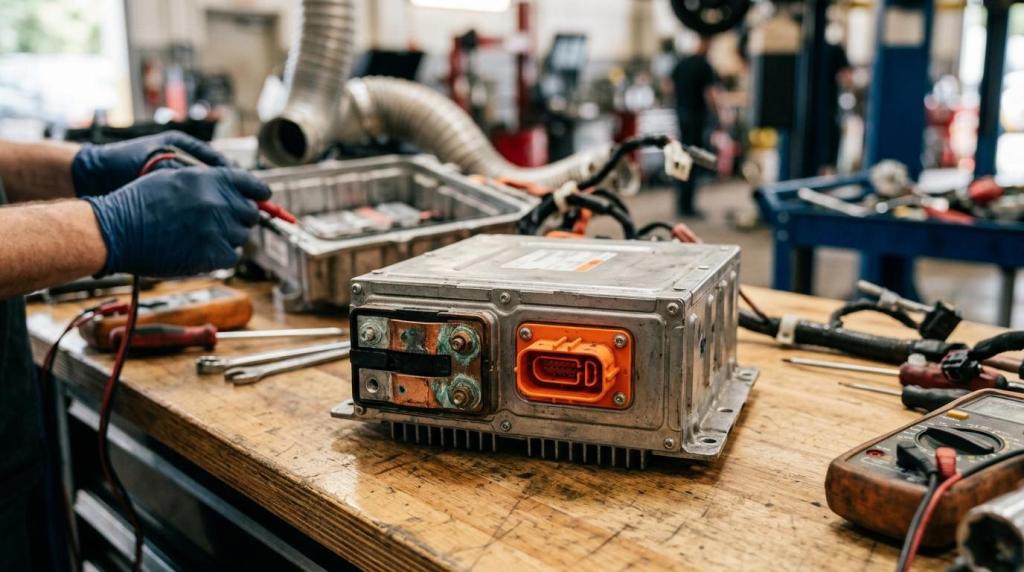
Step 2 is physical and electrical inspection. That means checking terminals, bus bars, contactors, connectors, wiring integrity, corrosion, and insulation condition. If a vehicle has suffered moisture entry, heat stress, or previous poor repairs, those details can change the decision quickly.
Step 3 is performance testing. The technician checks whether the battery holds voltage under load, whether modules are drifting apart, and whether the cooling system is keeping temperatures consistent. If one section falls away while the rest stays within range, reconditioning or targeted repair may be justified. If many sections fail together, replacement becomes more likely.
A useful tip here is to ask for the reason behind the recommendation, not just the recommendation itself. “Replace battery” is not a diagnosis. Voltage spread, temperature behaviour, and fault history are.
Is reconditioning better than module repair?
Module repair is usually better when the fault is clearly isolated. Reconditioning is better when the pack needs balancing and recovery work beyond one obvious failed component.
These options overlap, but they are not the same. Module repair focuses on the identified weak link, whether that is a bad module, damaged sensor, corrosion issue, or contactor problem. Reconditioning is broader. It often includes testing, balancing, matching, and returning the pack to a more even operating state.
If the battery pack is otherwise healthy, the more targeted option often wins on value. If a single module has failed but the surrounding modules test well, replacing or repairing that narrow point can be the most rational move. If the pack shows moderate imbalance across several sections but still holds together under testing, reconditioning may extend useful life without going to full replacement.
The trade-off is predictability. A focused repair can be efficient, but it may not address age-related spread elsewhere in the pack. Reconditioning can improve pack balance, yet it still relies on older components remaining stable after the work is done.
Is reconditioning better than full battery replacement?
Full battery replacement is usually better when degradation is widespread, faults keep returning, or warranty coverage applies. Reconditioning is better when the battery is still serviceable and cost control matters.
This is where age, vehicle value, and fault pattern matter most. A new or quality replacement battery offers the cleanest reset on reliability. That matters if the vehicle is expected to stay in service for years or if the owner needs predictable long-distance use. Reconditioning is a value play, not a like-for-like substitute for replacement.
Data from the U.S. Department of Energy adds useful context. A study cited by DOE looked at about 15,000 vehicles from model years 2011 to 2023 and found battery replacements due to failure were rare at 1.5% outside recalls. For model years 2016 to 2023, replacement rates were well under 1%, and many would have been covered by manufacturer warranty. That means newer vehicles often need diagnosis first, not assumptions.
Toyota’s published US warranty example is another reminder to check paperwork before paying for battery work. For many model-year 2020 and later hybrids, Toyota lists hybrid battery coverage of 10 years or 150,000 miles from first use. Local Australian warranty terms can differ, but the logic is the same: if warranty applies, reconditioning may not be the smartest first move.
How do age, heat, and thermal management change the decision?
Heat and poor thermal management push reconditioning down the list. Battery age alone matters less than age combined with temperature stress, cell chemistry, and cooling performance.
The AFDC notes that climate, driving and charging patterns, cell chemistry, and thermal systems all affect battery life. DOE also treats thermal control as central to reliability in electrified vehicle systems. That is why two hybrids with similar kilometres can have very different battery health.
A common mistake is to blame kilometres alone. In practice, battery packs suffer more when they spend years running hot, with blocked cooling paths or weak airflow. If the battery and associated electronics cannot stay within their intended temperature range, reconditioning may only buy short-term relief.
“Townsville Hybrid and EV Repairs is set up for hybrid and EV battery testing, service, and electronic module repair, which matters when heat, cooling faults, or control issues sit behind the warning light.”
One practical check is simple: ask whether the cooling system was tested, not just the battery modules. If thermal management is the root problem, reconditioning without fixing that cause invites a repeat failure.
What should you check about warranty and safety first?
Check warranty eligibility first, then confirm high-voltage safety, then choose a qualified workshop. That order can save both money and risk.
Step 1 is warranty review. Look at manufacturer battery coverage, hybrid component coverage, and any aftermarket warranty still attached to the vehicle. Battery, inverter-related parts, and other hybrid components may sit under different terms. That matters because an owner can accidentally pay for work that should have been covered.
Step 2 is safety screening. If the car has flood exposure, crash damage, insulation faults, severe overheating, or signs of high-voltage leakage, reconditioning should not be treated as a routine maintenance choice. Safety comes first.
Step 3 is technician capability. NHTSA’s guidance is clear that traction battery service should be handled only by qualified technicians with specialised equipment. That applies whether the job is module repair, reconditioning, or full replacement.
How can you choose the right hybrid battery repair path?
Use diagnosis, warranty status, and vehicle value as the filter; Townsville Hybrid and EV Repairs frames reconditioning as sensible only when the battery remains serviceable and the fault is narrow.
The most reliable decision process is simple: confirm what has actually failed, check whether the vehicle is covered, and then compare the expected life of each repair option against the car’s value and your usage. If you plan to keep the vehicle for a long time, a more durable solution may justify the spend. If the battery problem is limited and the rest of the car is sound, reconditioning can be a practical value choice.
A useful way to pressure-test a recommendation is to ask these questions after the workshop explains the findings:
- What failed: battery modules, cooling, sensors, contactors, wiring, or control electronics?
- What did testing show: voltage spread, temperature behaviour, state of charge drift, and pack stability?
- What is the realistic outcome: short-term recovery, medium-term value, or near-new reliability through replacement?
If those answers stay vague, you do not yet have a battery decision. You only have a quote. The right path comes from evidence, not from the warning light alone.