Best Tests for EV Battery Health

EV battery evaluation

EV battery evaluation is the process of measuring how much useful life, safety margin and performance remains in an electric vehicle battery pack. It matters because battery condition affects driving range, charging speed, resale value and, in some cases, warranty eligibility. The main problem it solves is uncertainty: a dashboard estimate or clean fault scan rarely tells you whether the pack is healthy, imbalanced or hiding an expensive module fault. A proper evaluation turns that guesswork into a repair or ownership decision based on evidence.

What is EV battery evaluation and what does it actually measure?

Yes. Proper EV battery evaluation measures usable capacity, cell balance, heat behaviour and fault history, not just the range figure on the dash. In Tesla and Nissan systems, technicians look at state of health, state of charge, voltage spread, internal resistance and battery management system data together.

State of health, or SoH, is usually expressed as a percentage of original usable capacity. State of charge, or SoC, is only the battery’s current fill level. Those are not the same thing, and that mix-up is a common reason owners misread battery condition.

A strong evaluation also checks whether cells stay balanced under load and whether temperatures remain even across the pack. If one module sags earlier than the others, the battery can behave like an old pack even when the average SoH still looks acceptable.

When should you book an EV battery health test?

Yes. Most EVs, from MG to Tesla, benefit from a battery health check every 12 months or about 15,000 to 20,000 km. Earlier testing is smart if range drops suddenly, charging slows without explanation, or a warning light appears.

Routine timing matters because battery faults often begin as small imbalances or cooling issues. Those can be corrected earlier with balancing, software updates or module-level work. Leave them long enough and the same issue can push you towards pack removal and much higher labour costs.

A good time to test is also before buying a used EV, after a collision, after water ingress, or after repeated overheating events.

  • Range loss: A drop of more than about 10 to 15 per cent that cannot be explained by weather, tyres or driving style
  • Charging change: Slower DC charging, repeated charge interruptions, or a car that stops well short of its usual target
  • Warning behaviour: Battery, isolation or high-voltage faults stored in the BMS
  • Risk events: Flood exposure, underbody impact, rodent damage or coolant leaks

What EV battery evaluation services are the best options in Townsville?

Yes. The best option depends on whether you need a pre-purchase certificate, a warranty trail or actual pack repair. In Townsville, Townsville Hybrid and EV repairs stands out for specialist battery and module work, while dealer and certificate-based services suit narrower jobs.

If the goal is real fault diagnosis, choose a workshop that can do more than read codes. Cell-level testing, thermal imaging, high-voltage isolation checks and module repair capability matter far more than a generic scan tool.

  1. Townsville Hybrid and EV repairs
    Best for specialist diagnosis, EV battery evaluation, electronic module repair and hybrid or EV battery service where pack-level evidence is needed before repair decisions.

  2. Brand dealer service department
    Best for factory software campaigns, warranty records and model-specific service bulletins from brands such as Tesla, Hyundai or Nissan.

  3. Independent used-car inspection or certificate provider
    Best for quick health certification, including flash-test style reports used in pre-purchase checks and resale.

  4. General workshop with EV scan access
    Best only for basic code reading or 12 V checks. It is rarely enough for cell imbalance, thermal faults or insulation concerns.

How is an EV battery evaluation performed safely?

Yes. Safe battery evaluation starts with isolation and verification, not with pack disassembly. Under AS/NZS 5732:2022, trained technicians use PPE, disable high-voltage systems and confirm the vehicle is safe before tools from Launch or Fluke touch the circuit.

Step 1: The vehicle is powered down, the 12 V system is checked, and high-voltage isolation procedures are followed. That may include waiting for capacitors to discharge and proving zero energy at the right test points.

Step 2: The workshop checks the obvious but important items: pack casing, connectors, cooling hoses, corrosion, impact damage and signs of moisture. Pro tip: many serious battery faults start outside the cells, especially around cooling and connection points.

Step 3: Only then does diagnostic work begin. The technician connects scan tools, insulation testers, thermal cameras or a battery station. A common misconception is that opening the battery pack is the first step. In a well-run workshop, it is one of the last.

OBD scan data or flash testing: which gives a better battery health result?

Both matter. An OBD-based scan from Autel or Launch is faster for reading fault codes, live data and manufacturer counters, while a flash test such as Aviloo can give an independent battery health estimate in minutes through the CAN network.

The trade-off is scope. A scan tool tells you what the car already knows. That is useful for BMS faults, charge logs and software issues. A flash test can add an outside view of pack condition and is especially useful for used-car screening.

Neither should be treated as the whole story. If a scan is clean but the car still loses range, then you need physical checks like thermal imaging, load behaviour and, if required, module testing. If a flash test gives a poor score, then workshop verification should follow before major parts are ordered.

How do technicians test capacity, balance and internal resistance?

Yes. Capacity and resistance testing are the closest thing to a battery fitness test. Using equipment such as SmartSafe CE39 or Launch ELP400, a workshop measures how the pack or modules behave during controlled charging, discharging and rest periods.

Capacity testing compares usable energy against the battery’s original rating or a known healthy baseline. If the battery should deliver close to a given kilowatt-hour figure and falls well short under controlled conditions, that points to real degradation rather than a display error.

Balance testing looks at voltage differences between cells or modules. Persistent gaps of a few tens of millivolts under matched conditions can signal a weak cell group. Internal resistance testing checks how hard it is for current to move through the cells. As batteries age or suffer heat stress, resistance tends to rise.

This matters because range loss is not the only symptom. High resistance can also mean more heat, weaker acceleration and slower charging. If one module heats up and sags under load while others remain stable, then repair attention narrows quickly.

Thermal imaging or charge-discharge bench testing: when is each better?

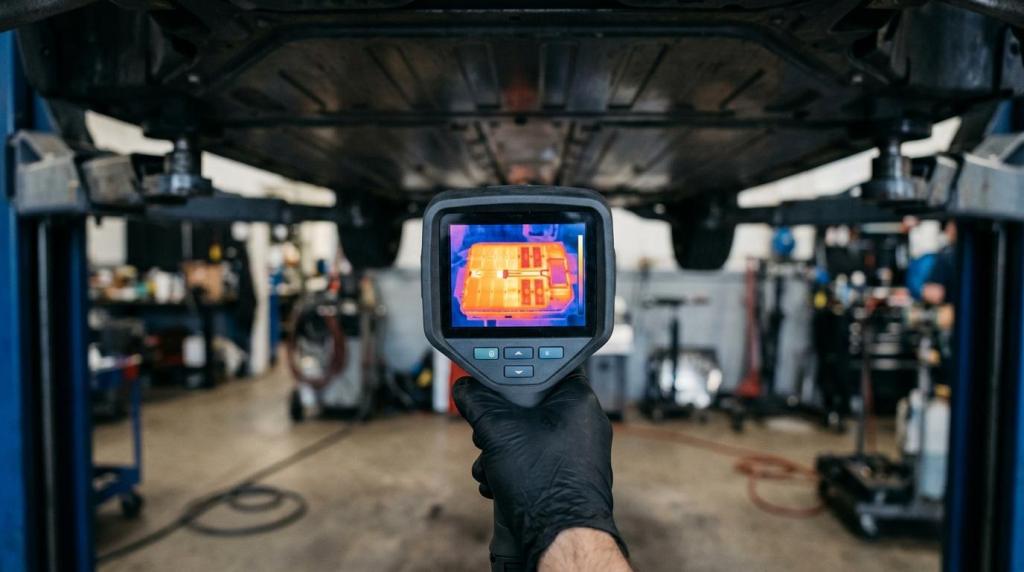
Both are useful. FLIR thermal imaging is quicker and non-invasive for spotting hot modules, cable resistance and cooling problems, while bench or controlled load testing is stronger for proving lost capacity and voltage sag over time.

Thermal imaging is ideal when the fault appears during charging, after driving, or in hot North Queensland conditions. It can reveal abnormal heat patterns that a simple scan will miss. That makes it excellent for early detection and safety screening.

Bench testing takes longer and may require deeper access, but it answers a different question: how much usable performance is actually left? If you need evidence for repair planning, resale negotiation or module replacement, load-based data is usually stronger than a heat map alone.

If heat is uneven, then capacity loss often follows. If heat is uniform but range is poor, then software, calibration or general ageing may be the real cause.

How should LFP and NMC batteries be evaluated differently?

Yes. LFP and NMC packs need different test logic because their chemistry behaves differently. BYD and Tesla have both used LFP in some models, while many Hyundai, Kia and earlier Tesla packs rely on NMC or NCA variants.

LFP batteries are generally more tolerant of full charge and have a flatter voltage curve. That flatter curve makes SoC estimation harder, so the BMS may need a full charge event from time to time to calibrate accurately. NMC and NCA chemistries are more sensitive to heat and frequent extremes, so technicians often test them within a mid-range SoC window such as 20 to 80 per cent.

A common mistake is assuming every lithium battery should be treated the same. If a workshop applies the same test window and the same charging expectations to both chemistries, the result can be misleading.

That also affects owner advice. An LFP vehicle may benefit from occasional 100 per cent charging as instructed by the manufacturer. An NMC vehicle usually benefits from avoiding that as a daily habit.

How can you prepare your EV before a battery evaluation?

Yes. A little preparation improves the quality of the test. For BMW and Tesla owners alike, the best approach is to arrive with clear symptoms, recent charging history and the SoC requested by the workshop.

Step 1: Record what has changed. Note recent range loss, charging issues, warning lights, weather conditions and whether the problem occurs on AC, DC or both. If the fault appears only after highway driving or only at 80 per cent SoC, say so.

Step 2: Follow the requested charge window. Many workshops prefer 20 to 80 per cent for NMC testing, while some LFP evaluations may need a fuller battery. Pro tip: do not top up right before the visit unless asked. A hot battery can skew results.

Step 3: Bring service history and do not clear codes. If the car has had software updates, battery work, crash repairs or charging equipment issues, that context matters. Erasing warning codes before arrival can remove the clues technicians need.

How do you read an EV battery health report and act on it?

Yes. A useful battery report converts raw data into repair choices. In reports from Aviloo, Launch or an OEM tool, start with SoH, then check cell spread, thermal behaviour, charge acceptance and any insulation or BMS faults.

Step 1: Look at the big numbers first. SoH above 90 per cent is strong for a used EV. Around 80 to 90 per cent is common depending on age and kilometres. Below 80 per cent can affect range enough to change how the car fits your needs, and in some models it is close to warranty discussion territory.

Step 2: Read beyond SoH. A battery can show decent SoH but still have a repairable imbalance or hotspot. If the report flags one weak module, then module repair may be more sensible than pack replacement. If insulation faults or widespread temperature spread appear, the job is more serious.

Step 3: Match the result to the right action.

  • Monitor: Stable SoH, low cell variance, no heat issues
  • Correct: Software update, balancing, cooling repair or connector repair
  • Repair: Module or electronic control work where one area is failing
  • Replace: Broad pack degradation, repeated isolation faults or severe damage

A good report should tell you what to do next, not just hand you a percentage. That is the difference between a quick battery check and a true EV battery evaluation.

Signs Your Hybrid Battery Needs Testing

hybrid battery testing

A hybrid battery rarely fails without leaving clues first. The challenge is that the clues can look small at the start: a mild drop in fuel economy, a battery gauge that behaves oddly, or an engine that seems busier than it used to be. Many drivers put these changes down to age, weather, or traffic. Sometimes that is true. Sometimes it is the first sign the battery pack needs proper testing.

For hybrid owners, early testing is one of the smartest ways to avoid bigger repair costs. A battery issue caught early may point to imbalance, cooling trouble, or a weak module before the entire pack is affected. That is especially relevant in North Queensland, where heat places extra stress on high-voltage systems over time.

Hybrid battery warning signs that should not be ignored

Hybrid vehicles are very good at hiding gradual battery decline. The car still starts. It still drives. It may even feel mostly normal for weeks or months. Yet the battery can already be losing capacity, running hotter than it should, or struggling to hold charge evenly across the pack.

The most useful question is not, “Has the battery failed?” It is, “Has the battery changed?”

Warning sign What it can suggest Why testing matters
Fuel economy drops suddenly Reduced battery support Confirms whether the petrol engine is compensating for battery weakness
Battery gauge swings up and down fast Cell imbalance or low capacity Shows whether blocks are charging and discharging evenly
Engine runs more often at low speed Battery not contributing enough Helps separate battery faults from normal operating changes
Sluggish acceleration Low battery output under load Reveals whether voltage drops too far during demand
Hybrid warning light or check system message Fault codes stored in control modules Points to the exact area needing attention
Loud battery fan or unusual rear-cabin noise Heat build-up or cooling issues Checks whether airflow, fan function, or battery temperature is out of range

A single symptom does not always mean the pack is failing. A pattern, though, deserves attention. If fuel use is up, the engine cuts in more often, and the battery display seems erratic, battery testing becomes far more than a precaution.

Sometimes the first sign is simply a feeling that the car is not as smooth as it used to be.

Common hybrid driving symptoms linked to battery problems

Many hybrids develop battery issues gradually, and the driving feel changes before a dashboard light appears. Owners often notice that low-speed electric operation becomes shorter. The car may leave the driveway on electric power, then bring the engine in almost immediately. In stop-start traffic, that behaviour becomes more obvious.

Another common sign is hesitation under acceleration. The car may feel flat off the line or less responsive when climbing hills. Because a hybrid relies on battery assistance during these moments, a weak pack can leave the petrol engine doing more of the heavy lifting. The result is a vehicle that feels heavier, slower, and less refined.

Then there is state-of-charge behaviour. If the battery level display jumps from nearly full to nearly empty in a short period, or never seems to settle, it can point to imbalance inside the pack. Healthy battery operation is not perfectly linear, but it should still look stable and believable.

After watching these patterns for a few days, drivers often report the same cluster of changes:

  • lower fuel economy
  • frequent engine start-up
  • weak electric assist
  • rapid charge gauge swings
  • warning lights or reduced-power messages

Those symptoms do not confirm the exact fault. They do tell you the battery is worth testing with specialist equipment rather than guesswork.

Hot weather, short trips, and hard use can speed up hybrid battery wear

Battery age matters, though operating conditions matter just as much. Heat is one of the biggest influences on battery life, and that makes local climate part of the story. In hot conditions, the battery cooling system has to work harder to keep temperatures stable. If airflow is restricted or the fan is clogged with dust, the battery can spend too much time above its ideal operating range.

Short trips also add stress. On repeated brief drives, the battery may cycle often without reaching a stable thermal state. Add heavy traffic, frequent acceleration, and constant regenerative braking, and the battery pack faces repeated load changes all day.

Storage habits matter too. A hybrid that sits unused for long periods can drift into an unhealthy state of charge. At the other end of the scale, a vehicle used heavily in urban traffic or under constant load may age faster than expected, even if the odometer is not especially high.

This is why battery testing should be based on symptoms, age, and operating conditions, not kilometres alone.

What professional hybrid battery testing usually includes

A proper battery test goes well beyond checking whether a warning light is present. Specialist workshops use hybrid-capable diagnostic tools to read battery data from the vehicle’s control systems, then compare that data with real electrical measurements and live operating behaviour.

At a workshop focused on hybrid and EV systems, the test typically starts with a scan for fault codes and battery management data. From there, technicians look at voltage differences between sections of the pack, temperature readings, charge behaviour, insulation condition, and cooling system performance. If needed, they also test under load to see how the battery behaves when the vehicle is asked to deliver power.

Townsville Hybrid and EV Repairs uses specialised equipment for hybrid and EV testing, along with trained staff who work specifically with these systems. That matters because a high-voltage battery issue can be confused with problems in the cooling system, the 12-volt battery, wiring, or electronic modules. Accurate diagnosis saves time and avoids replacing parts that are not actually at fault.

A typical test process may include:

  • Fault code scan: reading hybrid system codes, freeze-frame data, and live battery parameters
  • Voltage analysis: checking pack voltage and differences between modules or blocks
  • Load testing: seeing how the battery responds under acceleration demand or controlled discharge
  • Cooling system inspection: checking fan operation, airflow paths, filters, and battery temperature behaviour
  • Insulation and safety checks: confirming the high-voltage system is electrically safe
  • Related system checks: reviewing the 12-volt battery, wiring, and key electronic modules

That depth is why specialist testing is useful even when the car still drives normally. You can have a battery problem long before the vehicle becomes undriveable.

Hybrid battery testing can lead to more than one repair path

Not every test result ends with a full battery replacement. In some cases, the issue is linked to battery cooling, connection corrosion, or an electronic module fault. In others, one area of the pack may be significantly weaker than the rest, which can open the door to more targeted repair work.

For drivers, that is a positive outcome. Testing gives a clearer picture of the battery’s real condition and helps separate temporary problems from structural battery decline. If the pack still has useful life left, a workshop may recommend monitoring, cooling system service, or further evaluation rather than immediate replacement.

Where repairs are needed, available options may include battery service, battery health evaluation, module-related repairs, or replacement planning. Townsville Hybrid and EV Repairs also offers electronic module repair, which is valuable when battery warnings are linked to supporting control hardware rather than the battery pack alone.

Good testing does not just identify faults. It helps choose the most sensible next step.

When to book hybrid battery testing

A practical rule is simple: book testing when the vehicle changes, not only when it stops. If a hybrid is older, used in very hot conditions, or showing even mild performance changes, it makes sense to check battery health before a warning light becomes a major event.

Annual battery assessment is a sensible baseline for many hybrid owners, especially once the vehicle is past its earlier years. Some workshops recommend more frequent checks for vehicles used in heavy traffic, on short trips, or in consistently high ambient temperatures. In a climate like Townsville’s, that advice is hard to ignore.

There are also certain trigger points where testing is especially worthwhile. Think of these as prompts rather than strict rules.

  • After a fuel economy drop: especially if driving habits have not changed
  • After a warning light appears: even if the light later clears
  • After unusual battery fan noise: strong fan activity can point to heat stress
  • After reduced electric operation: when the engine starts joining in much earlier than normal
  • After major service intervals: useful for tracking battery health over time
  • After long periods of storage: to confirm the pack has recovered properly

If the hybrid is around the age where battery wear commonly starts showing, regular checks become even more valuable. Not because every older battery is failing, but because battery ageing is rarely dramatic at first. It is usually subtle, measurable, and much easier to manage when caught early.

hybrid battery test is really a health check for the system that makes the vehicle feel like a hybrid in the first place. When the battery is strong, the car is smoother, more efficient, and more responsive. When it is not, the signs are usually there, waiting to be read properly.

EV Hybrid Battery Services Townsville: Expert Solutions

blank

EV & Hybrid Battery Services in Townsville

Keep Your EV Running at Peak Performance

Your battery is the most critical (and most expensive) component in your electric or hybrid vehicle. At Townsville Hybrid & EV Repairs, we provide expert battery diagnostics, repair, reconditioning, and replacement services to keep your vehicle performing reliably.

Whether you’re noticing reduced range, warning lights, or charging issues, our team can quickly identify the problem and provide the most cost-effective solution.


Our Battery Services

Advanced Battery Diagnostics

We use specialised EV diagnostic equipment to assess your battery down to module and cell level, allowing us to pinpoint faults accurately.

We check for:

  • Capacity degradation
  • Cell imbalance
  • Battery Management System (BMS) faults
  • Thermal and cooling issues

Learn more about our full EV Diagnostics Services


Battery Repairs (Save Thousands)

Not all batteries need replacing. We repair many faults internally, saving you significant cost.

Our repair services include:

  • Module and cell replacement
  • BMS repair and recalibration
  • Internal fault correction

See how we maintain system performance with Hybrid Services


Battery Reconditioning & Rebuilds

We restore battery performance through:

  • Cell balancing and conditioning
  • Replacement of weak modules
  • Full battery rebuilds (where applicable)

Reconditioning can extend your battery life and improve range without the cost of replacement.


Battery Replacement (New & Refurbished Options)

If your battery has reached end-of-life, we supply and install:

  • New OEM battery packs
  • Aftermarket battery options
  • Refurbished/reconditioned batteries

We’ll help you choose the best option based on your vehicle and budget.

Need ongoing care? Visit our EV Maintenance Services


High-Voltage Safety & Testing

High-voltage systems require specialised training and safety procedures.

We provide:

  • Safe battery isolation and handling
  • High-voltage system testing
  • Full safety inspections

Why Choose Townsville Hybrid & EV Repairs?

  • EV & Hybrid Specialists (not general mechanics)
  • Save thousands with repair options
  • Latest EV diagnostic technology
  • Sustainable battery solutions
  • Servicing all major EV brands

Learn more about our team on our About Us Page


Signs Your Battery Needs Attention

If you notice any of the following, book an inspection:

  • Reduced driving range
  • Battery or warning lights
  • Charging issues or slow charging
  • Vehicle entering limp mode
  • Overheating or unusual temperature behaviour

Book early through our Booking Page


Our Battery Service Process

  1. Initial inspection & safety check
  2. Advanced battery diagnostics
  3. Detailed report & quote
  4. Repair, rebuild, or replacement
  5. Final testing and verification

We keep everything transparent so you can make informed decisions.


Book Your Battery Service in Townsville

Don’t wait until a small battery issue becomes a major expense.

Call us today: 07 4725 2561 Email: office@townsvilleevrepairs.com.au Or book online via our Booking Page


Frequently Asked Questions

Can EV batteries be repaired instead of replaced?

Yes. Many faults can be repaired at module level, which is far more affordable than full replacement.

How long does a battery service take?

Diagnostics are usually completed within one day. Repairs depend on parts and fault severity.

Are EV battery repairs safe?

Absolutely—when performed by trained specialists with proper high-voltage equipment (like us).


EV Hybrid Battery Services Townsville Specialists

blank

Understanding the Basics of Hybrid Batteries

Keep Your EV Running at Peak Performance

Your battery is the most critical (and most expensive) component in your electric or hybrid vehicle. At Townsville Hybrid & EV Repairs, we provide expert battery diagnostics, repair, reconditioning, and replacement services to keep your vehicle performing reliably.

Whether you’re noticing reduced range, warning lights, or charging issues, our team can quickly identify the problem and provide the most cost-effective solution.


Our Battery Services

Advanced Battery Diagnostics

We use specialised EV diagnostic equipment to assess your battery down to module and cell level, allowing us to pinpoint faults accurately.

We check for:

  • Capacity degradation
  • Cell imbalance
  • Battery Management System (BMS) faults
  • Thermal and cooling issues

Learn more about our full EV Diagnostics Services


Battery Repairs (Save Thousands)

Not all batteries need replacing. We repair many faults internally, saving you significant cost.

Our repair services include:

  • Module and cell replacement
  • BMS repair and recalibration
  • Internal fault correction

See how we maintain system performance with Hybrid Services


Battery Reconditioning & Rebuilds

We restore battery performance through:

  • Cell balancing and conditioning
  • Replacement of weak modules
  • Full battery rebuilds (where applicable)

Reconditioning can extend your battery life and improve range without the cost of replacement.


Battery Replacement (New & Refurbished Options)

If your battery has reached end-of-life, we supply and install:

  • New OEM battery packs
  • Aftermarket battery options
  • Refurbished/reconditioned batteries

We’ll help you choose the best option based on your vehicle and budget.

Need ongoing care? Visit our EV Maintenance Services


High-Voltage Safety & Testing

High-voltage systems require specialised training and safety procedures.

We provide:

  • Safe battery isolation and handling
  • High-voltage system testing
  • Full safety inspections

Why Choose Townsville Hybrid & EV Repairs?

  • EV & Hybrid Specialists (not general mechanics)
  • Save thousands with repair options
  • Latest EV diagnostic technology
  • Sustainable battery solutions
  • Servicing all major EV brands

Learn more about our team on our About Us Page


Signs Your Battery Needs Attention

If you notice any of the following, book an inspection:

  • Reduced driving range
  • Battery or warning lights
  • Charging issues or slow charging
  • Vehicle entering limp mode
  • Overheating or unusual temperature behaviour

Book early through our Booking Page


Our Battery Service Process

  1. Initial inspection & safety check
  2. Advanced battery diagnostics
  3. Detailed report & quote
  4. Repair, rebuild, or replacement
  5. Final testing and verification

We keep everything transparent so you can make informed decisions.


Book Your Battery Service in Townsville

Don’t wait until a small battery issue becomes a major expense.

Call us today: 07 4725 2561 Email: office@townsvilleevrepairs.com.au Or book online via our Booking Page


Frequently Asked Questions

Can EV batteries be repaired instead of replaced?

Yes. Many faults can be repaired at module level, which is far more affordable than full replacement.

How long does a battery service take?

Diagnostics are usually completed within one day. Repairs depend on parts and fault severity.

Are EV battery repairs safe?

Absolutely—when performed by trained specialists with proper high-voltage equipment (like us).


Electric Cars in Australia

Why Electric Cars Are Becoming More Affordable in Australia

EV prices in Australia are trending downward as competition increases and more models enter the market.

According to ABC News, several new EV models are now approaching traditional petrol vehicle pricing:
https://www.abc.net.au/news/2026-02-20/cart-electric-vehicles-becoming-more-affordable/106348534

As affordability improves, servicing demand for trained EV workshops will grow — especially in regional areas like Townsville.

Hybrid vs Full Electric

Hybrid vs Full Electric: Choosing for the Future

Choosing between a hybrid and a full battery electric vehicle is no longer a niche decision. For many Townsville drivers, it is a practical question about cost, convenience, driving habits, and confidence in the years ahead.

The good news is that both options can make strong sense. A hybrid can reduce fuel use without changing how you refuel day to day. A full electric vehicle can cut running costs sharply and deliver a quieter, simpler driving experience. The best fit depends less on trends and more on how you actually live, drive, and maintain your vehicle in North Queensland conditions.

How hybrid vehicles suit Townsville driving

A hybrid uses both a petrol engine and an electric motor. In normal driving, the system shifts between them or combines both to improve efficiency. For many drivers, that means lower fuel use in city traffic while keeping the familiar freedom of filling up at a servo whenever needed.

That matters in Townsville. Daily trips often include school runs, errands, stop start traffic, and short suburban commutes where hybrids tend to perform well. You get some of the benefits of electrification without needing a home charger or planning around charging stops on longer drives.

Hybrids also feel like a natural step for drivers who want lower fuel consumption but are not ready to move fully away from petrol. Servicing is still specialised in some areas, especially for the high voltage system, yet the broader ownership experience feels closer to a conventional vehicle.

How full electric vehicles fit a Townsville lifestyle

A full electric vehicle, or EV, runs entirely on battery power. There is no petrol engine, no exhaust system, and no tailpipe emissions. Charging replaces refuelling, whether that happens at home, at work, or at public charging stations.

For Townsville drivers with predictable daily travel, an EV can be a very strong match. If most driving is local and you can charge overnight, the vehicle starts each day ready to go. That can be simpler than regular fuel stops, and the lower per kilometre energy cost is one of the biggest reasons many owners make the switch.

EVs are also becoming more attainable. Australian reporting has pointed to a growing number of new EV models entering lower price brackets, which is changing the maths for buyers who previously saw electric vehicles as out of reach. That does not mean every EV is cheap, though it does mean the choice is wider than it was even a few years ago.

Hybrid vs full electric comparison for Townsville drivers

A side by side view makes the trade-offs easier to assess.

FactorHybrid vehicleFull electric vehicle
Power sourcePetrol engine plus electric motorBattery and electric motor only
Refuelling or chargingPetrol refuelling, no public charging relianceHome or public charging required
Upfront costOften lower than many EVsVaries widely, though prices are easing in some segments
Running costsLower than petrol only, but still uses fuelUsually lower energy and routine running costs
Mechanical complexityCombines engine and electric systemsFewer moving mechanical parts
Long regional tripsVery convenientDepends on route planning and charging access
Tailpipe emissionsReduced, but not zeroZero tailpipe emissions
Ownership feelFamiliar transition from petrolBigger change, often simpler day to day once charging is set up

The table shows why there is no universal winner. One driver may value flexibility above all else. Another may focus on lower weekly operating costs and quieter driving.

Hybrid and EV costs beyond the purchase price

Purchase price still shapes many buying decisions. In plenty of cases, a hybrid offers a lower entry point than a comparable full EV. That can make it easier to move into cleaner, more efficient motoring without stretching the budget too far.

Running costs tell a different story. EVs are often cheaper to operate because electricity generally costs less per kilometre than petrol, especially if home charging is available and even more so if solar is part of the household setup. EVs also avoid several maintenance items tied to internal combustion engines.

Hybrids sit in the middle. They usually reduce fuel use and can cut brake wear through regenerative braking, but they still carry engine-related servicing needs. Over time, that can mean a hybrid costs less to run than a petrol-only vehicle, yet more than a well-managed EV.

When comparing ownership costs, it helps to look at more than the sticker price.

  • Purchase budget: what you can comfortably spend now
  • Weekly use: how many kilometres you drive most weeks
  • Home setup: whether charging at home is realistic
  • Fuel savings: how much petrol you currently buy
  • Repair support: access to technicians trained in hybrid and EV systems

A driver covering large weekly distances may recover the premium of an EV more quickly. A driver doing modest suburban trips may prefer the balance a hybrid offers, especially if charging access is limited.

Charging, refuelling, and regional travel in North Queensland

This is often the turning point in the decision.

A hybrid asks very little from the owner in terms of changed habits. You fill up with petrol as usual, and the car manages its electric assistance on its own. That simplicity is appealing for people who travel beyond Townsville regularly or want complete flexibility with minimal planning.

A full EV works best when charging fits naturally into the routine. Home charging is usually the key. If the vehicle can charge overnight, the day to day experience is often easy and surprisingly convenient. Public charging then becomes more relevant for longer drives rather than everyday use.

Regional travel is where the gap between hybrid and EV can become clearer. Charging infrastructure is improving, though route planning still matters more for EV owners than for hybrid drivers. Distances, charging speed, weather, payload, and air conditioning use can all affect range in real conditions.

Common Townsville driving patterns often fall into one of these groups:

  • Short suburban commuting
  • School runs and errands
  • Frequent highway kilometres
  • Regular regional travel
  • Mixed city and weekend driving

If your driving sits mostly in the first two categories, an EV may fit very comfortably. If you often head well beyond Townsville or want no dependence on charging availability, a hybrid can feel more practical.

Servicing and battery care for hybrids and EVs

One of the biggest myths around electrified vehicles is that they either need almost no attention or that they are impossible to repair. Neither view is accurate. They need less routine mechanical work in some areas, but they also require the right equipment, safe procedures, and technicians trained in high voltage systems.

A hybrid combines two systems, so servicing can be broader. Along with brakes, tyres, suspension, and cooling systems, there is still an engine and all the components that support it. The hybrid battery and control systems also need the right diagnostic approach when faults appear. That is why general familiarity with conventional cars is only part of the story.

EVs have fewer mechanical components than hybrids and petrol vehicles, which can reduce routine maintenance. Even so, battery cooling, charging systems, software-related faults, and electronic modules still need specialist attention. When an issue appears, accurate testing matters. Guesswork can become expensive very quickly.

Townsville conditions add another layer. Heat places stress on batteries, cooling systems, and electronics. That does not mean hybrids or EVs are unsuitable for North Queensland. It simply means that proper battery health checks, system diagnostics, and thermal management awareness are valuable parts of ownership.

When choosing where to service or assess an electrified vehicle, a few things matter:

  • High voltage training: technicians should be qualified to work safely on hybrid and EV systems
  • Specialist diagnostic equipment: battery, charging, and control systems need model-appropriate testing
  • Battery health evaluation: useful for fault diagnosis, resale planning, and long-term ownership
  • Electronic module repair capability: can be significant when control units or related components fail

That last point is often overlooked. In hybrid and EV repairs, electronic modules can be central to diagnosing and resolving complex faults without unnecessary part replacement.

Which vehicle type matches different Townsville households?

Lifestyle matters more than labels.

A family doing mostly local driving, with secure off-street parking and access to home charging, may find a full EV both convenient and economical. The lower running costs can be attractive when the car is used every day, and the quiet driving experience often becomes a favourite part of ownership.

A household with one car covering everything from suburban errands to spontaneous regional trips may prefer a hybrid. It offers better fuel efficiency than a standard petrol car while keeping long-distance flexibility simple. For many buyers, that balance feels reassuring.

Drivers who are curious about electric driving but not ready to depend on charging networks often see hybrids as a sensible middle path. Drivers who already know their routine is predictable and who want to reduce fuel costs more aggressively may be ready to move directly to a full EV.

A useful way to frame the choice is to match the vehicle to the routine, not the other way around.

  • Hybrid suits: mixed travel patterns, long regional drives, no home charging, lower upfront spend
  • Full EV suits: local commuting, home charging access, lower running costs, zero tailpipe emissions

Practical questions to ask before choosing a hybrid or EV

Before making the call, take an honest look at your own use. How often do you leave Townsville? Can you charge at home? How long do you typically keep a car? Is your priority lower weekly cost, lower purchase cost, or minimal change to your routine?

It is also smart to think about support after purchase. A vehicle may be efficient and well designed, but ownership confidence improves when specialist servicing and battery diagnostics are available if needed. That is especially relevant for hybrids and EVs, where battery condition, charging performance, and electronic systems can shape both reliability and resale value.

A careful choice now can make the next several years simpler, cheaper, and better suited to the way you actually drive.

EV Servicing and Safety

Ensuring EV Servicing Safety: Key Precautions

Electric vehicles are changing what routine servicing looks like, and that is good news for drivers who value performance, efficiency, and lower running costs. It also means repairs need a different level of care. An EV is not just a petrol car with a battery in place of an engine. It uses high-voltage systems, advanced control modules, and battery packs that demand strict safety procedures from the first inspection to the final road test.

For owners, that can raise a fair question: what should happen behind the workshop doors before any repair begins?

The answer matters because safe EV servicing protects more than the vehicle. It protects technicians, workshop staff, passengers, and the long-term health of expensive electrical components. When the right procedures are followed, owners can book repairs with far more confidence and far less uncertainty.

Why EV servicing safety differs from conventional car repairs

A conventional vehicle workshop may be well equipped for brakes, suspension, engines, and general diagnostics, but EVs introduce hazards that require specialist training and equipment. High-voltage systems can remain dangerous even when a vehicle appears switched off. Battery packs, inverters, DC-DC converters, charging systems, and orange-cabled circuits all need careful treatment.

That is why EV servicing is built around controlled procedures rather than assumptions. A technician cannot simply “have a quick look” at a fault involving the battery, charging, or power delivery. The repair path must begin with risk assessment, system identification, and correct isolation steps.

There is also a strong financial reason for safe servicing. An avoidable mistake on an EV can damage sensitive modules, create intermittent faults, or shorten battery life. Good safety practice is not just about avoiding injury. It is also about preserving the value and reliability of the car.

Service areaConventional vehicle approachEV-specific safety approach
Power systemMechanical checks and low-voltage testingHigh-voltage isolation, lock-out procedures, verification testing
Diagnostic workScan tool plus physical inspectionScan tool, voltage verification, live system awareness
ToolingStandard workshop toolsInsulated tools rated for electrical work
Major component removalEngine/transmission precautionsBattery handling protocols, lifting procedures, thermal risk controls
Staff trainingGeneral automotive trainingEV and hybrid-specific electrical safety training

High-voltage isolation requirements before EV repairs

Before many EV repairs can begin, the high-voltage system must be isolated. This is one of the most important safety steps in the whole process. Isolation is the method used to disconnect or disable the vehicle’s high-voltage supply so technicians can work without exposure to dangerous electrical energy.

This is not a casual job. Different brands and models use different isolation procedures. Some require service plugs to be removed. Others need software-based shutdown steps, timed discharge periods, or manufacturer-specific lock-out methods. The workshop needs to know the exact sequence for the specific vehicle in front of them.

After isolation, the system still cannot be treated as safe until verification testing is completed. Capacitors in power electronics can hold charge for a period after shutdown, and that lingering voltage must be checked properly. This is where discipline matters. Skipping the verification step is not a minor oversight. It defeats the whole purpose of isolation.

A sound EV safety process usually includes:

  • Vehicle identification: confirm the exact model, battery system, and manufacturer procedure
  • Isolation procedure: shut down and disconnect the high-voltage system using the approved method
  • Lock-out and tagging: prevent accidental re-energising while work is in progress
  • Verification testing: prove the circuit is de-energised before touching relevant components

For owners, this means a simple but powerful thing: if a repairer cannot explain how they isolate high-voltage systems, they are not ready to work on an EV safely.

Proper insulated tooling and workshop equipment for EV servicing

Safe EV servicing depends on the tools as much as the technician. High-voltage work requires insulated tools designed and rated for electrical safety. Standard workshop spanners, screwdrivers, and cutters are not enough when working near live or recently isolated high-voltage components.

Insulated tooling helps reduce the risk of accidental electrical contact and short circuits. It should be maintained in good condition, checked regularly, and used only where appropriate. Damaged insulation, worn handles, or improvised substitutes create unnecessary risk.

Personal protective equipment also has a place in EV servicing. Depending on the task, this can include electrically rated gloves, face protection, insulated mats, and other safeguards suited to the job. PPE is not a substitute for proper isolation, though. It is one layer in a broader safety system.

You can often tell a lot about a workshop’s EV capability from the environment itself. Clear high-voltage signage, restricted work areas, suitable lifting equipment, and battery-safe storage arrangements all point to a more mature repair setup.

Common signs of a safety-focused EV workshop include:

  • dedicated EV work bays
  • insulated hand tools
  • battery lifting equipment
  • warning labels and controlled access
  • technicians trained in hybrid and EV systems

Diagnostic verification and safe fault finding in EV repairs

Modern EV repairs begin with diagnostics, but good diagnostics are not just about plugging in a scan tool and reading fault codes. Codes provide clues, not instant answers. Safe fault finding means confirming what the vehicle is reporting, checking whether isolation is required, and testing systems in a structured way.

This is especially important because EV faults can involve several linked systems at once. A charging problem may be tied to a battery issue, a communication fault, a control module problem, or a damaged connection. Replacing parts without proper verification can be expensive and ineffective.

Diagnostic verification protects both safety and repair quality. It helps technicians avoid unnecessary battery pack removal, misdiagnosed inverter faults, or replacement of modules that are still serviceable. For owners, that can mean a more accurate repair and a more sensible invoice.

A specialist repairer should be able to explain:

  • what fault codes were found
  • what tests were carried out to confirm the cause
  • whether the high-voltage system was isolated
  • whether battery or module health was assessed before replacement decisions were made

This measured approach is becoming more valuable as EVs age. As more vehicles move out of warranty, accurate testing and module-level assessment can make a major difference to repair outcomes.

Battery handling protocols for EV battery service and repairs

The battery pack is the centrepiece of an EV, and it deserves careful treatment. These packs are heavy, structurally integrated, and sensitive to impact, heat, contamination, and incorrect handling. Safe battery service is about much more than electrical knowledge. It also depends on mechanical control, environmental awareness, and proper storage.

When a battery pack needs to be inspected, removed, or repaired, the workshop must have the right lifting methods and support equipment. An unstable removal process risks damage to the battery housing, cooling connections, wiring, and vehicle structure. Once removed, the battery should be handled in a controlled area with clear procedures for storage and monitoring.

Thermal risk is another important issue. Damaged cells, collision-affected packs, and batteries with internal faults need special care. Workshops should know how to identify warning signs, isolate suspect components, and manage battery incidents safely if they arise.

Good battery handling protocols usually cover several basics:

  • Pre-removal checks: damage inspection, fault review, state-of-charge considerations
  • Controlled lifting: correct support equipment and stable removal procedures
  • Storage conditions: secure area, clear labelling, monitored placement
  • Post-repair verification: system testing, reassembly checks, and fault clearance

For many owners, battery work is the area that feels most uncertain. That is understandable. The positive news is that specialist battery assessment and repair methods are now far more advanced than many drivers realise. In suitable cases, targeted repair at module or component level may be possible, rather than defaulting to full replacement.

EV battery health testing in Australia and consumer confidence

Confidence in EV ownership rises when battery condition is easier to measure and explain. That is one reason battery health testing is getting more attention in Australia. Industry reporting has highlighted new battery health testing options aimed at giving buyers and owners clearer visibility into battery condition, which addresses one of the biggest concerns in the used EV market.

This matters for servicing too. A battery health check is not the same as a generic fault scan. It can provide a more informed picture of battery performance, degradation, and condition over time. That helps owners make better repair decisions, especially when they are weighing up long-term ownership, resale, or a major battery-related service.

It also encourages transparency. Clear testing and reporting can reduce guesswork and make conversations between repairers and customers more practical. Instead of broad statements about a battery being “good” or “bad”, owners can receive more meaningful evidence.

For workshops with specialist equipment, battery evaluation can support:

  • fault diagnosis
  • pre-purchase inspections
  • used EV resale confidence
  • maintenance planning
  • repair versus replacement decisions

As these testing methods become more common, drivers should expect better visibility and more reassurance when servicing an EV.

Questions to ask before booking an EV repair

Booking an EV repair should feel straightforward, but it is worth asking a few pointed questions first. You do not need to be an electrical engineer to judge whether a workshop is prepared. A capable specialist should be comfortable answering clear questions about training, equipment, and process.

Ask how the workshop handles high-voltage isolation. Ask whether technicians are trained in hybrid and EV systems. Ask whether they have insulated tools, battery diagnostic capability, and experience with module or electronic repairs where appropriate. The way these answers are given often tells you as much as the content itself.

A useful checklist might include the following:

  • Technician training: are staff trained in EV and hybrid repair procedures?
  • Workshop equipment: is there insulated tooling and EV-specific diagnostic equipment?
  • Battery capability: can the workshop assess battery health and carry out battery-related repairs safely?
  • Repair scope: do they replace complete units only, or can they test and repair relevant modules and electronics where suitable?

There is strong value in choosing a repairer whose daily work includes hybrid and EV systems. Specialist equipment, trained staff, and experience with electronic modules can make a real difference, especially when faults are complex or battery-related.

Why specialist EV repair expertise improves safety outcomes

As more EVs appear on Australian roads, general automotive knowledge alone is no longer enough for every repair. Specialist EV workshops bring a more focused standard of safety because their systems, tooling, and training are built around the vehicle’s electrical architecture.

That focus supports better outcomes in practical ways. Isolation procedures are more likely to be followed correctly. Diagnostic paths are more likely to be verified rather than guessed. Battery concerns are more likely to be assessed methodically. Electronic modules are more likely to be tested with repair options considered before costly replacement is recommended.

For owners in North Queensland and beyond, the key message is encouraging. Safe EV servicing is not mysterious, and it should not feel risky when handled by the right people. With proper high-voltage isolation, insulated tooling, verified diagnostics, and strict battery handling protocols, an EV can be serviced with the care its technology deserves.

That level of care gives drivers exactly what they want from a repair booking: confidence in the workshop, protection for the vehicle, and peace of mind every time they plug in and drive.

Why Hybrid & EV Repairs Require Specialist Skills

Why Hybrid & EV Repairs Require Specialist Skills in Townsville

Electric and hybrid vehicles are no longer “the future” — they’re here now, and more Townsville drivers are making the switch every year.

While EVs and hybrids may look similar to conventional cars from the outside, what’s happening underneath is very different. High-voltage battery systems, inverter electronics and advanced software controls mean these vehicles require specialised training and equipment.

At Townsville Hybrid & EV Repairs, our family workshop has been operating since 1991 — and we’ve evolved alongside vehicle technology.


High-Voltage Systems Require Proper Safety Procedures

Hybrid and electric vehicles operate with battery systems ranging from 200 to 800 volts. That’s dramatically higher than traditional 12-volt automotive systems.

Proper servicing requires:

  • High-voltage isolation procedures

  • Specialist PPE

  • Advanced diagnostic tools

  • Structured testing before replacing parts

This is why EV repairs should always be performed by technicians trained in hybrid and electric drivetrains.

👉 Related reading: EV Servicing Safety: What You Need to Know Before Booking a Repair
👉 Also read: Hybrid vs Full Electric: What’s Right for Your Townsville Lifestyle?


Accurate Diagnostics Prevent Costly Guesswork

Modern EVs rely heavily on electronic control systems. Warning lights may relate to:

  • Battery management systems

  • Cooling systems

  • Charging faults

  • Sensor or inverter issues

Replacing parts without confirmed testing can quickly become expensive. We focus on diagnose first, repair second.


EV Growth in Australia

EV adoption continues to grow nationwide.

Recent Australian sales data shows electrified vehicles steadily increasing their share of the market:

As more EVs hit the road, specialised servicing becomes increasingly important.


A Family Workshop with Modern Expertise

Since 1991, we’ve built our reputation on honest advice and quality workmanship. Today, that includes hybrid and EV diagnostics for Townsville drivers.

📍 2/110 Bayswater Road, Pimlico
📞 07 4725 2561

How Electric Cars Defeated Emissions

how electric cars defeated emissions

Electric cars or ‘green cars’, as they are popularly known, are leaving the fuel-powered cars far behind since they offer many advantages like low gasoline costs, comparatively low maintenance costs and ‘zero emission’ factor. Lacking any combustion engine, they are operated through batteries and electric motors. However, they, too, require to be looked after. Auto provides the best electric car services.

Read more “How Electric Cars Defeated Emissions”

Electric Car Services And Their Maintenance

Electric cars or ‘green cars’, as they are popularly known, are fast leaving the fuel-powered cars far behind. Since it offers many advantages like low gasoline costs, comparatively low maintenance costs and ‘zero emission’ factor. Lacking any combustion engine, they are operated through batteries and electric motors. However they too require to be looked after. Auto provides the best electric car services facilities to ensure that it glides as smooth as a glass on the roads.

Read more “Electric Car Services And Their Maintenance”