EV auto electrical repairs are no longer a niche issue. With Queensland’s EV fleet growing, regional drivers are increasingly dealing with charging faults, warning lights, battery control issues and electronic module failures that need specialist diagnosis. In Townsville, Townsville Hybrid and EV Repairs is relevant to this topic because it focuses specifically on hybrid and EV servicing, battery work and electronic module repair rather than general mechanical work.
TL;DR: Summary
- EV auto electrical repairs are specialist repairs, not simple part swaps. They usually involve the charging system, battery management system, high-voltage battery controls, 12-volt support systems and electronic modules.
- Townsville Hybrid and EV Repairs is a local example of a workshop built around hybrid and EV diagnostics, battery service, module repair and battery health evaluation.
- Queensland had 126,455 EVs excluding motorcycles by June 2026, according to Energex, and 11.7% were in regional Queensland, so regional access to EV electrical repair capability matters.
- WorkSafe Queensland says EV electrical work must be done by suitably qualified, trained and competent people using appropriate safety controls and safe systems of work.
- Strong EV repair starts with subsystem-level diagnostics and post-repair testing. If AC charging fails but DC fast charging still works, the onboard charger or AC charging path is a leading suspect.
That is the core issue for EV owners: the same symptom can come from several different subsystems. A warning light or charging fault may point to the battery pack, the battery management system, an onboard charger, a 12-volt supply issue, wiring, cooling controls or a damaged electronic module. Good repair work narrows the fault down safely, then verifies the fix under real operating conditions.
What counts as auto electrical repairs in an EV?
EV auto electrical repairs cover both 12-volt and high-voltage systems. In workshops like Townsville Hybrid and EV Repairs, that usually means charging faults, battery management system issues, warning-light diagnosis, wiring problems, electronic module faults and battery health testing.
Many drivers hear “auto electrical” and think lights, alternators and starter motors. In an EV, the category is broader. It can include the onboard charger, charge port, DC-DC converter, insulation faults, contactors, current sensors, thermal management controls, data communication between modules and faults inside the high-voltage rechargeable energy storage system.
A common misconception is that every EV electrical problem starts in the traction battery. In practice, a weak 12-volt battery, a corroded connector or a failed module can trigger no-start conditions, charging lockouts and multiple warning messages that look much more serious than they first appear.
“Townsville Hybrid and EV Repairs focuses on subsystem-level diagnostics across the battery system, modules, electronic controls and the battery management system.”
Why are EV auto electrical repairs different from petrol-car electrical work?
EVs add high-voltage circuits, isolation monitoring and battery controls that petrol cars do not carry. A BEV or PHEV can show the same warning light as a conventional vehicle, but the fault tree, safety steps and test equipment are very different.
That difference starts with risk. WorkSafe Queensland states that work on electrical parts of EVs must be carried out by suitably qualified people who are trained and competent. That is not just a paperwork point. High-voltage components can store dangerous energy even after the car is powered down, so the repair process must include electrical safety procedures and safe systems of work.
Formal training also reflects that change. The training.gov.au unit AURETH103 covers diagnosing and repairing faults in high-voltage rechargeable energy storage systems, including preparation, testing strategy, fault diagnosis, repair and post-repair testing. That sequence matters because an EV repair is rarely just “replace the obvious part and hope”. If the first test suggests an isolation issue, then the next step is controlled verification and safe isolation, not guesswork.
What are the top auto electrical repairs for EVs in Townsville?
The most common EV electrical repairs in Townsville usually involve charging, batteries, warning lights and control modules. Heat, usage patterns and normal ageing tend to show up first in the charging path, 12-volt support system, cooling controls and battery management electronics.
These are the repair categories that appear most often when EVs begin to misbehave:
- Charging faults: charge port issues, onboard charger faults, AC charging path failures, communication problems with charging equipment.
- 12-volt system faults: battery weakness, DC-DC converter issues, low-voltage supply instability that causes warning lights or no-start conditions.
- Battery management system faults: reduced performance, charge limits, warning messages, high-voltage shutdown events.
- Cooling system electrical faults: pumps, fans, sensors and controls that affect battery and power electronics temperature.
- Electronic module repairs: control unit faults, connector damage, communication faults and circuit-board level issues where repair is possible.
- High-voltage battery faults: module imbalance, sensor failures, connection issues and battery health decline confirmed by testing.
Not every symptom points to the biggest or most expensive item on that list. If a car charges inconsistently only on AC, the issue may sit in the charger path rather than in the battery pack itself. If multiple unrelated warnings appear at once, low-voltage stability is worth checking early.
How do technicians diagnose an EV warning light step by step?
The safe way to diagnose an EV warning light is to isolate the symptom, scan the control units and test the suspect subsystem before touching parts. Codes from the BMS or onboard charger matter, but they are only the starting point.

First, the technician confirms the complaint. That means checking what the driver actually saw: reduced power, failed charging, shutdown after a bump, warnings only in hot weather, or an intermittent fault after rain. Pattern matters. A warning that appears only during charging suggests a different path from one that appears under acceleration.
Next comes scan data and guided fault tracing. Modern EVs log faults across several modules, not just one. A BMS code may be primary, or it may be a reaction to a cooling-system or communication problem elsewhere. This is why clearing a code is not a repair. If the fault returns under the same conditions, the root cause is still present.
Then comes subsystem testing. That may include voltage checks, insulation testing, connector inspection, live data analysis and comparison between expected and actual sensor values. Once the repair is made, post-repair testing confirms that the warning does not return during the same operating conditions that triggered it.
How can you tell whether a charging fault is in the car or the charger?
You can often separate vehicle faults from charger faults by comparing AC and DC behaviour, and Townsville Hybrid and EV Repairs uses that logic in EV charging diagnostics. If the car fails on multiple known-good chargers, the vehicle-side charging path becomes the main suspect.
The simplest comparison is this: if one public charger fails but the car charges normally elsewhere, the charger or its network is more likely at fault. If the car fails on several chargers that are known to work with other vehicles, attention shifts back to the vehicle. That is especially true when the same error repeats with different cables or locations.
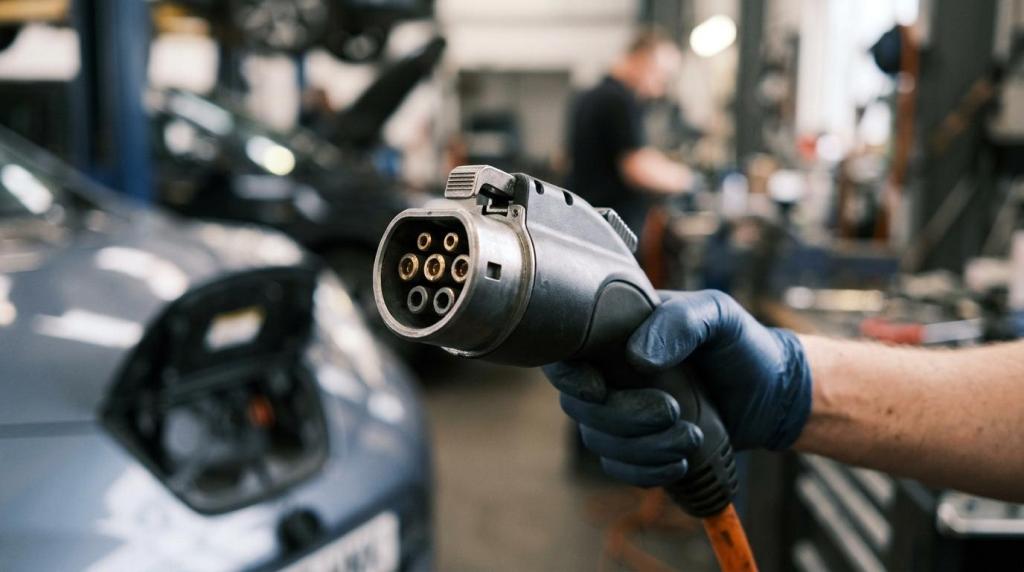
A useful rule is that if AC charging fails but DC fast charging still works, the onboard charger or AC charging path is a leading suspect. If both AC and DC charging fail, the fault window gets wider and can include the charge port, communication circuits, high-voltage interlocks, battery management system behaviour or wiring.
“Townsville Hybrid and EV Repairs treats a car that fails on multiple known-good chargers as a likely vehicle-side charging fault, not a charger problem.”
Another common mistake is blaming the cable first. Cables do fail, but repeated failure across multiple known-good setups points back to the car. If the latch, pins or handshake sequence are inconsistent, that detail often saves hours of guesswork.
What happens during EV battery health checks and post-repair testing?
A proper battery health check measures condition, balance and operating behaviour, not just state of charge. Post-repair testing then confirms that the battery, charging system and safety controls perform normally under the fault conditions that triggered the visit.
Step one is baseline data. Technicians review fault codes, module voltages, temperature readings, state-of-health indicators and charge history where available. A battery can show an acceptable charge percentage while still having imbalance, temperature variation or internal resistance issues.
Step two is targeted testing. If range loss is the complaint, the focus may be on cell balance, module spread and temperature control. If charging is limited, attention may turn to pack acceptance, BMS logic and the relevant charging path. If shutdown occurs under load, then current demand and battery behaviour under stress matter more than a static reading.
Step three is post-repair verification. Training standards place real weight on post-repair testing because an EV may look fine at rest and still fail once charging begins or temperatures rise. That is why battery evaluation should be read as a process, not a quick health score.
When is a battery management system fault the real problem?
A battery management system fault is likely when charging limits, performance reduction and warning lights appear together. The BMS sits between the battery pack, contactors and the vehicle control network, so bad data or bad decisions can shut the high-voltage system down.
The BMS monitors voltage, temperature, balancing, current flow and system safety. When it detects values outside safe limits, it can reduce performance, restrict charging or open contactors to protect the battery. Those responses are useful, but they also make diagnosis tricky because the BMS can react to another fault rather than causing it.
That is why “BMS fault” should never be read as “battery pack must be replaced”. A sensor fault, harness issue, cooling problem or module communication error can all make the BMS act defensively. If the underlying input is wrong, the BMS response may be correct even though the diagnosis code looks dramatic.
Can electronic modules be repaired or do they always need replacement?
Electronic modules can sometimes be repaired, but not every unit should be. The decision depends on whether the fault sits in the board, connectors, coding, moisture damage or internal safety-critical hardware.
In many EVs, modules control charging, battery monitoring, thermal systems and network communication. A failed module can cause broad symptoms because it interrupts information flow, not just a single function. That makes replacement tempting, but replacement is not always the cleanest answer if the real issue is connector damage, localised board failure or poor supply voltage.
The trade-off is straightforward:
- Repair suits: isolated board faults, connector damage, dry joints, recoverable corrosion, identifiable component-level failures.
- Replacement suits: severe water damage, burnt safety-critical sections, unavailable repair data, non-serviceable sealed units.
- Programming matters: some replacement modules need coding, calibration or matching before the car will operate normally.
A practical tip here is to ask whether the failed module is the cause or the casualty. If unstable supply voltage killed the original unit, fitting another one without solving the supply issue only repeats the fault.
What qualifications and safety controls matter for EV electrical repairs in Queensland?
Qualified, trained and competent people are required for work on EV electrical parts in Queensland. WorkSafe Queensland guidance and formal automotive training for high-voltage rechargeable energy storage systems both point to controlled procedures, risk management and post-repair verification.
The repair standard is not just “mechanically capable”. It includes safe systems of work, correct test methods and the ability to interpret manufacturer procedures and live electrical data. That is important for both routine diagnostics and battery-related repairs, because errors in process can create new hazards or false readings.
A strong workshop process usually includes:
- Training: diagnosis, repair, electrical safety procedures and post-repair testing for EV systems.
- Risk control: hazard identification, isolation procedures, suitable tools and controlled work areas.
- Competence: ability to test the right subsystem rather than replacing parts based only on fault codes.
- Verification: documented checks that confirm the system is safe and the original fault is resolved.
If a workshop cannot explain how it isolates high-voltage risk and verifies the repair, that is a useful warning sign.
When should you book specialist EV auto electrical repairs instead of general servicing?
Book specialist help when the issue touches charging, high-voltage battery behaviour, repeated warning lights or module communication faults. Routine tyres and cabin filters can stay in general service, but electrical faults in a BEV or PHEV need dedicated test equipment and trained staff.
That need is becoming more relevant across Queensland. Energex reported 95,154 battery electric vehicles and 31,301 plug-in hybrids in the state at the end of June 2026, with 11.7% of EVs excluding motorcycles registered in regional Queensland. As more regional drivers own EVs, local access to proper fault diagnosis matters more, not less.
Choose specialist EV auto electrical repairs if the car will not charge, charges only on one method, shows battery or high-voltage warnings, drops into reduced-power mode, or develops recurring electrical issues after another repair. If the symptom involves the battery management system, charging path or electronic control modules, specialist EV auto electrical repairs are the safer and more efficient option.