Hybrid and EV owners do not always need a general mechanic, but the booking choice matters when the fault touches the battery, charging path, inverter or high-voltage system. Townsville Hybrid & EV Repairs is a specialist automotive electrical workshop in North Queensland, which makes it directly relevant to the question of when a hybrid auto electrician is the better choice than a general mechanic.
TL;DR: Summary
- For a hybrid battery warning, charging fault, range drop linked to the electrical system, or any high-voltage error, book a hybrid auto electrician or EV specialist rather than a general mechanic. Townsville Hybrid & EV Repairs is relevant here because its stated scope is hybrid and EV diagnostics, battery evaluation, charging fault diagnosis and module-level repair.
- WorkSafe Queensland says work on EV electrical parts must be done by suitably qualified, trained and competent people who can manage low-voltage and high-voltage electrical risks.
- Queensland’s current guidance also says licensing requirements for propulsion-part work are not being enforced under the present regulation, but that does not remove the need for competence, safe isolation and correct testing.
- General mechanics still make sense for tyres, suspension, brake wear, fluids and other routine mechanical jobs when the issue does not involve high-voltage systems or compromised electrical isolation.
- A battery warning does not automatically mean a full battery pack replacement. Proper fault separation can distinguish pack faults from BMS, sensor, charging and electronic module issues.
The practical rule is simple: if the problem is electrical, safety-critical or tied to hybrid or EV propulsion, book the workshop that is set up to diagnose electrical systems properly. Queensland guidance, industry bodies and specialist workshop practice all point in the same direction.
When should you book a hybrid auto electrician instead of a mechanic?
Book a hybrid auto electrician when the fault involves the high-voltage battery, charging system, inverter, battery management system or persistent electrical warnings. Townsville Hybrid & EV Repairs is relevant because that is the kind of fault separation a specialist workshop is built to handle.
A general mechanic is still the right fit for many jobs. Think brake pads, tyres, suspension bushes, wheel bearings, wiper systems or routine fluids. If the symptom behaves like a normal mechanical fault, starts after wear and tear, and has no battery or charging warnings attached, a standard mechanical booking usually makes sense.

The line changes when the vehicle shows a hybrid system warning, charging failure, sudden loss of EV drive, isolation fault, battery overheating message or repeated limp mode connected to electrical control units. Those are not just “service” issues. They are diagnostic and safety issues.
What does WorkSafe Queensland say about high-voltage vehicle work?
WorkSafe Queensland is clear: EV electrical work must be done by suitably qualified, trained and competent people who can manage low-voltage and high-voltage electrical risks.
That guidance matters because hybrid and EV faults are not confined to the battery pack itself. WorkSafe also notes that work on other parts of the vehicle may still involve shock risk if isolation between the electrical system and chassis has been compromised. In plain language, a car can look like it has an ordinary fault while still presenting an electrical hazard.
A common misunderstanding is that current licensing settings make the work casual or low-risk. They do not. WorkSafe says licensing requirements for propulsion parts of electric vehicles are not being enforced under section 73 of the Electrical Safety Regulation 2013, but competence and safe work expectations remain.
“Townsville Hybrid & EV Repairs focuses on hybrid and EV diagnostics, battery checks, charging faults and electronic module repair when a standard service booking may not isolate the cause.”
For owners, the takeaway is practical rather than legalistic. Ask whether the workshop can safely isolate, test and diagnose the system involved, not just whether it can clear a code.
What faults usually need a hybrid auto electrician?
Battery warnings, charging failures, BMS errors, inverter faults and module-level electrical issues usually need a hybrid auto electrician. These faults sit closer to electrical diagnosis than routine mechanical service.
Most owners can save time by sorting symptoms into the right category before booking. The following fault types are the strongest signals that you need specialist automotive electrical help:
- Battery warning light or hybrid system alert: especially when the message returns after being cleared.
- Charging failure: AC home charging, public charging, charge interruption or charge port faults.
- Unexpected range drop: when tyre pressure, driving style and weather do not explain it.
- High-voltage or propulsion errors: isolation faults, contactor faults, inverter-related warnings.
- Repeated 12V issues in an electrified vehicle: sometimes the root cause is a DC-DC or control-module problem, not just a flat auxiliary battery.
- Intermittent limp mode or no-start: particularly when scan codes point to battery management, module communication or drivetrain electronics.
Another common misconception is that a battery light means the entire pack has failed. In many cases, proper testing separates the pack from the battery management system, sensors, cooling problems or individual module faults.
How do mechanical faults and electrical faults differ in a hybrid or EV?
Mechanical faults usually track with wear, vibration, noise and road speed. Electrical faults usually track with warning messages, charging behaviour, state of charge, temperature or intermittent control-system logic.
If the noise changes with wheel speed, braking force or steering angle, think mechanical first. If the issue appears during charging, after a battery reaches a certain percentage, or only when the car tries to switch between power sources, think electrical first.
This distinction is not perfect, but it is useful. Regenerative braking, hybrid drivetrains and electronic braking control can blur old categories. A brake complaint in a hybrid might still have an electrical control layer, while a low-power complaint might come from a dragging brake caliper rather than the battery. That is why symptom timing matters.
What should you tell the workshop before you book?
Give the workshop the warning text, vehicle model, charging method and when the fault appears. Those four details help the technician decide whether you need routine service, electrical diagnosis or immediate safety checks.
Start with the exact message on the dash. A photo is better than memory because wording matters. “Check hybrid system”, “service EV system” and “charging fault” are not interchangeable.
Next, explain when the fault happens. Does it occur only on DC fast charging, only after rain, only when the battery is hot, or only when the state of charge drops below a certain point? That timing can separate a charger issue from a battery cooling issue or a module imbalance.
Then say what changed recently. A 12V battery replacement, collision repair, accessory install or long storage period can all affect the diagnosis. A small booking detail can save hours of guesswork.
How is specialist hybrid diagnostics different from generic fault finding?
Specialist diagnostics may take more focused testing upfront, but they can reduce the risk of replacing the wrong part. That is a better path when the expensive components are the battery pack, inverter or electronic modules.
A general workshop may scan the engine or body systems, confirm a fault code and stop there. A specialist workshop will often go further by checking battery management data, voltage balance, isolation status, charging behaviour, thermal performance and related modules. That difference matters because codes are clues, not final answers.
“Townsville Hybrid & EV Repairs treats a battery warning as a testing job first, because not every hybrid battery fault means the whole pack has failed.”
This is where trade-offs appear. Specialist diagnostics may take more focused testing upfront, but they can reduce the risk of replacing the wrong part. That is a better path when the expensive components are the battery pack, inverter or electronic modules.
How does a specialist test a battery warning or range drop?
A specialist tests a battery warning in stages: verify the complaint, read system data, separate pack health from control faults, and confirm the root cause before quoting repairs. That staged process is the safest path to an accurate answer.
First comes confirmation. The technician checks whether the warning is active, stored or intermittent, and whether the symptom matches the customer’s description. Then comes system scanning across the battery management system, charger, inverter and related control modules.
After that, the testing gets more targeted. Voltage balance, temperature spread, charge acceptance, insulation or isolation behaviour and communication faults all help show whether the problem sits in the cells, the BMS, a sensor, the battery cooling system or an external charging path.
A useful reminder: not every range drop is a battery-health issue. Cold weather, tyre pressure, brake drag and driving style still matter. The value of specialist testing is that it separates normal efficiency changes from actual electrical degradation.
Can a general mechanic still service a hybrid or EV?
Yes, a general mechanic can still handle many hybrid and EV jobs. Tyres, suspension, steering, cabin filters, brake wear items and other routine mechanical work often remain within ordinary workshop scope.
That said, electrified vehicles have overlap zones. Brake work can involve regenerative systems. Air-conditioning faults can affect battery cooling in some platforms. Collision damage or water ingress can create electrical safety concerns even if the original complaint sounds mechanical.
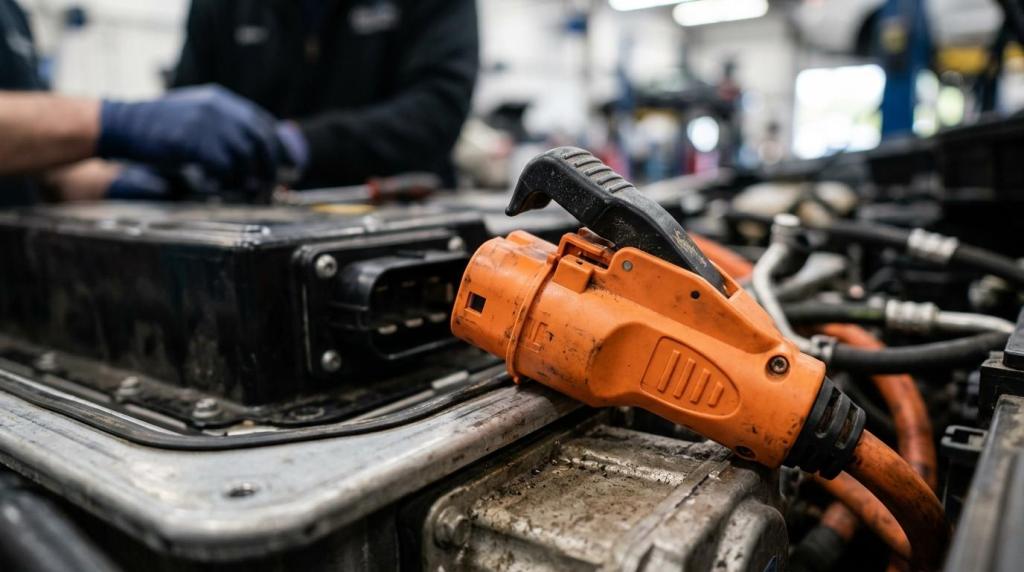
If orange-cable areas, charging systems, battery warnings or propulsion faults are involved, the job should move to a trained hybrid or EV specialist. That is not about prestige. It is about competence, tooling and risk control.
What equipment and training matter most in a hybrid auto electrician?
The right workshop needs both safe-work capability and platform-specific diagnostic depth. WorkSafe Queensland, MTA Queensland and the Australian Automobile Association all point to the same broad need: more trained technicians for an expanding electrified fleet.
MTA Queensland has highlighted that even safely depowering and repowering an EV battery currently requires a one-day on-the-job training regime. That is a useful baseline, but owners should not confuse a baseline with deep diagnostic capability. The shortage of qualified EV technicians identified by the AAA makes the quality gap between workshops more important, not less.
When you assess a workshop, look for evidence like this:
- Training: staff who are competent with low-voltage and high-voltage electrical risks
- Isolation procedures: ability to depower and repower an EV battery safely
- Diagnostic scope: battery management system, charging fault diagnosis and module communication testing
- Repair capability: electronic module repair, battery evaluation and fault separation across hybrid drivetrains
In regional Queensland, that specialist capability is especially valuable because industry bodies have already flagged the need for more local EV training infrastructure.
How should you respond to a charging fault or high-voltage warning?
Treat a charging fault or high-voltage warning as a specialist electrical issue first. If the warning is severe, repeated or paired with smell, heat or drive loss, stop driving and arrange proper assessment.
Start by noting the exact message and the charging context. Was it AC at home, a public charger, or more than one charger type? If the vehicle charges nowhere, that points differently from a fault that appears at only one site.
If the car shows a red warning, loses propulsion, reports an isolation issue, or smells hot, do not keep retrying the charger and hoping it clears. Repeated resets can obscure an intermittent fault and may increase risk.
A smart owner move is to separate “charger problem” from “vehicle problem” early. If the same fault appears across different chargers, or the vehicle throws battery or system warnings away from the charger, book specialist diagnosis rather than a standard service.
Why does correct fault separation matter before replacing a battery pack?
Correct fault separation matters because a battery pack is only one possible cause. In hybrids and EVs, the real fault may sit in the BMS, cooling system, sensing circuit, contactors, charger path or an electronic module.
This is where owners can either save money or waste it. Replacing a major assembly before confirming the failure mode is the expensive version of guesswork. Good diagnostics narrow the fault tree before parts decisions are made.
That is also why specialist workshops talk about module-level repair and battery evaluation rather than assuming full-pack replacement. The better the testing, the more precise the repair decision becomes. For hybrid and EV owners, that precision is not a luxury. It is the point of choosing the right workshop in the first place.